

344
15.
COSMIC RAYS
with other lines of evidence, it appears
most probable that the
radiation originates somewhere in inter—stellar space or in the
distant stars.
It is, truly, a
“
cosmic
”
ray.
.
15—2.
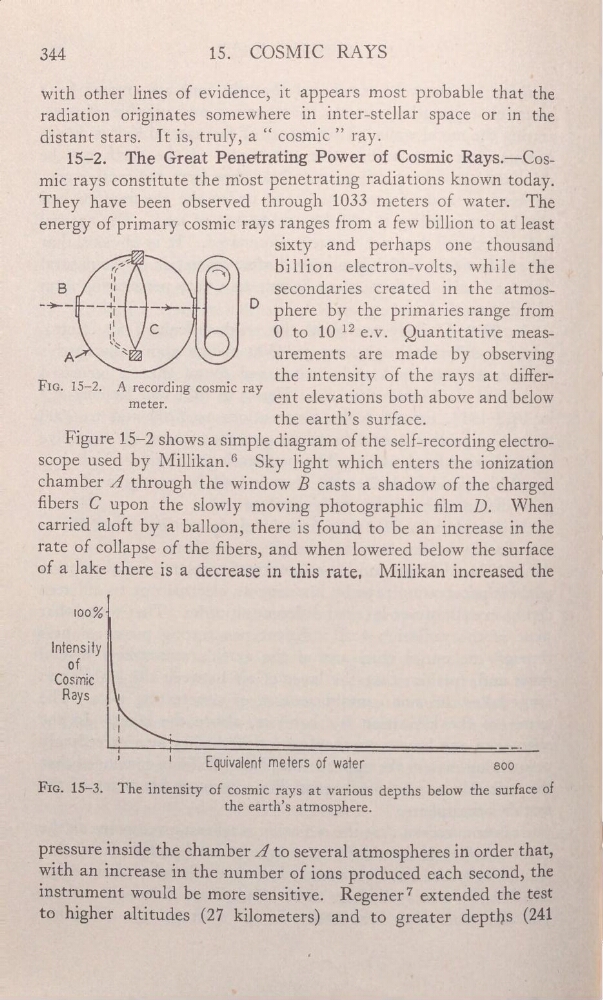
The Great Penetrating Power of Cosmic Rays—Cosmic rays constitute the most penetrating radiations known today.
They have been observed through 1033 meters of water. The
energy of primary cosmic rays ranges from a few billion to at least
'
_
srxty
and
perhaps one thousand
‘
billion electron—volts, Wh1l€ the
.
B
{|
secondaries created in the atmos"""l ““.“i
“"—|
D
phere by the primaries range from
::
C
0 to 10 12
e.v.
Quantitative measA
\\
urements
are
made by observing
F
_
_
the intensity of the rays
at
differ—
IG.
15—2.
A recording cosmic ray
—
meter_
ent elevat10ns both above and below
the earth’s surface.
_
Figure 15—2 shows a simple diagram of the self—recording electro—
scope used by Millikan.6 Sky light which enters the ionization
chamber  through the window B casts a shadow of the charged
bers C upon the slowly movingphotographic lm D. When—
carried aloft by a balloon, there is found to be an increase in the
-
rate of collapse of the bers, and when lowered below the surface
of a lake there is a decrease in this rate.
Millikan increased the
'
100%
lnîensily
‘
_
of
_
Cosmic
?
'
Rays
|
_
"
_
.
.
_
'
[
'
__.
-
_
’
'
Equivalent meiers of wa1er
eoo
FIG.— 15—3.
The intensity of cosmic rays at various depths below the'surface of. '
,
.
the
earth’s atmosphere.
'
pressure inside the chamber  to several atmospheres in order that,
'
with an increase in the number of ions produced each second, the ’
_
:instrument would be more sensitive.
_
Regener7 extended the test
to higher altitudes (27 kilometers) and to greater depths-(241
15.
COSMIC RAYS
with other lines of evidence, it appears
most probable that the
radiation originates somewhere in inter—stellar space or in the
distant stars.
It is, truly, a
“
cosmic
”
ray.
.
15—2.
The Great Penetrating Power of Cosmic Rays—Cosmic rays constitute the most penetrating radiations known today.
They have been observed through 1033 meters of water. The
energy of primary cosmic rays ranges from a few billion to at least
'
_
srxty
and
perhaps one thousand
‘
billion electron—volts, Wh1l€ the
.
B
{|
secondaries created in the atmos"""l ““.“i
“"—|
D
phere by the primaries range from
::
C
0 to 10 12
e.v.
Quantitative measA
\\
urements
are
made by observing
F
_
_
the intensity of the rays
at
differ—
IG.
15—2.
A recording cosmic ray
—
meter_
ent elevat10ns both above and below
the earth’s surface.
_
Figure 15—2 shows a simple diagram of the self—recording electro—
scope used by Millikan.6 Sky light which enters the ionization
chamber  through the window B casts a shadow of the charged
bers C upon the slowly movingphotographic lm D. When—
carried aloft by a balloon, there is found to be an increase in the
-
rate of collapse of the bers, and when lowered below the surface
of a lake there is a decrease in this rate.
Millikan increased the
'
100%
lnîensily
‘
_
of
_
Cosmic
?
'
Rays
|
_
"
_
.
.
_
'
[
'
__.
-
_
’
'
Equivalent meiers of wa1er
eoo
FIG.— 15—3.
The intensity of cosmic rays at various depths below the'surface of. '
,
.
the
earth’s atmosphere.
'
pressure inside the chamber  to several atmospheres in order that,
'
with an increase in the number of ions produced each second, the ’
_
:instrument would be more sensitive.
_
Regener7 extended the test
to higher altitudes (27 kilometers) and to greater depths-(241