

CHAPTER 15
COSMIC RAYS
15—1.
Introduction.—The electroscope has been used for
many years
to measure small electrical currents.
The leaves of
_
this instrument repel each other, when charged With the same kind
of electricity, and remain apart unless charges of opposite sign
ow to them from the surrounding gas or a small current leaks
across
the surface of the insulating support
to neutralize their
charge. It is possible to prepare
an insulator so that the latter
_
_
leakage does not take place in measurable amount. In order to
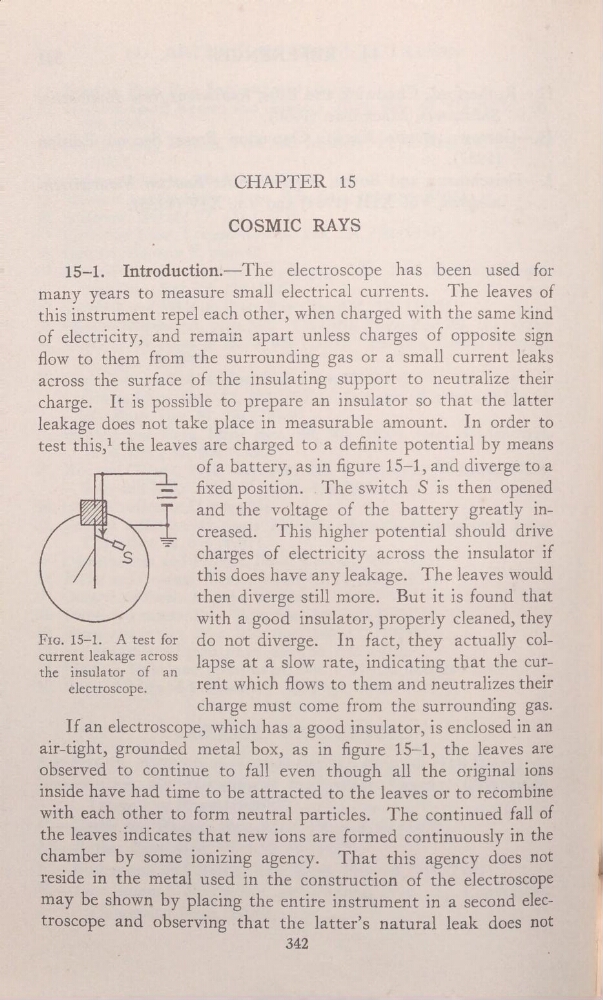
test this,1 the leaves are charged to a denite potential by means
of a battery, as in gure 15—1, and diverge to a
|
;
xed position. .The switch S is then opened
'
%Ë
'
and the voltage of the battery greatly in__
creased.
This higher potential should drive
charges of electricity across the insulator if
this does have any leakage. The leaves would
then diverge still more. But it is found that
'
‘Wlîh a good insulator, properly cleaned, they
Fm. 15f1.
A test for
do not diverge.
In fact, they actually colleakage a°ï°SS
lapse at a slow rate, indicating that the curthe
1nsulator
of
an
_
_
_
electrosœp@_
'
-
rent which ows to them and neutralrzes the1r
_
_
'
charge must come from the surrounding gas.
*
electroscope, which has a good'insulator, is enclosed_in an
air—tight, grounded metal box, as in gure 15—1, the leaves are
.
observed to continue to falleven though all the original ions
.
inside have had time
attracted to the leaves or to rec‘ombine
‘
With each other to form neutral particles. The continued fall of
.
the leaves“indiçates that new ions are formed continuously in the
chamber by some ionizing agency. That this agency does not
’
reside in the metal_used in the construction of the electmscope ,
;
-
may
be Shown by placing the entire instrument in a second elec—
l
troscope and observing thatthe latter’s natural leak does not
‘_
342
'
!
_
f
COSMIC RAYS
15—1.
Introduction.—The electroscope has been used for
many years
to measure small electrical currents.
The leaves of
_
this instrument repel each other, when charged With the same kind
of electricity, and remain apart unless charges of opposite sign
ow to them from the surrounding gas or a small current leaks
across
the surface of the insulating support
to neutralize their
charge. It is possible to prepare
an insulator so that the latter
_
_
leakage does not take place in measurable amount. In order to
test this,1 the leaves are charged to a denite potential by means
of a battery, as in gure 15—1, and diverge to a
|
;
xed position. .The switch S is then opened
'
%Ë
'
and the voltage of the battery greatly in__
creased.
This higher potential should drive
charges of electricity across the insulator if
this does have any leakage. The leaves would
then diverge still more. But it is found that
'
‘Wlîh a good insulator, properly cleaned, they
Fm. 15f1.
A test for
do not diverge.
In fact, they actually colleakage a°ï°SS
lapse at a slow rate, indicating that the curthe
1nsulator
of
an
_
_
_
electrosœp@_
'
-
rent which ows to them and neutralrzes the1r
_
_
'
charge must come from the surrounding gas.
*
electroscope, which has a good'insulator, is enclosed_in an
air—tight, grounded metal box, as in gure 15—1, the leaves are
.
observed to continue to falleven though all the original ions
.
inside have had time
attracted to the leaves or to rec‘ombine
‘
With each other to form neutral particles. The continued fall of
.
the leaves“indiçates that new ions are formed continuously in the
chamber by some ionizing agency. That this agency does not
’
reside in the metal_used in the construction of the electmscope ,
;
-
may
be Shown by placing the entire instrument in a second elec—
l
troscope and observing thatthe latter’s natural leak does not
‘_
342
'
!
_
f