

EXPERIMENT 14—1
337
thought of as though it were a gas. With nuclei, however, where
the forces are of very short range and where many particles form a
compact mass, it is better to consider the nucleus in terms of a
ligujd drop. This nuclear model was rst advanced by Bohr.
When a particle enters the nucleus its energy is divided between all
constituent parts.
Later,, a sufcient excess of energy may concentrate on one particle as to permit its ejection; a process comparable
to evaporation.
EXPERIMENT 14—1
_
ARTIFICIAL TRAN SMUTÀTION OF LITHIUM
"
In order to observe the alpha particles ejected from a lithium
_
target bombarded With protons use the apparatus of gure 10—12.
The magnetic and electric deecting elds are _not needed. Protons are to be accelerated in the same manner as described in detail -
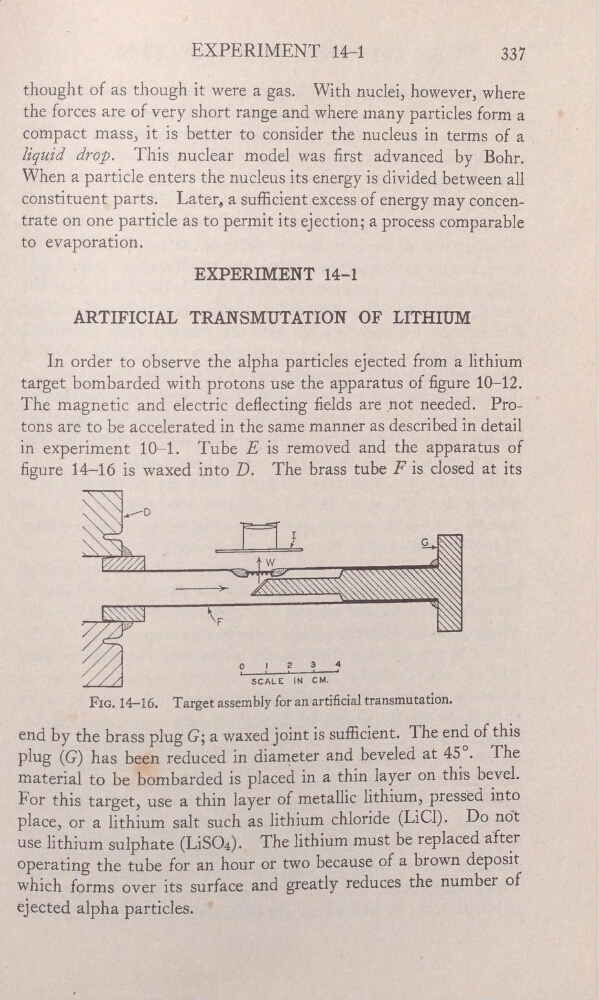
in experiment 10—1. Tube E is removed and the apparatus of
gure 14—16 is waxed into D. The brass tube F is closed at its
‘
.
-
.
=_Jîu
,
s
’Il/lA
_
_
———>
'
Y
\
/
0
|
2
3
4
_
_
'
A
,
SCALE
IN
CM.
FIG. 14—16.
Target assembly for an articial
transmutation.
end by the brass plug G; a waxed joint is sufcient. The end‘of this
_
plug (G) has been reduced in diameter
and beveled at
The
material to be bombarded is placedin a thin layer on
th1s bevel.
For this target, use a'thin layer-of metallic lithium, pressed 1nto
—
place, or a lithium salt such as lithium chloride (L1Cl)._ Do no‘t
use lithium‘ sulphate (LiSO4).’ Thelithium must be r eplaœd after
_
Operating the tube for a—n_hoùr or two because of a brown depos1t
-
_
Which forms over its surface e“mdfgreatly reduces the
number of
,€jectedalpha particles;
,
°
_
,
,
'
_'
'
337
thought of as though it were a gas. With nuclei, however, where
the forces are of very short range and where many particles form a
compact mass, it is better to consider the nucleus in terms of a
ligujd drop. This nuclear model was rst advanced by Bohr.
When a particle enters the nucleus its energy is divided between all
constituent parts.
Later,, a sufcient excess of energy may concentrate on one particle as to permit its ejection; a process comparable
to evaporation.
EXPERIMENT 14—1
_
ARTIFICIAL TRAN SMUTÀTION OF LITHIUM
"
In order to observe the alpha particles ejected from a lithium
_
target bombarded With protons use the apparatus of gure 10—12.
The magnetic and electric deecting elds are _not needed. Protons are to be accelerated in the same manner as described in detail -
in experiment 10—1. Tube E is removed and the apparatus of
gure 14—16 is waxed into D. The brass tube F is closed at its
‘
.
-
.
=_Jîu
,
s
’Il/lA
_
_
———>
'
Y
\
/
0
|
2
3
4
_
_
'
A
,
SCALE
IN
CM.
FIG. 14—16.
Target assembly for an articial
transmutation.
end by the brass plug G; a waxed joint is sufcient. The end‘of this
_
plug (G) has been reduced in diameter
and beveled at
The
material to be bombarded is placedin a thin layer on
th1s bevel.
For this target, use a'thin layer-of metallic lithium, pressed 1nto
—
place, or a lithium salt such as lithium chloride (L1Cl)._ Do no‘t
use lithium‘ sulphate (LiSO4).’ Thelithium must be r eplaœd after
_
Operating the tube for a—n_hoùr or two because of a brown depos1t
-
_
Which forms over its surface e“mdfgreatly reduces the
number of
,€jectedalpha particles;
,
°
_
,
,
'
_'
'