

334
_
14.
ARTIFICIAL TRANSMUTATION
In the experiment just described there was always a background of neutrons entering D whose number was not altered by
‘
the speed of the discs. These neutrons are, therefore, not absorbed
to any appreciable extent in cadmium. Their velocities can be
shown to lie in a range from about one to one—thousand volts.
_
Measurements of the absorption of thermal neutrons were
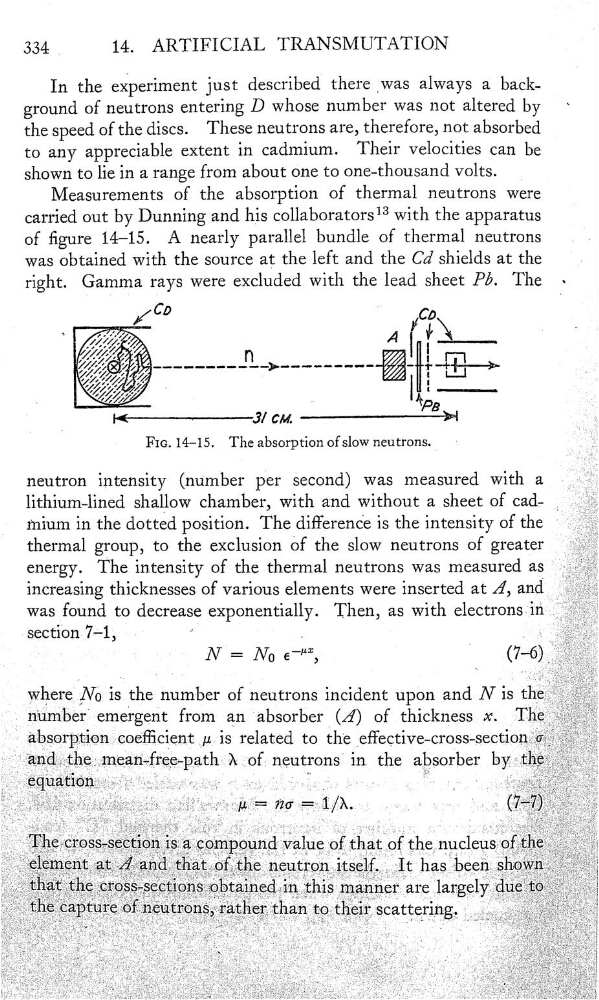
carried out by Dunning and his collaborators13 with the apparatus
of gure 14—15. A nearly parallel bundle of thermal neutrons
.
,
was obtained with the source at the left and the Cd shields at the
,
right. Gamma rays were excluded with the lead sheet Pb. The
—
/CD
CD
n
A
'
LW
—
|
:_.—
.
,
///
.,
s<——————————3/ cu.
__
«_
PIG. 14—15.
The absorption of slow neutrons.
-
neutron
intensity (number per second) was measured with a
lithiumdined shallow chamber, with and without a sheet of cadmium in the dotted position. The difference is the intensity of the ‘
thermal group,
to the exclusion of the slow neutrons of greater
energy.
The intensity of the thermal neutrons was measured as
increasing thicknesses of various elements were inserted at Â, and
was found to decrease exponentially. Then, as with electronsiñ
section 7—1,
.
’
,
.
.
.
.
N : NO E—”x>
(7—6)
wheref j\ÏÔ is the number of neutrons incident upon
and N is the‘
number emergent from an ”absorber
_
(Â) of thickness x. The
is related to the effect1ve—cross-sect10a
andthemean-free-pathx
neutrons in the absorber by the
equation
fŸÏ…f«
—
.
thatthecmsssectmns@btamedmthwmanneralelargelyduet®;
_
14.
ARTIFICIAL TRANSMUTATION
In the experiment just described there was always a background of neutrons entering D whose number was not altered by
‘
the speed of the discs. These neutrons are, therefore, not absorbed
to any appreciable extent in cadmium. Their velocities can be
shown to lie in a range from about one to one—thousand volts.
_
Measurements of the absorption of thermal neutrons were
carried out by Dunning and his collaborators13 with the apparatus
of gure 14—15. A nearly parallel bundle of thermal neutrons
.
,
was obtained with the source at the left and the Cd shields at the
,
right. Gamma rays were excluded with the lead sheet Pb. The
—
/CD
CD
n
A
'
LW
—
|
:_.—
.
,
///
.,
s<——————————3/ cu.
__
«_
PIG. 14—15.
The absorption of slow neutrons.
-
neutron
intensity (number per second) was measured with a
lithiumdined shallow chamber, with and without a sheet of cadmium in the dotted position. The difference is the intensity of the ‘
thermal group,
to the exclusion of the slow neutrons of greater
energy.
The intensity of the thermal neutrons was measured as
increasing thicknesses of various elements were inserted at Â, and
was found to decrease exponentially. Then, as with electronsiñ
section 7—1,
.
’
,
.
.
.
.
N : NO E—”x>
(7—6)
wheref j\ÏÔ is the number of neutrons incident upon
and N is the‘
number emergent from an ”absorber
_
(Â) of thickness x. The
is related to the effect1ve—cross-sect10a
andthemean-free-pathx
neutrons in the absorber by the
equation
fŸÏ…f«
—
.
thatthecmsssectmns@btamedmthwmanneralelargelyduet®;