

324
14.
ARTIFICIAL TRANSMUTATION
A series of experiments were carried out by severalworkers21 to
determine the exact reaction which took place.
There are two
isotopes of lithium, namely, lithium—six (3Liô) and lithium-seven
(3Li7), the latter predominating. They may be separated in small °
'
quantities by passing a beam of lithium
HV
ions through a velocity selector and col—
lecting them in.thin layers on metal
plates. Also, the hydrogen gas used in
the discharge tubeto produce the protons
(1H1) contained a trace of the
/'4
.
..
heavy isotope (deuterium) which would
'//'/H ////
give a contamination of deuterons (1H2).
M
/
Li
Other
experiments have shown that
/
even a few deuterons are very effective
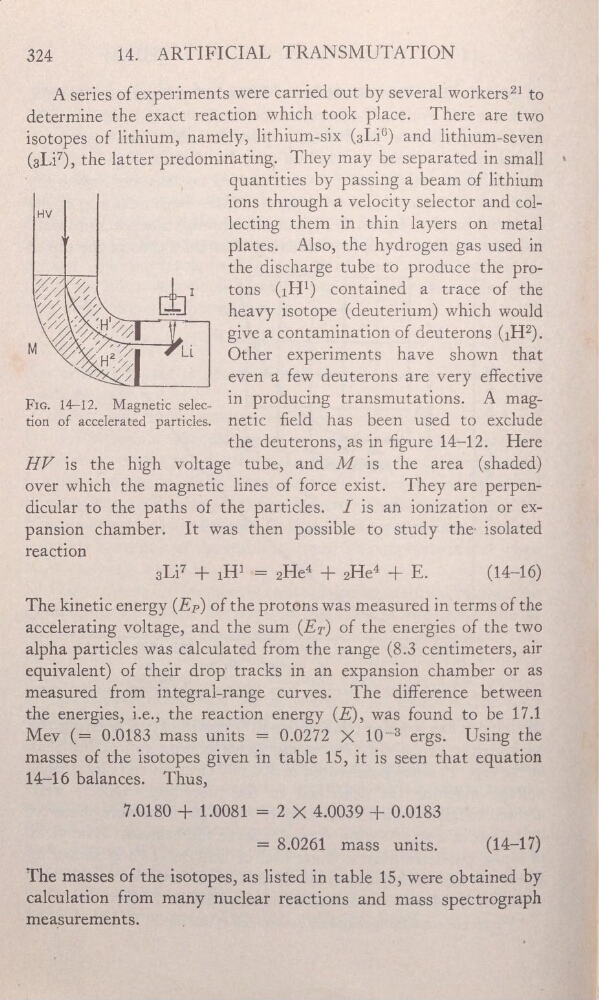
Fm. 14_12_
Magnetic selec—
in producing transmutations. A magtion of accelerated particles.
netic eld has
been used to exclude
the deuterons, as in gure 14—12. Here
HV is the high voltage tube, and M is the area (shaded)
over which the magnetic lines of force exist. They are perpen—
dicular to the paths of the particles. ] is an ionization or ex—
pansion chamber. It was then possible to study the isolated
reaction
'
3Ll7 + 1H1
2H€4 + 2Ï“I€4 + E.
(14—16)
The kinetic energy (Ep) of the protons was measured in terms of the
accelerating voltage, and the sum (ET) of the energies of the two
=
'
alpha particles was calculated from the range (8.3 centimeters, air
f
'
equivalent) of their drop tracks in an expansion chamber or as
'
measured from integral—range curves. The difference between
'
the energies, ie, the reaction energy (E), was found to be 17.1
0.0183 mass units = 0.0272 X 10“3 ergsÇ Using
masses of the isot0pes given in table 15, it is seen that équation
_
14—16 balances. Thus,
_
.
7.0180 + 1.0081 = 2 X 4.0039 + 0.0183
-
-
'
,
-_
_Ï _
=
8.0261
mass
units.
(14—17)
‘
The masses of the isotopes,’as listed in table 15,‘Were obtained by
,
calculation from many nuclear reactions and mass spectrograph ,
measurements.
.
_
_
_
,
'
14.
ARTIFICIAL TRANSMUTATION
A series of experiments were carried out by severalworkers21 to
determine the exact reaction which took place.
There are two
isotopes of lithium, namely, lithium—six (3Liô) and lithium-seven
(3Li7), the latter predominating. They may be separated in small °
'
quantities by passing a beam of lithium
HV
ions through a velocity selector and col—
lecting them in.thin layers on metal
plates. Also, the hydrogen gas used in
the discharge tubeto produce the protons
(1H1) contained a trace of the
/'4
.
..
heavy isotope (deuterium) which would
'//'/H ////
give a contamination of deuterons (1H2).
M
/
Li
Other
experiments have shown that
/
even a few deuterons are very effective
Fm. 14_12_
Magnetic selec—
in producing transmutations. A magtion of accelerated particles.
netic eld has
been used to exclude
the deuterons, as in gure 14—12. Here
HV is the high voltage tube, and M is the area (shaded)
over which the magnetic lines of force exist. They are perpen—
dicular to the paths of the particles. ] is an ionization or ex—
pansion chamber. It was then possible to study the isolated
reaction
'
3Ll7 + 1H1
2H€4 + 2Ï“I€4 + E.
(14—16)
The kinetic energy (Ep) of the protons was measured in terms of the
accelerating voltage, and the sum (ET) of the energies of the two
=
'
alpha particles was calculated from the range (8.3 centimeters, air
f
'
equivalent) of their drop tracks in an expansion chamber or as
'
measured from integral—range curves. The difference between
'
the energies, ie, the reaction energy (E), was found to be 17.1
0.0183 mass units = 0.0272 X 10“3 ergsÇ Using
masses of the isot0pes given in table 15, it is seen that équation
_
14—16 balances. Thus,
_
.
7.0180 + 1.0081 = 2 X 4.0039 + 0.0183
-
-
'
,
-_
_Ï _
=
8.0261
mass
units.
(14—17)
‘
The masses of the isotopes,’as listed in table 15,‘Were obtained by
,
calculation from many nuclear reactions and mass spectrograph ,
measurements.
.
_
_
_
,
'