

13—3.
BELT GENERATORS
301
potential above the ground. The total potential difÎerence
between the spheres is thus doubled, and, in one installation,
with spheres 15 feet in diameter, has reached the value of 5 megavolts.
An upper limit to the voltage is set by the corona breakdown at the surface of the spheres, which is less when they are
large and smooth. The voltage may be varied by changing the
voltage of the supply. The generator may be made self-exciting
by arranging the sprays in such a manner as to give a cumulative
separation by induction of small charges on the belt. 'The rate
of charging the spheres is given by the product of the surface
charge density and the areal velocity with which the belt enters
the spheres.
Several belts are used instead of one to increase
this rate.
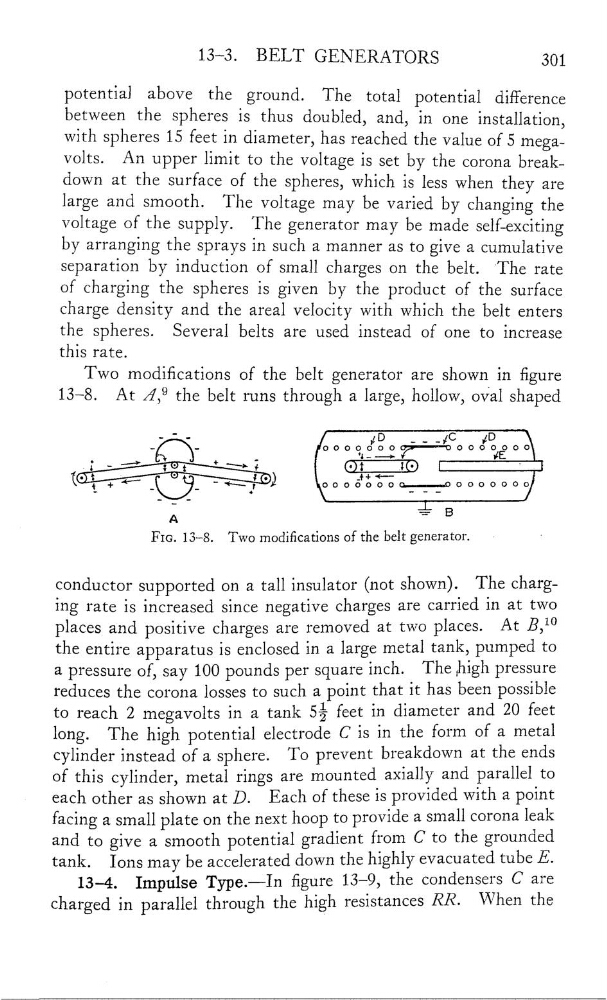
Two modications of the belt generator are shown in gure
13—8.
At Â,9 the belt runs through a large, hollow, oval shaped
-
-
-
,zD
-
-
-;1C
JD
—m—
_
,;
—
—->
o
*
+
_
-
À
-
___
B
FIG. 13—8.
Two modications of the belt generator.
-
conductor supported on a tall insulator (not shown). The charging rate is increased since negative charges are carried 1n at tWO
places and positive charges are removed at two places. At B,…
the entire apparatus is enclosed in a large metal
pumped to
a pressure of, say 100 pounds per square
inch.
The high pressure
reduces the corona losses to such a point that it has been pos51ble
to reach 2 megavolts in a tank 5% feet in diameter and 20 feet
long. The high potential electrode C is in the form of a metal
cylinder instead of a sphere. To prevent
breakdown at the ends
of this cylinder, metal rings are mounted axially
and
each other as shown at D.
Each of these is prov1ded With a p01nt
facing a small plate on the next hoop to provide a small C0f0na leak
and to give a smooth potential gradient from
C to the grounded
tank.
Ions may be accelerated down the highly evacuated tube E.
13—4.
Impulse Type.—In gure 13—9, the condensers C are
charged in parallel through the high
resistances RR.
When the
BELT GENERATORS
301
potential above the ground. The total potential difÎerence
between the spheres is thus doubled, and, in one installation,
with spheres 15 feet in diameter, has reached the value of 5 megavolts.
An upper limit to the voltage is set by the corona breakdown at the surface of the spheres, which is less when they are
large and smooth. The voltage may be varied by changing the
voltage of the supply. The generator may be made self-exciting
by arranging the sprays in such a manner as to give a cumulative
separation by induction of small charges on the belt. 'The rate
of charging the spheres is given by the product of the surface
charge density and the areal velocity with which the belt enters
the spheres.
Several belts are used instead of one to increase
this rate.
Two modications of the belt generator are shown in gure
13—8.
At Â,9 the belt runs through a large, hollow, oval shaped
-
-
-
,zD
-
-
-;1C
JD
—m—
_
,;
—
—->
o
*
+
_
-
À
-
___
B
FIG. 13—8.
Two modications of the belt generator.
-
conductor supported on a tall insulator (not shown). The charging rate is increased since negative charges are carried 1n at tWO
places and positive charges are removed at two places. At B,…
the entire apparatus is enclosed in a large metal
pumped to
a pressure of, say 100 pounds per square
inch.
The high pressure
reduces the corona losses to such a point that it has been pos51ble
to reach 2 megavolts in a tank 5% feet in diameter and 20 feet
long. The high potential electrode C is in the form of a metal
cylinder instead of a sphere. To prevent
breakdown at the ends
of this cylinder, metal rings are mounted axially
and
each other as shown at D.
Each of these is prov1ded With a p01nt
facing a small plate on the next hoop to provide a small C0f0na leak
and to give a smooth potential gradient from
C to the grounded
tank.
Ions may be accelerated down the highly evacuated tube E.
13—4.
Impulse Type.—In gure 13—9, the condensers C are
charged in parallel through the high
resistances RR.
When the