

'
‘
CHAPTER 2.
_
.
.
THE MASS OF THE ELECTRON
_
-
2—1.
Cathode Rays—Connect
of an induction
"
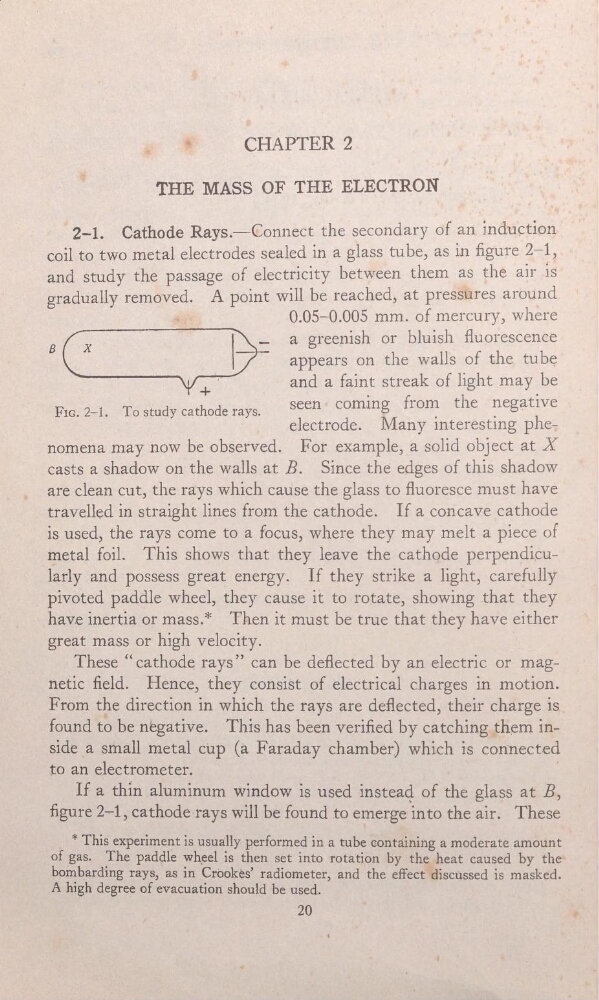
coil to two metal. electrodes sealed in a glass tube, as in gure 2—l,.
and study the passage
of electricity between them as the air is
‘
gradually removed. A point will be reached, at pressùres
around
ODS—0.005 mm. of mercury,
Where
.
,
B. _
a
greenish Or bluish uorescence
appears on the walls of the tube
-
+
‘
-
and a faint streak of light may be
_
FIG. 2—1.
To study cathode rays.
coming
the
_
.
-
_
_
electrode.
Many interesting phe7
nomena may now be observed.
For example, a solid object at X
'
_
casts a shadow on the walls at B.
Since the edges of this shadow
are clean cut, the rays which cause the glass to uoresce must have
_
travelled in straight lines from the cathode. If a concave cathode
.
_
is used, the rays come to a focus, where they may melt a piece of
.
'
metal foil. This shows that they leave the cathode perpendicu—y
lady-and
great energy.
they strike a light,carefully
_
pivoted paddle
they cause it torotate, showing that they
-
:
have inertia or mass.* Then it must be true that they have either *
‘
great mass or high velocity. —»
’
'.
'_
These “cathode rays” can be deected by an electric or mag—
'netic eld. Hence, they consiSt of electrical charges in motion.
F r0inthe direction in which the rays are deected, their charge
_
’
Ï found
to be negative. This has
by catChing_thenï in—
.
_
metal cup
Chamber)
.
electrometer.
'
_
_
.
,
.
'
_
'
î
_
,
If a thin aluminum window is used inSteaid of the glass at
'
-_
gure 2—1, cathode-rays
will be found to _emerge- into the
These
._* This
is usually performed in a tube containing a moderate amount
_
'
'
of gas… The paddle wheel is then; set‘into rotatiOn by theheat caused by the
,'
j
_
bombarding
as in Cr'ookès’ radiometer,»‘and
effect discuæed is masked.
,
Ahigh‘degree0f evacuation‘ should be used; ;
.
__
._
'
.‘
‘
CHAPTER 2.
_
.
.
THE MASS OF THE ELECTRON
_
-
2—1.
Cathode Rays—Connect
of an induction
"
coil to two metal. electrodes sealed in a glass tube, as in gure 2—l,.
and study the passage
of electricity between them as the air is
‘
gradually removed. A point will be reached, at pressùres
around
ODS—0.005 mm. of mercury,
Where
.
,
B. _
a
greenish Or bluish uorescence
appears on the walls of the tube
-
+
‘
-
and a faint streak of light may be
_
FIG. 2—1.
To study cathode rays.
coming
the
_
.
-
_
_
electrode.
Many interesting phe7
nomena may now be observed.
For example, a solid object at X
'
_
casts a shadow on the walls at B.
Since the edges of this shadow
are clean cut, the rays which cause the glass to uoresce must have
_
travelled in straight lines from the cathode. If a concave cathode
.
_
is used, the rays come to a focus, where they may melt a piece of
.
'
metal foil. This shows that they leave the cathode perpendicu—y
lady-and
great energy.
they strike a light,carefully
_
pivoted paddle
they cause it torotate, showing that they
-
:
have inertia or mass.* Then it must be true that they have either *
‘
great mass or high velocity. —»
’
'.
'_
These “cathode rays” can be deected by an electric or mag—
'netic eld. Hence, they consiSt of electrical charges in motion.
F r0inthe direction in which the rays are deected, their charge
_
’
Ï found
to be negative. This has
by catChing_thenï in—
.
_
metal cup
Chamber)
.
electrometer.
'
_
_
.
,
.
'
_
'
î
_
,
If a thin aluminum window is used inSteaid of the glass at
'
-_
gure 2—1, cathode-rays
will be found to _emerge- into the
These
._* This
is usually performed in a tube containing a moderate amount
_
'
'
of gas… The paddle wheel is then; set‘into rotatiOn by theheat caused by the
,'
j
_
bombarding
as in Cr'ookès’ radiometer,»‘and
effect discuæed is masked.
,
Ahigh‘degree0f evacuation‘ should be used; ;
.
__
._
'
.‘