

12—11.
INTERACTION WITH MATTER
281
(12) the addition of a sheet of the absorbing material of thickness
d(= dg — dl).
The fact that beta mys obey an exponential law of the type
just described, is entirely fortuitous since the rays consist ofa complex mixture of the continuous or disintegration electrons and the
characteristic line or photoelectric electrons whose velocities from
any one substance vary over Wide limits.
In addition, the interaction of beta particles With matter is a complicated process. In
practice, however, a logarithmic plot, such as that in gure 12—17,
will show one or more nearly straight sections, each of which may
be associated With a denite mean value of #.
The numerical
values so obtained vary for beta rays from different radioactive
substances passing through aluminum from 13.1 to 5500. Radium
C, for example, sends out beta rays having coefcients of 13.2 and
53.
These correspond roughly to groups
of high and low velocity
(energy), respectively.
(See table 12.)
Absorption coefcients
for gamma rays are given in table 13 at the end of the book.
12—11.
Interaction of Beta and Gamma Rays With Matter.—
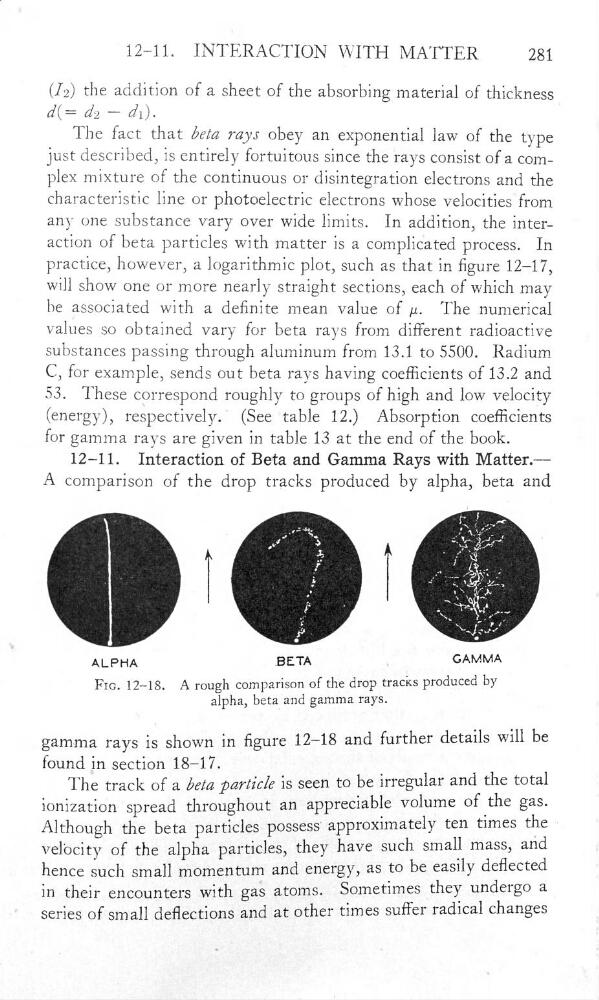
A comparison of the drop tracks produced by alpha, beta and
ALPHA
BETA
GAMMA
F1G, 12-18,
A rough comparison of the drop tracks produced by
alpha, beta
and gamma rays.
gamma rays is shown in gure 12—18 and further details will be
found in section 18—17.
The track of a [m‘a particle is seen to be irregular and the total
ionization spread throughout an appreciable
volume
gas.
Although the beta particles possess approx1mately
ten t1mes the
velocity of the alpha particles, they have such small
mass, and
hence such small momentum and energy, as to be easin deected
in their encounters With gas
atoms.
Sometimes th6Y undergo a
series of small deections and at other times suffer radical changes
INTERACTION WITH MATTER
281
(12) the addition of a sheet of the absorbing material of thickness
d(= dg — dl).
The fact that beta mys obey an exponential law of the type
just described, is entirely fortuitous since the rays consist ofa complex mixture of the continuous or disintegration electrons and the
characteristic line or photoelectric electrons whose velocities from
any one substance vary over Wide limits.
In addition, the interaction of beta particles With matter is a complicated process. In
practice, however, a logarithmic plot, such as that in gure 12—17,
will show one or more nearly straight sections, each of which may
be associated With a denite mean value of #.
The numerical
values so obtained vary for beta rays from different radioactive
substances passing through aluminum from 13.1 to 5500. Radium
C, for example, sends out beta rays having coefcients of 13.2 and
53.
These correspond roughly to groups
of high and low velocity
(energy), respectively.
(See table 12.)
Absorption coefcients
for gamma rays are given in table 13 at the end of the book.
12—11.
Interaction of Beta and Gamma Rays With Matter.—
A comparison of the drop tracks produced by alpha, beta and
ALPHA
BETA
GAMMA
F1G, 12-18,
A rough comparison of the drop tracks produced by
alpha, beta
and gamma rays.
gamma rays is shown in gure 12—18 and further details will be
found in section 18—17.
The track of a [m‘a particle is seen to be irregular and the total
ionization spread throughout an appreciable
volume
gas.
Although the beta particles possess approx1mately
ten t1mes the
velocity of the alpha particles, they have such small
mass, and
hence such small momentum and energy, as to be easin deected
in their encounters With gas
atoms.
Sometimes th6Y undergo a
series of small deections and at other times suffer radical changes