

12—10. ABSORPTION OF BETA AND GAMMA RAYS 279
the alpha rays are successively decreased but the other two are
practically unalÏected. With about 0.006 centimeter of aluminum,
or a sheet of ordinary writing paper, all the alpha rays are absorbed.
The beta rays may now be reduced by successive additions of
aluminum sheets, 0.01 centimeter thick.
A sheet of aluminum
approximately 3 millimeters thick will absorb all the alpha and
beta rays.
The addition of lead sheets 3 millimeters in thickness
Will now serve to show the absorption of gamma rays alone.
Gamma rays are more penetrating than X—rays and, with the
exception of cosmic rays, are the most penetrating known today.
They will pass through a block of iron one foot thick.
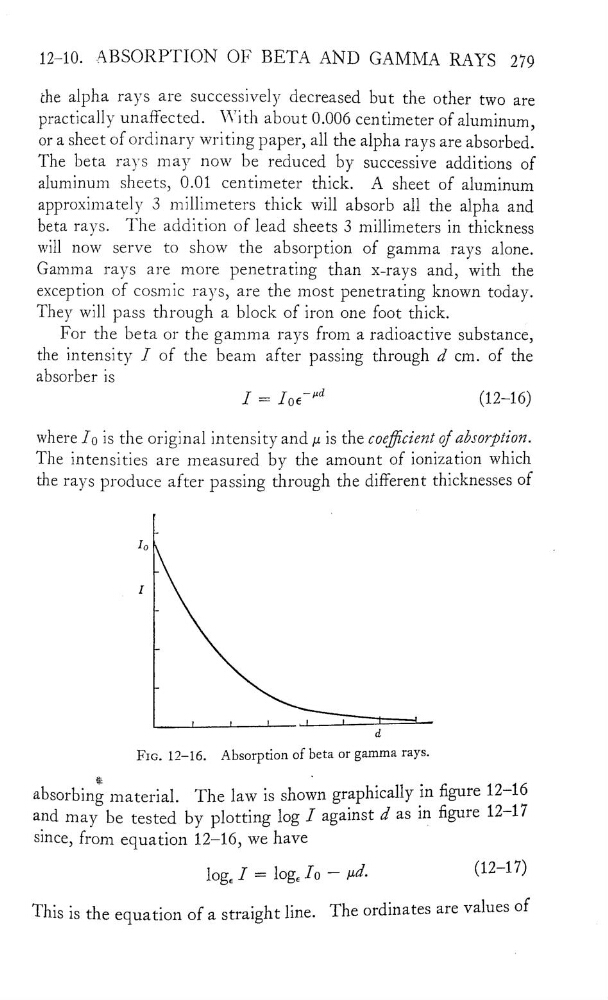
For the beta or the gamma rays from a radioactive substance,
the intensity ] of the beam after passing through ci cm. of the
absorber is
1 = [Oe—“d
(12—16)
where [0 is the original intensity and ,a is the cocycimt 0fæbsorpz‘ion.
The intensities are measured by the amount of ionization which
the rays produce after passing through the different thicknesses of
10
.
1
d
FIG. 12—16.
Absorption of beta or gamma rays.
absorbing material. The law is shown graph1cally
gure 12—16
and may be tested by plotting log ] against d as in gure 12—17
since, from equation 12—16, we have
logE ] = loge [0 _ #d(12—17)
This is the equation of a straight line. The ordinates are values of
the alpha rays are successively decreased but the other two are
practically unalÏected. With about 0.006 centimeter of aluminum,
or a sheet of ordinary writing paper, all the alpha rays are absorbed.
The beta rays may now be reduced by successive additions of
aluminum sheets, 0.01 centimeter thick.
A sheet of aluminum
approximately 3 millimeters thick will absorb all the alpha and
beta rays.
The addition of lead sheets 3 millimeters in thickness
Will now serve to show the absorption of gamma rays alone.
Gamma rays are more penetrating than X—rays and, with the
exception of cosmic rays, are the most penetrating known today.
They will pass through a block of iron one foot thick.
For the beta or the gamma rays from a radioactive substance,
the intensity ] of the beam after passing through ci cm. of the
absorber is
1 = [Oe—“d
(12—16)
where [0 is the original intensity and ,a is the cocycimt 0fæbsorpz‘ion.
The intensities are measured by the amount of ionization which
the rays produce after passing through the different thicknesses of
10
.
1
d
FIG. 12—16.
Absorption of beta or gamma rays.
absorbing material. The law is shown graph1cally
gure 12—16
and may be tested by plotting log ] against d as in gure 12—17
since, from equation 12—16, we have
logE ] = loge [0 _ #d(12—17)
This is the equation of a straight line. The ordinates are values of