

_
274
12.
ALPHA, BETA AND GAMMA RAYS
The general shape of this Bragg curve is the same for the alpha
rays
from various radioactive substances and is not altered by
change of temperature or pressure or the kind of gas used, although
its absolute value is altered.
_
the ionization by an alpha particle varies along its path,
it is only possible to give a rough gure for the average specic
ionization.
an
alpha particle has a range of 7 centimeters it
Will produce an average of approximately 2440 ion pairs per millimeter
in air at 15° C. and 76 centimeters pressure.
Corresponding
values 5 for other ranges are: 5 cm., 2540; 3 cm., 2880; 2 cm.,
3440; 1 cm., 4800; 0.47 cm., 6000, and 0.21, 4500.
12—7.
Primary Beta Ray Spectra—The ratio of charge to
mass
of beta particles has been measured from the amount of
their déection in a magnetic eld as discussed in chapter 2. (See
_
section
It was found that they are high-speed electron:
‘
spontaneously emitted from the atoms of radioactive materials
,
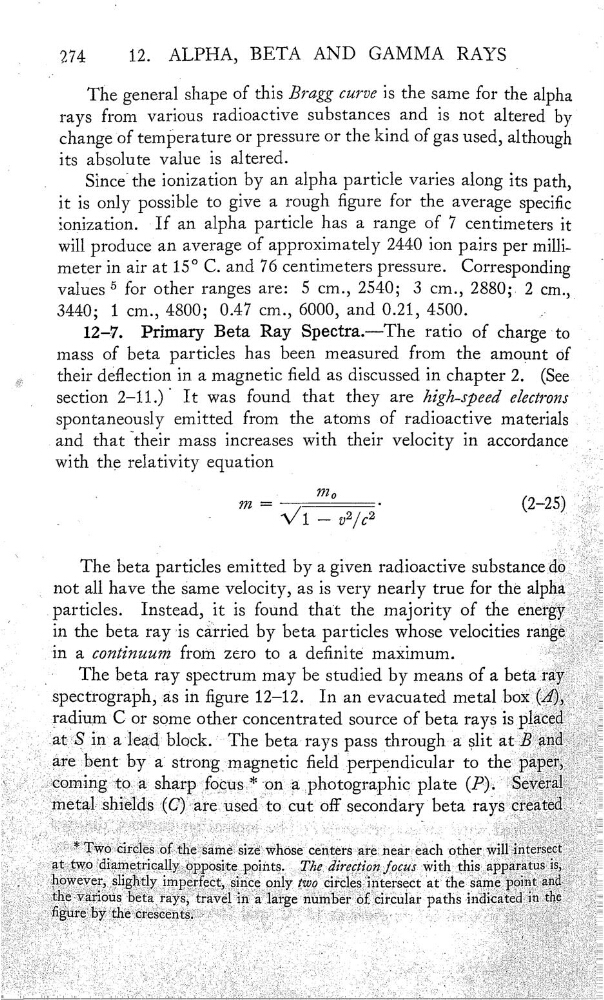
and that their mass increases With their velocity in accordance
.
With the relativity equation
.
‘
m = ————m—°——
(2—25)
w _
The beta particles emitted by a given radioactive substance do
notall have the Same velocity, as is very nearly true for the alpha
'
particles. Instead, it is found that the majority of the ene1gy
in the beta ray is carried by beta particles whose velocities range
_
‘
in a continuum from zero to a denité maXimum.
"
_
_
—
The beta ray spectrum may be studied by means of a betaray
,
spectrog‘raph, as in gure 12—12. In an evacuated metal b0XÊ(Â),
radium C or some other concentrated source of beta rays
; fatS in a'lead block. " The beta rays pass througha' slit atBand
by a“
eld
to
°°mmgtofarî
apn-ça
Plate
Several
metal Sh1€lds
cut on secondary beta rayscreated
’:—i
7
Tize diraÆäià
274
12.
ALPHA, BETA AND GAMMA RAYS
The general shape of this Bragg curve is the same for the alpha
rays
from various radioactive substances and is not altered by
change of temperature or pressure or the kind of gas used, although
its absolute value is altered.
_
the ionization by an alpha particle varies along its path,
it is only possible to give a rough gure for the average specic
ionization.
an
alpha particle has a range of 7 centimeters it
Will produce an average of approximately 2440 ion pairs per millimeter
in air at 15° C. and 76 centimeters pressure.
Corresponding
values 5 for other ranges are: 5 cm., 2540; 3 cm., 2880; 2 cm.,
3440; 1 cm., 4800; 0.47 cm., 6000, and 0.21, 4500.
12—7.
Primary Beta Ray Spectra—The ratio of charge to
mass
of beta particles has been measured from the amount of
their déection in a magnetic eld as discussed in chapter 2. (See
_
section
It was found that they are high-speed electron:
‘
spontaneously emitted from the atoms of radioactive materials
,
and that their mass increases With their velocity in accordance
.
With the relativity equation
.
‘
m = ————m—°——
(2—25)
w _
The beta particles emitted by a given radioactive substance do
notall have the Same velocity, as is very nearly true for the alpha
'
particles. Instead, it is found that the majority of the ene1gy
in the beta ray is carried by beta particles whose velocities range
_
‘
in a continuum from zero to a denité maXimum.
"
_
_
—
The beta ray spectrum may be studied by means of a betaray
,
spectrog‘raph, as in gure 12—12. In an evacuated metal b0XÊ(Â),
radium C or some other concentrated source of beta rays
; fatS in a'lead block. " The beta rays pass througha' slit atBand
by a“
eld
to
°°mmgtofarî
apn-ça
Plate
Several
metal Sh1€lds
cut on secondary beta rayscreated
’:—i
7
Tize diraÆäià