

272
12.
ALPHA, BETA AND GAMMA RAYS
close to the main track.
These are due to the so—called delta
rays or electrons ejected from atoms by the incident alpha par_
ticles with su‘icient energy
to account, in some cases for as much
as two-thirds of the total ionization.
,
'
As alpha particles travel through a gas, they retain
.
,
double charge over more than 90 per cent of their path but,
near
the end, they capture and lose electrons, changing their
chargé several thousand times within the last few millimeters of
their path.
.
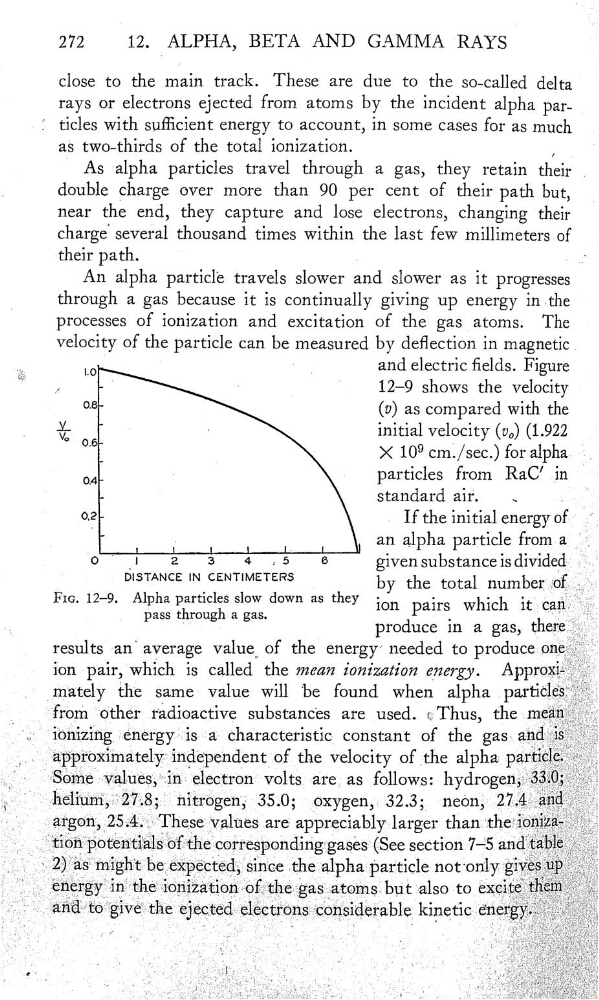
An alpha particle travels slower and slower as it progresses
_
through a gas because it is continually giving up energy inthe
processes of ionization and excitation of the gas atoms.
The
velocity of the particle can be measured by deection in magnetic _
…
‘
and electric elds. Figure
,
'
12—9 shows the velocity
0—8
(0) as compared with the
%
initial velocity (vo) (1.922
X 109 cm./sec.) for alpha
O_4
particles from RaC’ _in_
’
standard air.
.
o,2
If the initial energy of7
an alpha particle from a
'o
'
_|
2
3
4
,5
6
DISTANCE IN CENTIMETERS
by the total number of
FIG. 12—9.
Alpha particles slow down as they
ion pairs which
can
pass through a gas.
_
"
produce m a gas,
results -an' average
of the energy“ needed to produce one
ion pair,which is called the mean ionimtion energy. Appmx1—
_maœl—y the same value will “be found when alpha particles
other radioactive substances are used. rgçThus, the mean
ioizing energy-is a characteristic constant of the gas—; and13
of the velocity of the alpha particle
volts areas follows: hydrogen,330,
hehum278 nat—régen, 35.0; oxygen, 32.3; neOn, 274and
,
are appreciably larger than thei®n1z'
t10npotentlalsofthecorrespond1nggases (See section 7—Α5 andtable
' Ë
2)asmlghtbeeXpected,smce the ‘alphaparticle- not*on‘ly glVGSUP
j andtogivethe eJCCtedelECtronscon81derable kinetic energy
12.
ALPHA, BETA AND GAMMA RAYS
close to the main track.
These are due to the so—called delta
rays or electrons ejected from atoms by the incident alpha par_
ticles with su‘icient energy
to account, in some cases for as much
as two-thirds of the total ionization.
,
'
As alpha particles travel through a gas, they retain
.
,
double charge over more than 90 per cent of their path but,
near
the end, they capture and lose electrons, changing their
chargé several thousand times within the last few millimeters of
their path.
.
An alpha particle travels slower and slower as it progresses
_
through a gas because it is continually giving up energy inthe
processes of ionization and excitation of the gas atoms.
The
velocity of the particle can be measured by deection in magnetic _
…
‘
and electric elds. Figure
,
'
12—9 shows the velocity
0—8
(0) as compared with the
%
initial velocity (vo) (1.922
X 109 cm./sec.) for alpha
O_4
particles from RaC’ _in_
’
standard air.
.
o,2
If the initial energy of7
an alpha particle from a
'o
'
_|
2
3
4
,5
6
DISTANCE IN CENTIMETERS
by the total number of
FIG. 12—9.
Alpha particles slow down as they
ion pairs which
can
pass through a gas.
_
"
produce m a gas,
results -an' average
of the energy“ needed to produce one
ion pair,which is called the mean ionimtion energy. Appmx1—
_maœl—y the same value will “be found when alpha particles
other radioactive substances are used. rgçThus, the mean
ioizing energy-is a characteristic constant of the gas—; and13
of the velocity of the alpha particle
volts areas follows: hydrogen,330,
hehum278 nat—régen, 35.0; oxygen, 32.3; neOn, 274and
,
are appreciably larger than thei®n1z'
t10npotentlalsofthecorrespond1nggases (See section 7—Α5 andtable
' Ë
2)asmlghtbeeXpected,smce the ‘alphaparticle- not*on‘ly glVGSUP
j andtogivethe eJCCtedelECtronscon81derable kinetic energy