

268
12.
ALPHA, BETA AND GAMMA RAYS
If we assume that the force near the nucleus of an atom is
inversely proportional
to the square
of the distance from its center,
then, in order that an alpha particle can approach head-on to '
:o
,
Ra;Cf,
'
log r
°
0
0.4
05
06
RaA°
..“
AeC
_Ê>_°
.
P°°/
-10
‘ÎÏ/
RU
,
,
_
Io
,
_,
_'
'
Th
/ ur
‘
Fm.
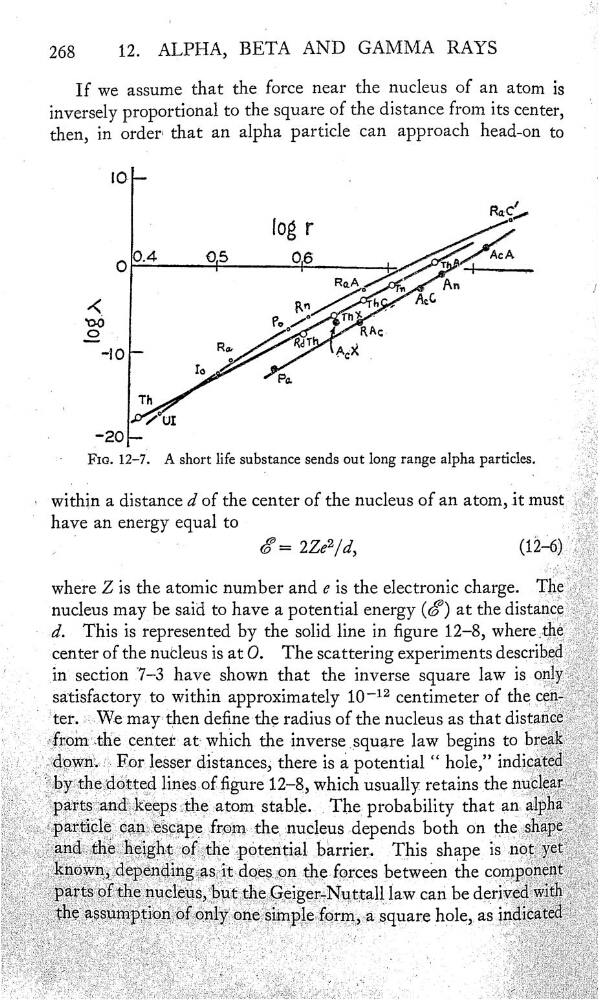
A short life substance sends out long range alpha particles.
within a distance 52 of the center of the nucleus of an atom, .it must
have an energy equal to
-
â’= zze2/d,
(lil—6)
Where Z is the atomic number and 6 is the electronic charge. The
nucleus may be said to have a potential energy (€) at the d1stance
'
—
d.
This is represented by the solid line in gure 12—8, wherethe
center of the nu‘cleus is at 0.
The scattering experiments described
’in section 7—3 have shown that the inverse square
law 130nly
.
sàtisfactory to Within approximately 10“12 centimeter of the_cen—
:g«Wemaythen dene-the radius of the nucleus as that distance
center at which the inverse_square law begins to break
& down
Eor l_eSser distances,- there is a potential
“
hole,” indicated
bythedotted linesof gure 12—8, Which usually retains the nuclear
Part1d€ °anescape fmmthe nucleus » depends both on th€5haPe
kn@WndePendmgas1tdœsenthef0rces between the component
Paft30fthenudeusbuttheGelgerNuttall law cari be derivedW“h
12.
ALPHA, BETA AND GAMMA RAYS
If we assume that the force near the nucleus of an atom is
inversely proportional
to the square
of the distance from its center,
then, in order that an alpha particle can approach head-on to '
:o
,
Ra;Cf,
'
log r
°
0
0.4
05
06
RaA°
..“
AeC
_Ê>_°
.
P°°/
-10
‘ÎÏ/
RU
,
,
_
Io
,
_,
_'
'
Th
/ ur
‘
Fm.
A short life substance sends out long range alpha particles.
within a distance 52 of the center of the nucleus of an atom, .it must
have an energy equal to
-
â’= zze2/d,
(lil—6)
Where Z is the atomic number and 6 is the electronic charge. The
nucleus may be said to have a potential energy (€) at the d1stance
'
—
d.
This is represented by the solid line in gure 12—8, wherethe
center of the nu‘cleus is at 0.
The scattering experiments described
’in section 7—3 have shown that the inverse square
law 130nly
.
sàtisfactory to Within approximately 10“12 centimeter of the_cen—
:g«Wemaythen dene-the radius of the nucleus as that distance
center at which the inverse_square law begins to break
& down
Eor l_eSser distances,- there is a potential
“
hole,” indicated
bythedotted linesof gure 12—8, Which usually retains the nuclear
Part1d€ °anescape fmmthe nucleus » depends both on th€5haPe
kn@WndePendmgas1tdœsenthef0rces between the component
Paft30fthenudeusbuttheGelgerNuttall law cari be derivedW“h