

…
l
.
11—8.
ACTIVE DEPOSITS
247
is given by dividing Avogadro’s number (6:06 X1023) by the
molecular weight.
‘
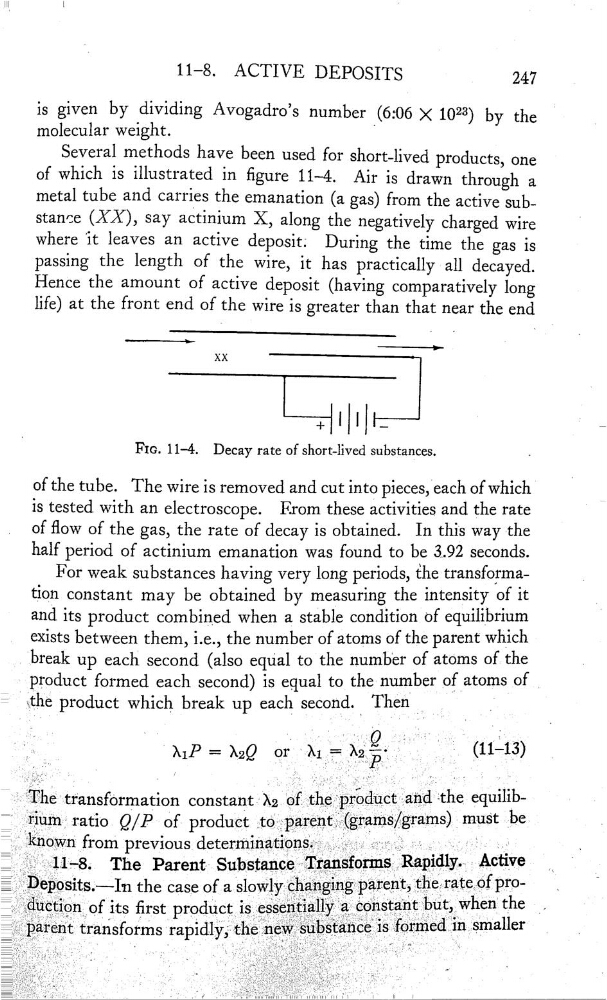
Several methods have been used for short—lived products, one
of which is illustrated in gure 11—4. Air is drawn through a
metal tube and
the emanation (a gas) from the active substance (XX), say actinium X, along the negatively charged wire
where 'it leaves an active deposit; During the time the gas is
passing the length of the wire, it has practically all decayed.
Hence the amount of active deposit (having comparatively long
life) at the front end of the wire is greater than that near the end
—_—_
_
_
XX
l:—l+ IIII3_
_
FIG. 11-4.
Decay rate of short-lived substances.
.
of the tube. The wire is removed and cut into
of which
is tested with an electroscope. From these activities and the rate
_
of ow of the gas, the rate of decay is obtained. In this way the
half period of actinium emanation was found to be 3.92 seconds.
For weak substances having very long periods, the transforma_
tion constant may be obtained by measuring the intensity
of it
and its product combined when a stable condition of equilibrium
'
exists between them, ie, the number of atoms of the parent which
break up each second (also equal to the number of at0ms of the
.
product formed each second) is equal to the number of
atoms of
product which break up each second.
…
Then
_
>qP = X2Q or
…
_
(11_
)
_
.*‘a The transformation constant 'À2 oftheprbductand
equilib‘
_? num ratio Q/P cif product
must .be
previous,
…
11—8
The Parent
Active «
.
the Case of & slow1YChangmgpafentathefate°fP—“"
—
.
_
l
.
11—8.
ACTIVE DEPOSITS
247
is given by dividing Avogadro’s number (6:06 X1023) by the
molecular weight.
‘
Several methods have been used for short—lived products, one
of which is illustrated in gure 11—4. Air is drawn through a
metal tube and
the emanation (a gas) from the active substance (XX), say actinium X, along the negatively charged wire
where 'it leaves an active deposit; During the time the gas is
passing the length of the wire, it has practically all decayed.
Hence the amount of active deposit (having comparatively long
life) at the front end of the wire is greater than that near the end
—_—_
_
_
XX
l:—l+ IIII3_
_
FIG. 11-4.
Decay rate of short-lived substances.
.
of the tube. The wire is removed and cut into
of which
is tested with an electroscope. From these activities and the rate
_
of ow of the gas, the rate of decay is obtained. In this way the
half period of actinium emanation was found to be 3.92 seconds.
For weak substances having very long periods, the transforma_
tion constant may be obtained by measuring the intensity
of it
and its product combined when a stable condition of equilibrium
'
exists between them, ie, the number of atoms of the parent which
break up each second (also equal to the number of at0ms of the
.
product formed each second) is equal to the number of
atoms of
product which break up each second.
…
Then
_
>qP = X2Q or
…
_
(11_
)
_
.*‘a The transformation constant 'À2 oftheprbductand
equilib‘
_? num ratio Q/P cif product
must .be
previous,
…
11—8
The Parent
Active «
.
the Case of & slow1YChangmgpafentathefate°fP—“"
—
.
_