

11—7.
RADIOACTIVE CONSTANTS
245
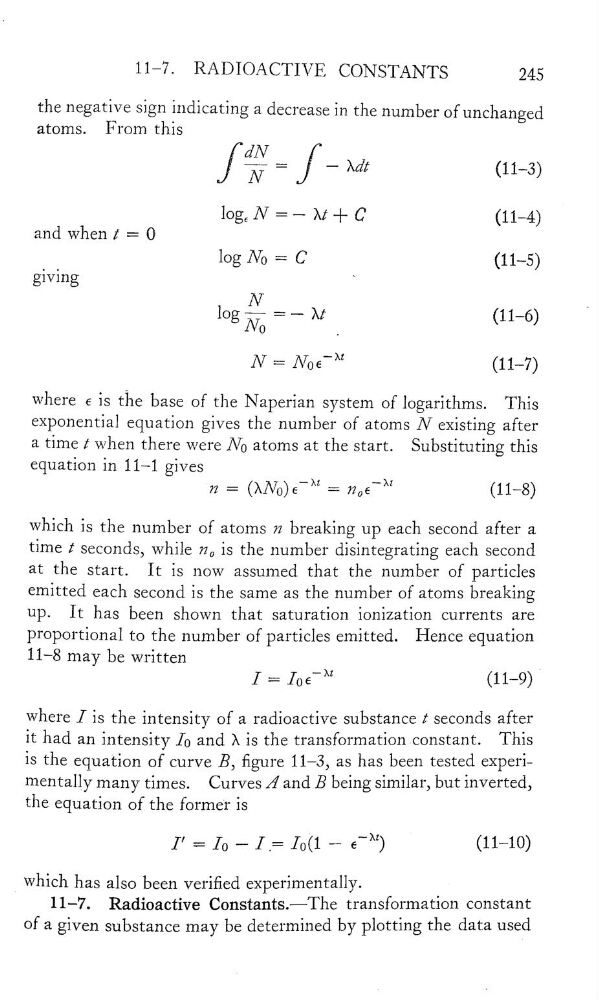
the negative sign indicating a decrease in the number of unchanged
atoms.
From this
“‘
[
hdi
11 3
N
_
( " )
logE N = — M + C
(ll—4)
and when ! = 0
log No = C
(ll—5)
giving
‘
N
.
l
—
=
——
7\t
11—6
og
No
_
(
)
N = Noe‘M
(ll—7)
where 6 is the base of the Naperian system of logarithms. This
exponential equation gives the number of atoms N existing after
a time [ when there were No atoms at the start.
Substituting this
equation in 11—1 gives
n
=
(>xNg)€M =
(ll—8)
which is the number of atoms n breaking up each second after a
time ! seconds, while 770 is the number disintegrating each second
at
the start.
It is now assumed that the number of particles
emitted each second is the same as the number of atoms breaking
up.
It has been shown that saturation ionization currents are
proportional to the number of particles emitted. Hence equation
11—8 may be written
_
[ = [Oe—“
(11—9)
where ] is the intensity of a radioactive substance ! seconds after
it had an intensity [0 and À is the transformation constant. This
is the equation of curve B, gure 11—3, as has been tested expen—
mentally many times.
Curves  and B being similar, but inverted,
the equation of the former is
[’ = 10 — 1_= 10(1 —— €“)
(11—10)
which has also been veried experimentally.
11—7.
Radioactive Constants.—The transformation constant
of a given substance may be determined by plotting the data used
RADIOACTIVE CONSTANTS
245
the negative sign indicating a decrease in the number of unchanged
atoms.
From this
“‘
[
hdi
11 3
N
_
( " )
logE N = — M + C
(ll—4)
and when ! = 0
log No = C
(ll—5)
giving
‘
N
.
l
—
=
——
7\t
11—6
og
No
_
(
)
N = Noe‘M
(ll—7)
where 6 is the base of the Naperian system of logarithms. This
exponential equation gives the number of atoms N existing after
a time [ when there were No atoms at the start.
Substituting this
equation in 11—1 gives
n
=
(>xNg)€M =
(ll—8)
which is the number of atoms n breaking up each second after a
time ! seconds, while 770 is the number disintegrating each second
at
the start.
It is now assumed that the number of particles
emitted each second is the same as the number of atoms breaking
up.
It has been shown that saturation ionization currents are
proportional to the number of particles emitted. Hence equation
11—8 may be written
_
[ = [Oe—“
(11—9)
where ] is the intensity of a radioactive substance ! seconds after
it had an intensity [0 and À is the transformation constant. This
is the equation of curve B, gure 11—3, as has been tested expen—
mentally many times.
Curves  and B being similar, but inverted,
the equation of the former is
[’ = 10 — 1_= 10(1 —— €“)
(11—10)
which has also been veried experimentally.
11—7.
Radioactive Constants.—The transformation constant
of a given substance may be determined by plotting the data used