

_
10—11.
THE NEUTRONÆROTON THEORY
233
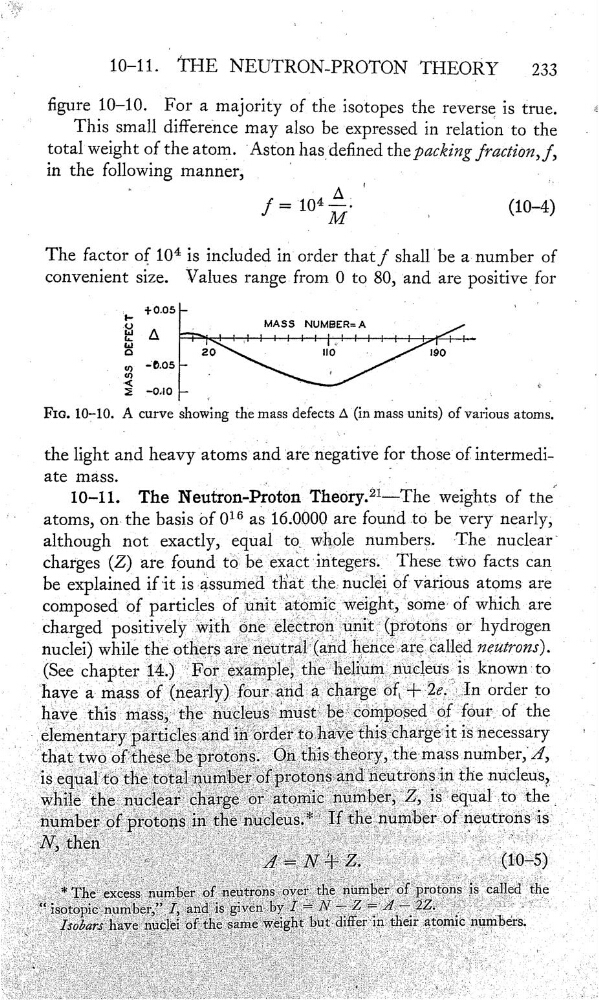
gure 10—10. For a majority of the isotopes the reverse is true.
'
This small difference may also be expressed in relation to the
-
total weight of the atom. Aston
the packing fracti0n, f,
in the following manner-,
_
.
,
,.
”
'
A
.
=
104 ——
.
10“4:)
f
M
(
The factor of 104 is included in‘ order that f shall be a-number of
convenient size.
Values rangefrom 0 to 80, and ”are positive for
.
+o.os
»
'
‘
'
8
MASS
NUMBER=A
m
o
zo
190
’
'
_
.,,
-‘O.os
«)
'
.
<
-
,
2
.
._
.
FIG. 10—_—10. A curve showing the mass defects A (in mass units) of various atoms.
the light and heavy atoms and ’are‘n'egativè for those’of intermedi—
ate mass.
.
10—11.
The Neutron—Prot0n The‘0ry.21—The weights of the
'
‘
atoms, on the basis 'of 016 as 16.0000 are found to‘ be very
although n0t exactly, equal to_ Whole numbers. The nuclea‘r‘
charges (Z) are found to;
These tWo facts can
be explained if it is-aissunièd
atoms are
.
composed of particles
which are
charged positivelÿttWäth nltnunt
nuclei> while ththnt1—
,
Î'have .… mffudhg f+2rn orrr‘lr ro
.
,
haveth1smassthenucleusmustbecomposedof fgf_Ôurg of the
'
elementarÿparüclesand 1n0rdef t0havethïsChargeït ‘-13
’
> 5113
=
-
'
"
5
'
"
?“ '«l1,=«î%îrr:»
;’f‘-…,‘x.
:
.*
,
”“Theexcessnumber0f1eu"ümnsOverth"““lmber°fprOthSIScalled
the f
«
—
IsobamhavenuCIe1bfthesamewelg}1tbutdenthe“atomlcnumbers
‘
10—11.
THE NEUTRONÆROTON THEORY
233
gure 10—10. For a majority of the isotopes the reverse is true.
'
This small difference may also be expressed in relation to the
-
total weight of the atom. Aston
the packing fracti0n, f,
in the following manner-,
_
.
,
,.
”
'
A
.
=
104 ——
.
10“4:)
f
M
(
The factor of 104 is included in‘ order that f shall be a-number of
convenient size.
Values rangefrom 0 to 80, and ”are positive for
.
+o.os
»
'
‘
'
8
MASS
NUMBER=A
m
o
zo
190
’
'
_
.,,
-‘O.os
«)
'
.
<
-
,
2
.
._
.
FIG. 10—_—10. A curve showing the mass defects A (in mass units) of various atoms.
the light and heavy atoms and ’are‘n'egativè for those’of intermedi—
ate mass.
.
10—11.
The Neutron—Prot0n The‘0ry.21—The weights of the
'
‘
atoms, on the basis 'of 016 as 16.0000 are found to‘ be very
although n0t exactly, equal to_ Whole numbers. The nuclea‘r‘
charges (Z) are found to;
These tWo facts can
be explained if it is-aissunièd
atoms are
.
composed of particles
which are
charged positivelÿttWäth nltnunt
nuclei> while ththnt1
,
Î'have .… mf
.
,
haveth1smassthenucleusmustbecomposedof fgf_Ôurg of the
'
elementarÿparüclesand 1n0rdef t0havethïsChargeït ‘-13
’
> 5113
=
-
'
"
5
'
"
?“ '«l1,=«î%îrr:»
;’f‘-…,‘x.
:
.*
,
”“Theexcessnumber0f1eu"ümnsOverth"““lmber°fprOthSIScalled
the f
«
—
IsobamhavenuCIe1bfthesamewelg}1tbutdenthe“atomlcnumbers
‘