

228
10.
POSITIVE RAYS AND ISOTOPES
"
major acceleration by a large potential on the second cathode
(82). By this means, the positive ions all have approximately the
same velocity, as contrasted with the wide range of velocities in
the case of a cold discharge
_
+
M
tube.
However, because of
the comparatively Wide slits
|Ël
Î__=
l
used, they travel in slightly
…Eâ_…r
?
[
different directions as they
_
?
â
pass through the second slit
-
2
82.
Under the action of a
:
magnetic eld perpendicular
\
to the paper,
the various ions
£avp)
the
s}ame valpe
of
e
roug
t to a
ocus
at the slit Sg.
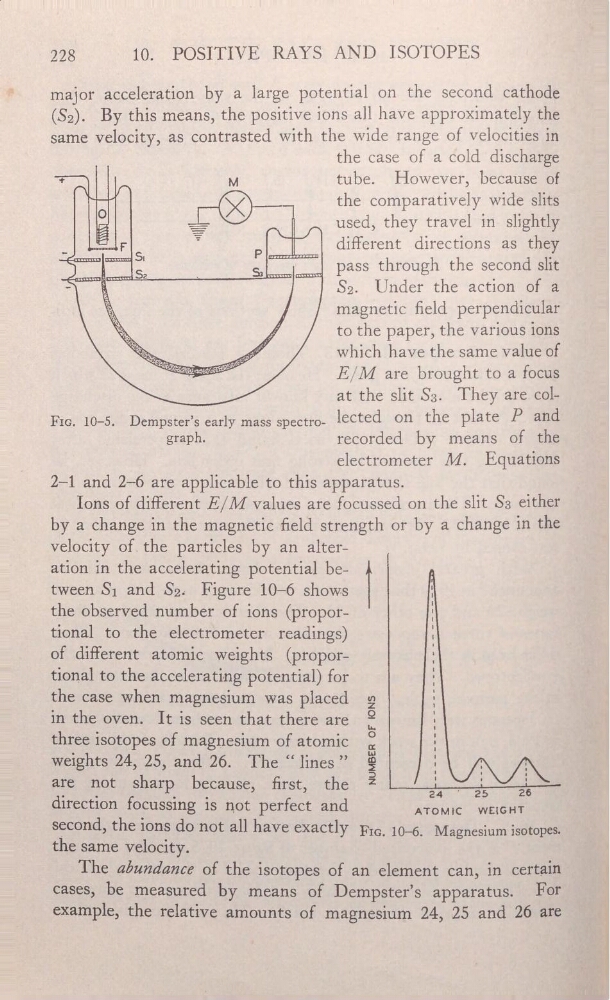
They are colFIG. 10—5.
Dempster’s early mass spectroleCted on the Plate P and
.
graphrecorded by means of the
electrometer M.
Equations
2—1 and 2—6 are applicable to this apparatus.
Ions of di"erent E/M values are focussed on the slit 83 either
by a change in the magnetic eld strength or by a change in the
velocity of. the particles by an alter'
ation in the accelerating potential be—
tween 81 and S2.—
Figure 10—6 shows î
:
_
the observed number of ions (proporE
tional to the electrômeter readings)
l
of dierent atomic weights (propor'
tional to the accelerating potential) for
'
the case when magnesium was placed 9
;
'
'
in the,oven. It is seen that there are
Î
' :
three isotopes of magnesium of atomic î
'
'
.
weights 24, 25, and” 26. The
“
lines ”
ê
;
3
;
are not sharp because, rst, the
%
2'4
2'5
direction focussing is not perfect and
_
Ammc
WElGHT
second, the ions donot all have exactly Fm. 10—6. Magnesium isotopes.‘
'
the same velocity.
'
‘
.
-
The abundcmce of the isotopes of an element can, in certain
'_
cases,
by means of Dempster’s' apparatus.
For
example, the relative amounts of magnesiurn 24, 25 and 26 are
10.
POSITIVE RAYS AND ISOTOPES
"
major acceleration by a large potential on the second cathode
(82). By this means, the positive ions all have approximately the
same velocity, as contrasted with the wide range of velocities in
the case of a cold discharge
_
+
M
tube.
However, because of
the comparatively Wide slits
|Ël
Î__=
l
used, they travel in slightly
…Eâ_…r
?
[
different directions as they
_
?
â
pass through the second slit
-
2
82.
Under the action of a
:
magnetic eld perpendicular
\
to the paper,
the various ions
£avp)
the
s}ame valpe
of
e
roug
t to a
ocus
at the slit Sg.
They are colFIG. 10—5.
Dempster’s early mass spectroleCted on the Plate P and
.
graphrecorded by means of the
electrometer M.
Equations
2—1 and 2—6 are applicable to this apparatus.
Ions of di"erent E/M values are focussed on the slit 83 either
by a change in the magnetic eld strength or by a change in the
velocity of. the particles by an alter'
ation in the accelerating potential be—
tween 81 and S2.—
Figure 10—6 shows î
:
_
the observed number of ions (proporE
tional to the electrômeter readings)
l
of dierent atomic weights (propor'
tional to the accelerating potential) for
'
the case when magnesium was placed 9
;
'
'
in the,oven. It is seen that there are
Î
' :
three isotopes of magnesium of atomic î
'
'
.
weights 24, 25, and” 26. The
“
lines ”
ê
;
3
;
are not sharp because, rst, the
%
2'4
2'5
direction focussing is not perfect and
_
Ammc
WElGHT
second, the ions donot all have exactly Fm. 10—6. Magnesium isotopes.‘
'
the same velocity.
'
‘
.
-
The abundcmce of the isotopes of an element can, in certain
'_
cases,
by means of Dempster’s' apparatus.
For
example, the relative amounts of magnesiurn 24, 25 and 26 are