

EXPERIMENT 9—1
215
_mately homogeneous rays Which pass through this lter travel
upward through the various absorbing materials (À], Fe, Cu, and
C of gure 9—18) to a photographic plate. The plate should be
supported parallel to and 6 to 7 centimeters above the lter in
order to reduce scattered radiations.
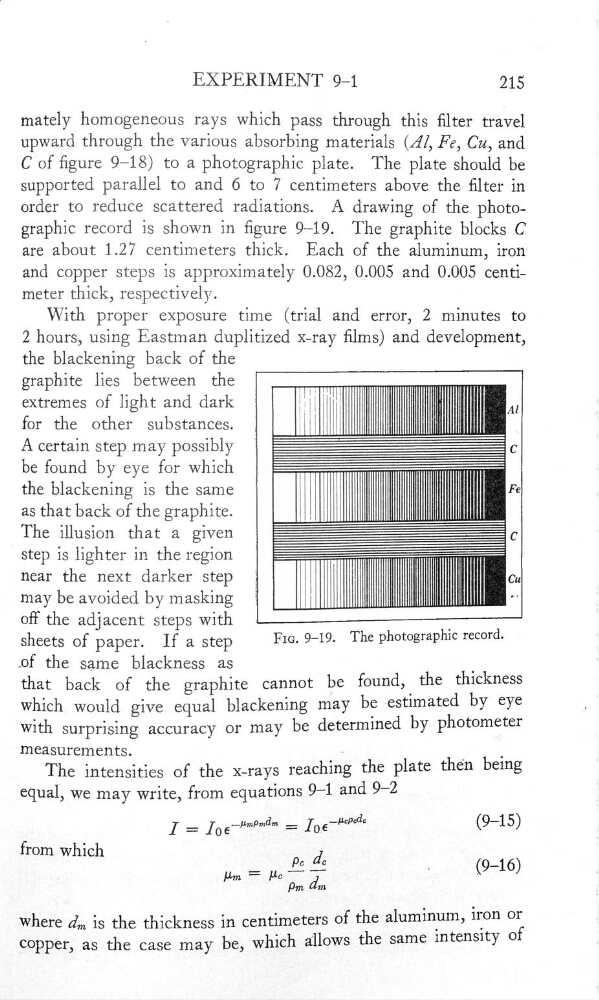
A drawing of the photo—
graphic record is shown in gure 9—19. The graphite blocks C
are
about 1.27 centimeters thick.
Each of the aluminum, irong
_
and copper steps is approximately 0.082, 0.005 and 0.005 centimeter_thick, respectively.
-
With proper exposure time (trial and error, 2 minutes to
2 hours, using Eastman duplitized x-ray lms) and development,
the blackening back of the
graphite lies between the
-
extremes of light and dark
:
for the other
substances.
_
A certain step.may possibly
'
c
be found by eye for which
.
the blackening is the same
Fe
as that back of the graphite.
The illusion that a given
(:
'
step is lighter in the region
near
the next darker step
Cu
may be avoided by masking
‘
"
off the adjacent steps With
_
_
sheets of paper.
If a step
FïGThe Phomgraphïc record‘ '
.of the same blackness as
—_
that back of the graphite
cannot
be found;_
the thickness
which would give equal blackening may
be estimated by eye
With surprising accuracy or may
be determined by photometer
measurements.
—
_
,
The intensities of the x-rays reaching the plate
then being
equal, we may write, from equations 9—1 and 9—2
’
.
_
I : Joe—#mpmdm =,IÛ6—"cp°d°
(9‘15)
froniwhich
'
-
.
,
_
._
(9—16)
’
'
'
Pm dm
.
'
Where dm is the thickness in centireters
of the aluminum, 1r_0n
01‘
copper, as the case may be, which
allows the same
of
215
_mately homogeneous rays Which pass through this lter travel
upward through the various absorbing materials (À], Fe, Cu, and
C of gure 9—18) to a photographic plate. The plate should be
supported parallel to and 6 to 7 centimeters above the lter in
order to reduce scattered radiations.
A drawing of the photo—
graphic record is shown in gure 9—19. The graphite blocks C
are
about 1.27 centimeters thick.
Each of the aluminum, irong
_
and copper steps is approximately 0.082, 0.005 and 0.005 centimeter_thick, respectively.
-
With proper exposure time (trial and error, 2 minutes to
2 hours, using Eastman duplitized x-ray lms) and development,
the blackening back of the
graphite lies between the
-
extremes of light and dark
:
for the other
substances.
_
A certain step.may possibly
'
c
be found by eye for which
.
the blackening is the same
Fe
as that back of the graphite.
The illusion that a given
(:
'
step is lighter in the region
near
the next darker step
Cu
may be avoided by masking
‘
"
off the adjacent steps With
_
_
sheets of paper.
If a step
FïGThe Phomgraphïc record‘ '
.of the same blackness as
—_
that back of the graphite
cannot
be found;_
the thickness
which would give equal blackening may
be estimated by eye
With surprising accuracy or may
be determined by photometer
measurements.
—
_
,
The intensities of the x-rays reaching the plate
then being
equal, we may write, from equations 9—1 and 9—2
’
.
_
I : Joe—#mpmdm =,IÛ6—"cp°d°
(9‘15)
froniwhich
'
-
.
,
_
._
(9—16)
’
'
'
Pm dm
.
'
Where dm is the thickness in centireters
of the aluminum, 1r_0n
01‘
copper, as the case may be, which
allows the same
of