

‘
9—16. DISTRIBUTION OF ELECTRONS IN ATOMS
213
traversed by the rays is 0.20 for carbon; using a ray of
.
)\ = 0.71A.
This quantity, multiplied by 3m2c4/87re4, is equal
to the number of electrons in each gram‘,“ according to the theory.
:For carbon, then, there are 3.0 X 10²³ electrons in ’each gram.
Also, the number of carbon atoms per gram is N /M = 6.06 X
1023/12' = 0.505 X 10²³. Hence, there \are 6.0 electrons in each
.
atom of carbon, a number equal to its atomic number.
.
-
_
'
'
'
The index of refraction of. materials
X—rays
is less than
unity. The deviation from uhity, Which is called the unit decremem‘, 5, of the index of refraction, can be measured15 and is
related to the number, 71, of electrons per cubic centimeter by a
simple equation (6 = n62À2/27rm62) When the_wavé—lengths (>\)
_
'
'
are
much shorter than any
wave—lengths.
'
.
From 71, the number of electrons per atom._can be calculated with
'
‘
case and is found to be equal to the atomic number in the large
number of cases tested.
"
,
'
'
_
‘,
-
'
9—16.
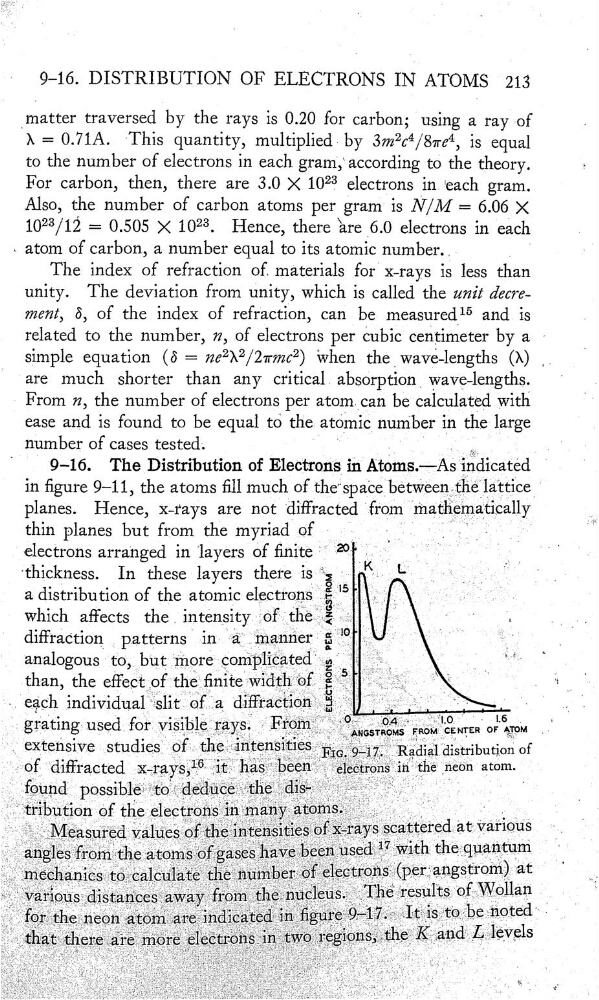
The Distribution of ElectroS_ iii Atoms.—AS‘iridieatéd
'
'
in gure 9—11, the atoms ll much of
planes. Hen‘ce, X—r’ays are not ‘diffracted 'froin -'mathematically
_
thin planes but from the myriad of
ÏÏ'
‘
*,
Ÿ
electrons arranged in layers Of nite
_
7
_
"
'
'
thickness. In these layers there is*%
KL
f
«
a distribution of the atomic eleCtrons_ Ï.:ËÇ“Ï5
f
: -'
.
Which affects
'
‘
.
'
diffraCtiOn patterns
in amannerÊ‘°
‘
'
_
‘
‘_
analogous “to, but ,'more comphcated2
‘
_
_
”
°
than, the
5
;
"
‘
—
…
each
d1rracmn
‘
î
": extensive studiesï'ë‘f themtensmeste9—i7Rdld1stnbutwn of
of, l‘diffract6d xrays16 1thasbeenelectronsmthe neo”n ' ..….
-
-t
f0undP°SS‘—lb1€t0deduœthed13
F
-
Ï ’
'
.
Measuredvaluesofthelnœn81tœS@fxfaYssœtæfedat
various
…
'
9—16. DISTRIBUTION OF ELECTRONS IN ATOMS
213
traversed by the rays is 0.20 for carbon; using a ray of
.
)\ = 0.71A.
This quantity, multiplied by 3m2c4/87re4, is equal
to the number of electrons in each gram‘,“ according to the theory.
:For carbon, then, there are 3.0 X 10²³ electrons in ’each gram.
Also, the number of carbon atoms per gram is N /M = 6.06 X
1023/12' = 0.505 X 10²³. Hence, there \are 6.0 electrons in each
.
atom of carbon, a number equal to its atomic number.
.
-
_
'
'
'
The index of refraction of. materials
X—rays
is less than
unity. The deviation from uhity, Which is called the unit decremem‘, 5, of the index of refraction, can be measured15 and is
related to the number, 71, of electrons per cubic centimeter by a
simple equation (6 = n62À2/27rm62) When the_wavé—lengths (>\)
_
'
'
are
much shorter than any
wave—lengths.
'
.
From 71, the number of electrons per atom._can be calculated with
'
‘
case and is found to be equal to the atomic number in the large
number of cases tested.
"
,
'
'
_
‘,
-
'
9—16.
The Distribution of ElectroS_ iii Atoms.—AS‘iridieatéd
'
'
in gure 9—11, the atoms ll much of
planes. Hen‘ce, X—r’ays are not ‘diffracted 'froin -'mathematically
_
thin planes but from the myriad of
ÏÏ'
‘
*,
Ÿ
electrons arranged in layers Of nite
_
7
_
"
'
'
thickness. In these layers there is*%
KL
f
«
a distribution of the atomic eleCtrons_ Ï.:ËÇ“Ï5
f
: -'
.
Which affects
'
‘
.
'
diffraCtiOn patterns
in amannerÊ‘°
‘
'
_
‘
‘_
analogous “to, but ,'more comphcated2
‘
_
_
”
°
than, the
5
;
"
‘
—
…
each
d1rracmn
‘
î
": extensive studiesï'ë‘f themtensmeste9—i7Rdld1stnbutwn of
of, l‘diffract6d xrays16 1thasbeenelectronsmthe neo”n ' ..….
-
-t
f0undP°SS‘—lb1€t0deduœthed13
F
-
Ï ’
'
.
Measuredvaluesofthelnœn81tœS@fxfaYssœtæfedat
various
…
'