

206
9.
X—RAYS
.
_.
the same order of magnitude as the wave—length of X-rays. A
-
crystal, composed of reecting centers regularly spaced in planes -
at suitable distances apart should serve as a three dimensional
grating for X—rays.
His idea was tested by Friedrich and Knipping15 and found to be correct. This work will be discussed in
the next section (9—11).
_
Bragg devised his spectrograph shortly after the work of
‘
Friedrich and Knipping and gave the following simple interpreè
"
tation of its operation. When the X-ray beam reached the crystal,
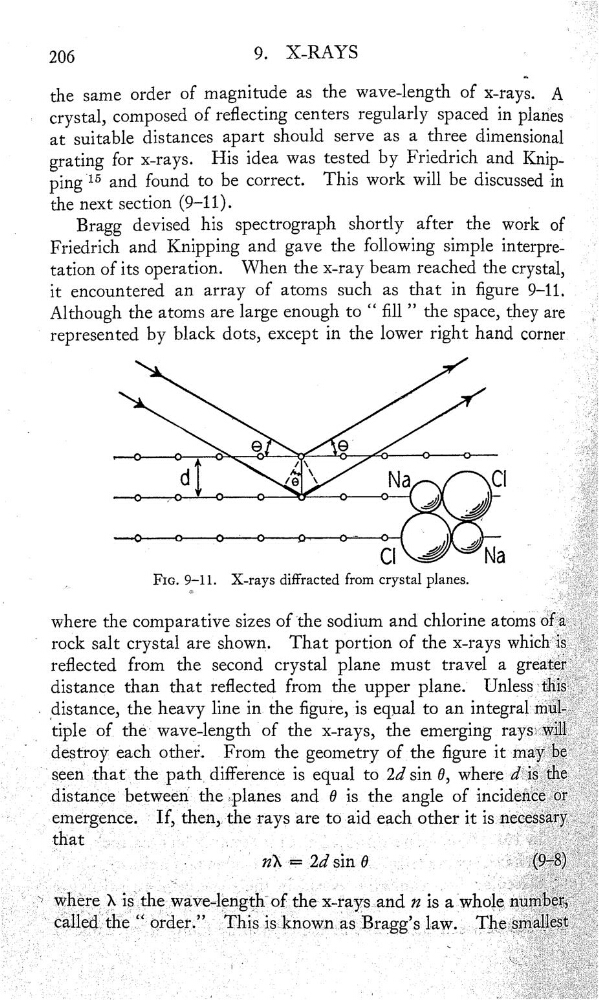
it encountered an array of atoms such as that in gure 9—11.
Although the atoms are large enough to
“
ll
”
the space, they are
represented by black dots, except in the lower right hand corner
_
J
,
FIG. 9—11.
X—rays diffracted from crystal planes.
where the comparative sizes of the sodium and chlorine atoms ofa
‘
rock salt crystal are shown. That portion of the X-rays wh1chiS
reected from the second crystal plane must travel a greater
distance than that reected from the upper plane; Unlessth15
'
distance, the heavy line in the gure, is equal to an 1ntegralmul‘
_
tiple of the wave-length
the X-rays, the emerging rayswrll
'
destroy each other. From the geometry of the gure it maybe
,
'
,
seen
that the
difference is equal to 252 sin 9, Where d13th6
-
distance between?
and a is the angle of 1nc1deCor
f
emergence.
‘
If,then,the rays are to aid eaCh other it 13necessal‘ÿ,
°alledthe
order This
1aW Thesmaet
9.
X—RAYS
.
_.
the same order of magnitude as the wave—length of X-rays. A
-
crystal, composed of reecting centers regularly spaced in planes -
at suitable distances apart should serve as a three dimensional
grating for X—rays.
His idea was tested by Friedrich and Knipping15 and found to be correct. This work will be discussed in
the next section (9—11).
_
Bragg devised his spectrograph shortly after the work of
‘
Friedrich and Knipping and gave the following simple interpreè
"
tation of its operation. When the X-ray beam reached the crystal,
it encountered an array of atoms such as that in gure 9—11.
Although the atoms are large enough to
“
ll
”
the space, they are
represented by black dots, except in the lower right hand corner
_
J
,
FIG. 9—11.
X—rays diffracted from crystal planes.
where the comparative sizes of the sodium and chlorine atoms ofa
‘
rock salt crystal are shown. That portion of the X-rays wh1chiS
reected from the second crystal plane must travel a greater
distance than that reected from the upper plane; Unlessth15
'
distance, the heavy line in the gure, is equal to an 1ntegralmul‘
_
tiple of the wave-length
the X-rays, the emerging rayswrll
'
destroy each other. From the geometry of the gure it maybe
,
'
,
seen
that the
difference is equal to 252 sin 9, Where d13th6
-
distance between?
and a is the angle of 1nc1deCor
f
emergence.
‘
If,then,the rays are to aid eaCh other it 13necessal‘ÿ,
°alledthe
order This
1aW Thesmaet