

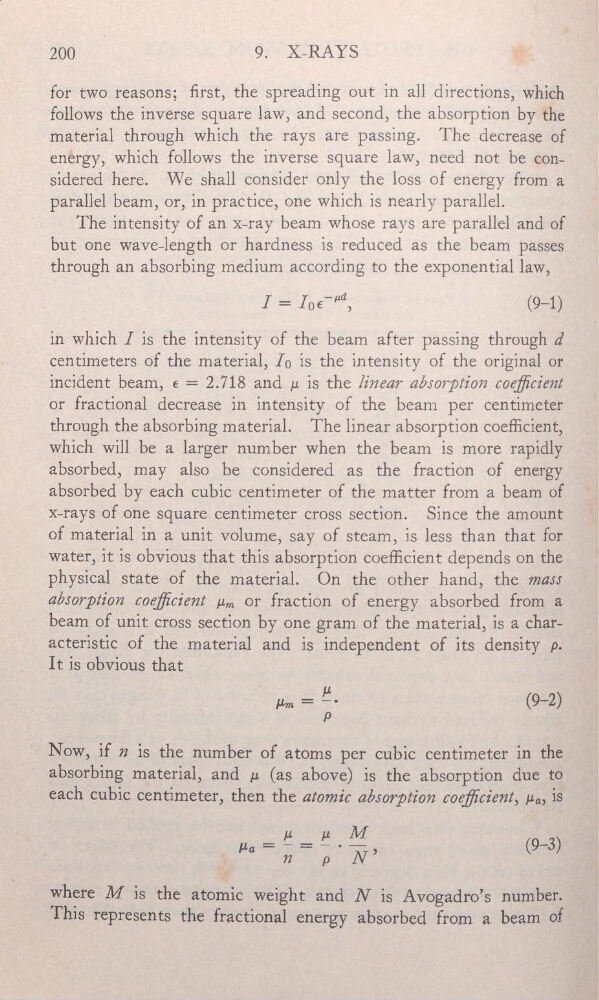
200
9.
X—RAYS
for two reasons; rst, the spreading out in all directions, Which
folloWs the inverse square law, and second, the absorption
material through which the rays are passing. The decrease of
energy, which follows the inverse square law, need not be considered here.
We shall consider only the loss of energy from a
parallel beam, or, in practice, one Which is nearly parallel.
'
-
The intensity of an X—ray beam whose rays are parallel and of
but one wave-length or hardness is reduced as the beam passes
through an absorbing medium according to the exponential law,
’
] = [Oe—“d, '
(9—1)
in which ] is the intensity of the beam after passing through a7
centimeters of the material, 10 is the intensity of the original or
incident beam, & = 2.718 and ,a is the linear absorption coqcient
fractional decrease in intensity of the beam per centimeter
through the absorbing material. The linear absorption coefcient,
which Will be a larger number when the beam is more rapidly
absorbed, may also be considered as the fraction of energy j
absorbed by each cubic centimeter of the matter from a beam of
X-rays of one square centimeter cross section.
Since the amount
of material in a unit volume, say of steam, is less than that for
water, it is obvious that this absorption coefcient depends on the
physical state of the material. On the other hand, the mass
_
aérorption coqicient p… or fraction of energy absorbed from a
'
beam of unit cross section by one gram of the material, is a char- 1 *
acteristic of the material and is independent of its density
It is obvious that
,
'
'
..
—
-
u… =
>
(9—2)
,
‘
Now, if n is the number of atoms per cubic centimeter
the
‘
'
absorbing material, and y (as above) is the absorption due to
each
cubic centimeter, then the atomic absorption coqcient, ,ua, ié
a
77
[J
.
'
‘where “M 'is”the atomic weight and N is Avogadro’s number.
This represents the fr'actio_nàl energy absorbed from a
_
9.
X—RAYS
for two reasons; rst, the spreading out in all directions, Which
folloWs the inverse square law, and second, the absorption
material through which the rays are passing. The decrease of
energy, which follows the inverse square law, need not be considered here.
We shall consider only the loss of energy from a
parallel beam, or, in practice, one Which is nearly parallel.
'
-
The intensity of an X—ray beam whose rays are parallel and of
but one wave-length or hardness is reduced as the beam passes
through an absorbing medium according to the exponential law,
’
] = [Oe—“d, '
(9—1)
in which ] is the intensity of the beam after passing through a7
centimeters of the material, 10 is the intensity of the original or
incident beam, & = 2.718 and ,a is the linear absorption coqcient
fractional decrease in intensity of the beam per centimeter
through the absorbing material. The linear absorption coefcient,
which Will be a larger number when the beam is more rapidly
absorbed, may also be considered as the fraction of energy j
absorbed by each cubic centimeter of the matter from a beam of
X-rays of one square centimeter cross section.
Since the amount
of material in a unit volume, say of steam, is less than that for
water, it is obvious that this absorption coefcient depends on the
physical state of the material. On the other hand, the mass
_
aérorption coqicient p… or fraction of energy absorbed from a
'
beam of unit cross section by one gram of the material, is a char- 1 *
acteristic of the material and is independent of its density
It is obvious that
,
'
'
..
—
-
u… =
>
(9—2)
,
‘
Now, if n is the number of atoms per cubic centimeter
the
‘
'
absorbing material, and y (as above) is the absorption due to
each
cubic centimeter, then the atomic absorption coqcient, ,ua, ié
a
77
[J
.
'
‘where “M 'is”the atomic weight and N is Avogadro’s number.
This represents the fr'actio_nàl energy absorbed from a
_