

198
9.
X—RAYS
î
latter offers higher absorption of the x-rays and hence is preferable
'
except above 3.86 angstroms where it is as transparent as air.
Below 0.86 angstroms, krypton is very efficient.
_
If the intensities of x-ray beams of different wave-lengths are
to be compared, correction must be made, among other factors,
for their respective absorption in the gas of the chamber.
"‘
'
-
|
l
|
;
N
mo
…
Ç
(
]
VOLTS
_
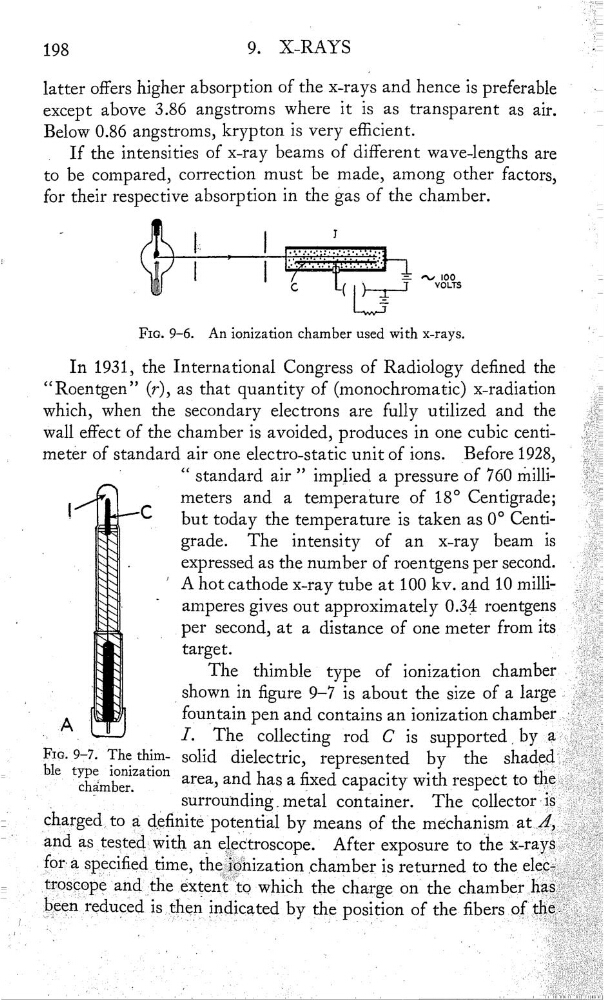
F1G. 9—6.
An ionization chamber used With x-rays.
In 1931, the International Congress of Radiology dened the
_
“Roentgen” (r), as that quantity of (monochromatic) x-radiation
which, when the secondary electrons are fully utilized and the
«
wall effect of the chamber is avoided, produces in one cubic centimeter of standard air one electro-static unit of ions.
Before 1928,
'
'
“
standard air
”
implied a pressure
of 760 milli—
meters
and a temperature of 18° Centigrade;
!
= !
Ç
but today the temperature is taken as 0° CentiËÊI
grade.
The intensity of an x-ray beam is
.
_
ËË .
expressed as the number of roentgens per second. ,_
'
’
A hot cathode x-ray tube at 100 kV. and 10 milli—
’
ssl
'
amperes gives out approximately 0.34 roentgens
'
_
ë%
per second, at a distance of one meter from its
==
target.
_
= :
The
thimble type of ionization chamber
“. '.
'
'
‘
L : } shown 1n gure 9—7 ls about the s12e of a large .
'
A
“
fountain pen and contains an ionization chamber
…
.
]
.
The collecting rod C is supported
,
by a
Frs. 9—7. "_1‘he thi_m— solid dielectric, represented by the shaded
ble
area., and has a xed capacity with respeCt
to the
‘
_
'
surrounding.metal container. The
to a denité potential by means of the me’chanismat Â,
'
and,
electroscope. After exposure
to the x-rays
f01‘ & SpÇÇiedtime,
is returned to the, elec—
_
and the
Which the
the chamber has
been reduœd ÏS then indicated by the position of the berS Off the
9.
X—RAYS
î
latter offers higher absorption of the x-rays and hence is preferable
'
except above 3.86 angstroms where it is as transparent as air.
Below 0.86 angstroms, krypton is very efficient.
_
If the intensities of x-ray beams of different wave-lengths are
to be compared, correction must be made, among other factors,
for their respective absorption in the gas of the chamber.
"‘
'
-
|
l
|
;
N
mo
…
Ç
(
]
VOLTS
_
F1G. 9—6.
An ionization chamber used With x-rays.
In 1931, the International Congress of Radiology dened the
_
“Roentgen” (r), as that quantity of (monochromatic) x-radiation
which, when the secondary electrons are fully utilized and the
«
wall effect of the chamber is avoided, produces in one cubic centimeter of standard air one electro-static unit of ions.
Before 1928,
'
'
“
standard air
”
implied a pressure
of 760 milli—
meters
and a temperature of 18° Centigrade;
!
= !
Ç
but today the temperature is taken as 0° CentiËÊI
grade.
The intensity of an x-ray beam is
.
_
ËË .
expressed as the number of roentgens per second. ,_
'
’
A hot cathode x-ray tube at 100 kV. and 10 milli—
’
ssl
'
amperes gives out approximately 0.34 roentgens
'
_
ë%
per second, at a distance of one meter from its
==
target.
_
= :
The
thimble type of ionization chamber
“. '.
'
'
‘
L : } shown 1n gure 9—7 ls about the s12e of a large .
'
A
“
fountain pen and contains an ionization chamber
…
.
]
.
The collecting rod C is supported
,
by a
Frs. 9—7. "_1‘he thi_m— solid dielectric, represented by the shaded
ble
area., and has a xed capacity with respeCt
to the
‘
_
'
surrounding.metal container. The
to a denité potential by means of the me’chanismat Â,
'
and,
electroscope. After exposure
to the x-rays
f01‘ & SpÇÇiedtime,
is returned to the, elec—
_
and the
Which the
the chamber has
been reduœd ÏS then indicated by the position of the berS Off the