

196
9.
X—RAYS
_
For rapid photographic (diagnostic) work in clinics, 50 to
140 kilovolts are used.
Usually this is 80 kilovolts, the upper
"
limit being set by scattering phenomena. Then, with a broad
'
focal spot
of say
3 square millimeters, a usual value of the current
-
-
.
l
would be 50 to 100 m1lhamperes and the power consumption
'
around 4 to 8 kilowatts.
With a focal spot
4 square millimeters _
and a slightly higher power consumption, 150 to 250 milliamperes
_
would be used.
For slow exposures
and a 1.5 to 3 kilowatt tube,
.
using a ne focal spot
of say
1 square millimeter, in order to obtain
good detail in the photograph, 10 to 30 milliamperes would be used.
For therapeutic work, a xed voltage of 200 kilovolts is common
although much higher values have been used.
9—4.
Intensity -Measurements.—The intensity of an X-ray
beam may be roughly estimated by the brightness of the illumi—
_
nation which it produces on a uorescent screen. The screens
usually consist of a thin layer of calcium tungstate supported on
paper.
-_
.
The photographic lms used to record X-rays are coated on
'
both sides with the sensitive emulsion.
A series of correct exposure
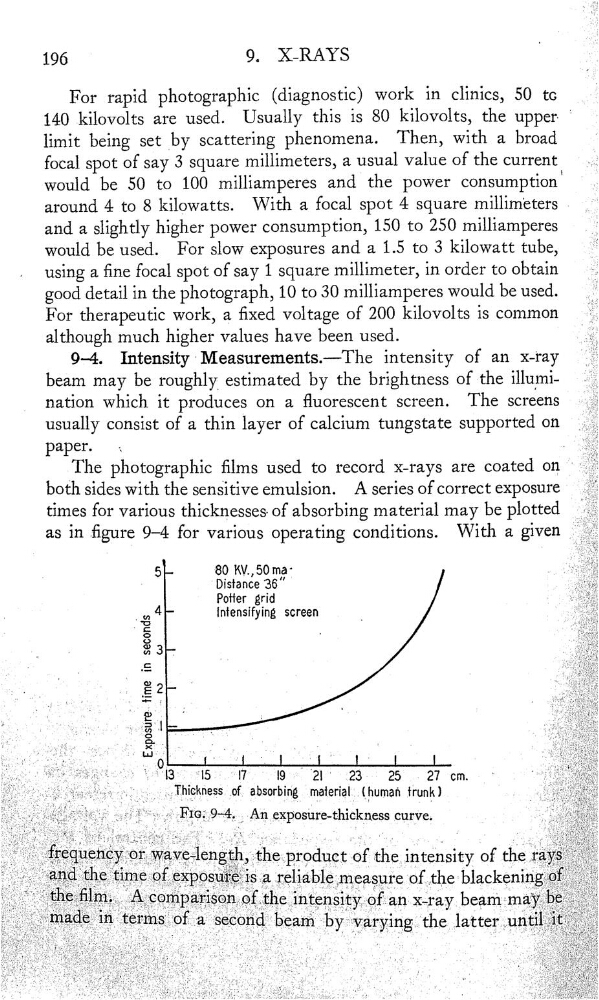
times for various thicknesses— of absorbing material may be plotted
as in gure 9—4 for various operating conditions. With a given
5
80 w.,5o ma.
Distance 36"
grid
—…: ä
,
inten51fymg screen
_
'
€
—
°
::ç!=:ïi
'
3
..
—,
8_
_
'
?Ï;;ÿ;i—_:zÿj
—'
ï'l3 } “l5 a l?
'
l9 '
21 ‘
23
25
27 cm.
"
,
‘
,0f. absorbing
trunk)
,
_
.
FIG9—4
exposure—thickness curÿe.
J ;
andthet1m60fexposms arehablemeasure of the = blackenmgof
9.
X—RAYS
_
For rapid photographic (diagnostic) work in clinics, 50 to
140 kilovolts are used.
Usually this is 80 kilovolts, the upper
"
limit being set by scattering phenomena. Then, with a broad
'
focal spot
of say
3 square millimeters, a usual value of the current
-
-
.
l
would be 50 to 100 m1lhamperes and the power consumption
'
around 4 to 8 kilowatts.
With a focal spot
4 square millimeters _
and a slightly higher power consumption, 150 to 250 milliamperes
_
would be used.
For slow exposures
and a 1.5 to 3 kilowatt tube,
.
using a ne focal spot
of say
1 square millimeter, in order to obtain
good detail in the photograph, 10 to 30 milliamperes would be used.
For therapeutic work, a xed voltage of 200 kilovolts is common
although much higher values have been used.
9—4.
Intensity -Measurements.—The intensity of an X-ray
beam may be roughly estimated by the brightness of the illumi—
_
nation which it produces on a uorescent screen. The screens
usually consist of a thin layer of calcium tungstate supported on
paper.
-_
.
The photographic lms used to record X-rays are coated on
'
both sides with the sensitive emulsion.
A series of correct exposure
times for various thicknesses— of absorbing material may be plotted
as in gure 9—4 for various operating conditions. With a given
5
80 w.,5o ma.
Distance 36"
grid
—…: ä
,
inten51fymg screen
_
'
€
—
°
::ç!=:ïi
'
3
..
—,
8_
_
'
?Ï;;ÿ;i—_:zÿj
—'
ï'l3 } “l5 a l?
'
l9 '
21 ‘
23
25
27 cm.
"
,
‘
,0f. absorbing
trunk)
,
_
.
FIG9—4
exposure—thickness curÿe.
J ;
andthet1m60fexposms arehablemeasure of the = blackenmgof