

188
8.
ELECTRICITY THROUGH GASES
of V.,, vertically and distances of the probe from the anode hori—
zohtally.
3. In experiment 8—3 a curve is plotted of the voltage required _
to start a glow discharge for various pressures
of the gas.
With the
apparatus
of gure 8—17, it is possible to determine the striking
'
voltage for various distances between the electrodes, using the
probe as the anode and either of the other electrodes as the cathode.
;.Ÿ“
The probe circuit is not required. It is suggested that the voltage
supply have a range from 200 to 800, that the pressure be maintained constant at approximately 0.1 millimeter and that the distance between the electrodes be varied from 20 centimeters to as
.'
short a value as possible. The striking potentials at the smaller
distances are of particular interest in the design of x—ray tubes.
'
Data on striking potentials are frequently presented in
the product of the electrode separation and the pressure.
»
'
EXPERIMENT 8—5
STRIKING POTENTIALS OF A GAS-FILLED TRIODE
'
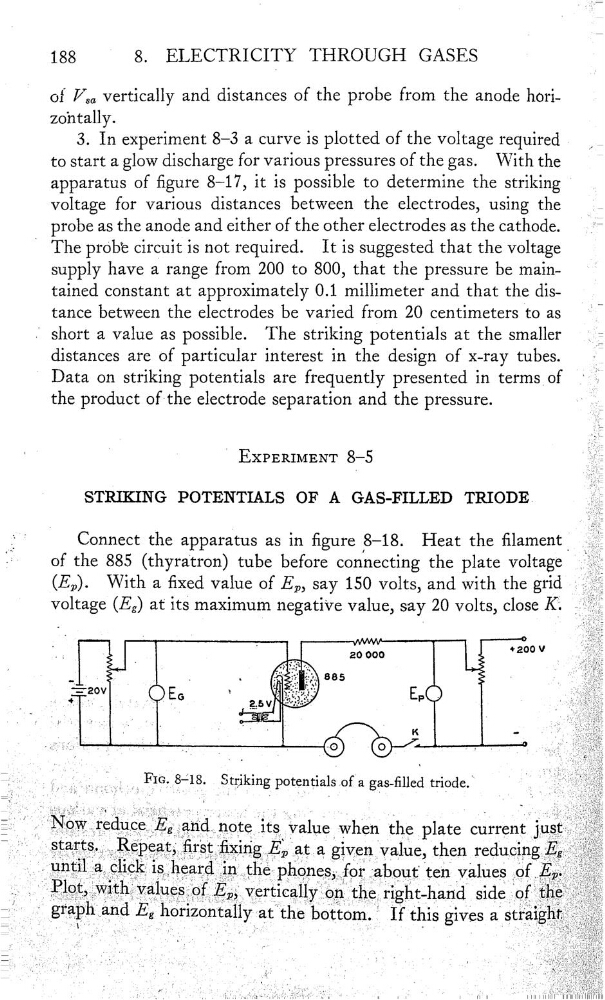
Connect the apparatus as in gure 8—18. Heat the lament
of the 885 (thyra'tron) tube before connecting the plate voltage
(Ep).
With a xed value of Ep, say 150 volts, and With the grid
voltage (Eg) at its maximum negatiVe value, say 20 volts, close K
-.
‘
-
-
!“
865
potentials of a gas-lled
StartsRePeatrstxngata glvenvalue then reducng
‘P10tw1thvaluesofEVert1callron therlghthand s1deofthe
graph…and Eg
bottom.
If this gives a' stralghf
8.
ELECTRICITY THROUGH GASES
of V.,, vertically and distances of the probe from the anode hori—
zohtally.
3. In experiment 8—3 a curve is plotted of the voltage required _
to start a glow discharge for various pressures
of the gas.
With the
apparatus
of gure 8—17, it is possible to determine the striking
'
voltage for various distances between the electrodes, using the
probe as the anode and either of the other electrodes as the cathode.
;.Ÿ“
The probe circuit is not required. It is suggested that the voltage
supply have a range from 200 to 800, that the pressure be maintained constant at approximately 0.1 millimeter and that the distance between the electrodes be varied from 20 centimeters to as
.'
short a value as possible. The striking potentials at the smaller
distances are of particular interest in the design of x—ray tubes.
'
Data on striking potentials are frequently presented in
the product of the electrode separation and the pressure.
»
'
EXPERIMENT 8—5
STRIKING POTENTIALS OF A GAS-FILLED TRIODE
'
Connect the apparatus as in gure 8—18. Heat the lament
of the 885 (thyra'tron) tube before connecting the plate voltage
(Ep).
With a xed value of Ep, say 150 volts, and With the grid
voltage (Eg) at its maximum negatiVe value, say 20 volts, close K
-.
‘
-
-
!“
865
potentials of a gas-lled
StartsRePeatrstxngata glvenvalue then reducng
‘P10tw1thvaluesofEVert1callron therlghthand s1deofthe
graph…and Eg
bottom.
If this gives a' stralghf