

168
8.
ELECTRICITY THROUGH GASES
region around the probe, as indicated in gure 8—9. The current
to the probe (ip), under these conditions, is made up of positive
ions alone.
Further, the only positive ions which are able to
reach the probe are those which, due to their random thermal
motion in the gas, chance to strike the boundary of the sheath.
As the probe is made less negative, by decreasing voltage (V)
in gure 8—9, the positive ion sheath becomes slightly thinner and
-(i,,) becomes smaller.
In addition, at B in gure 8—10, some of
,
the faster electrons in the discharge tube have sufcient energy to
their way against the retarding potential and reach the
negative probe. At ?} the number of positive ions which are
attracted to the probe is equal to the number of electrons Which
.
are able to reach it against the opposing force. This is the voltage
(with respect
to the anode) which a oating or free probe would
"
assume; it is not the potential of the gas.
At decreasingly negative potentials of the probe, even the
slower electrons
gas are able to force their way
to it.
At
V,, gure 8—10, the probe has reached the potential of the space
(of the gas) at this place in the tube, the positive ion sheath
,
disappeared, and all electrons which, in their random motion in
the gas discharge chance to reach the probe, are collected by 1t
When the probe is made still less negative (with respect
to the,
anode), it will be more positive than the space and will serve to
attract electrons.
The curve to the right of V, rises very slowly
since there exists a negative electron sheath, similar but th1nner‘
.
and of opposite sign to the positive ion sheath of the region B
If the probe is made still more positive with respect
to the space,
the electrons travel toward it with increasing velocities until, at C,
_
they ’are able to ioni2e the gas cloSe to the probe and create a cur—
rent of such large magnitude as frequently to melt the probe.
The_hext four sections giVe a more quantitative d1scuss1onof>
..
3 the use of probes
the measurement of the phenomena occurrrng'
.
;Ï8+9=
of Electron
has
*
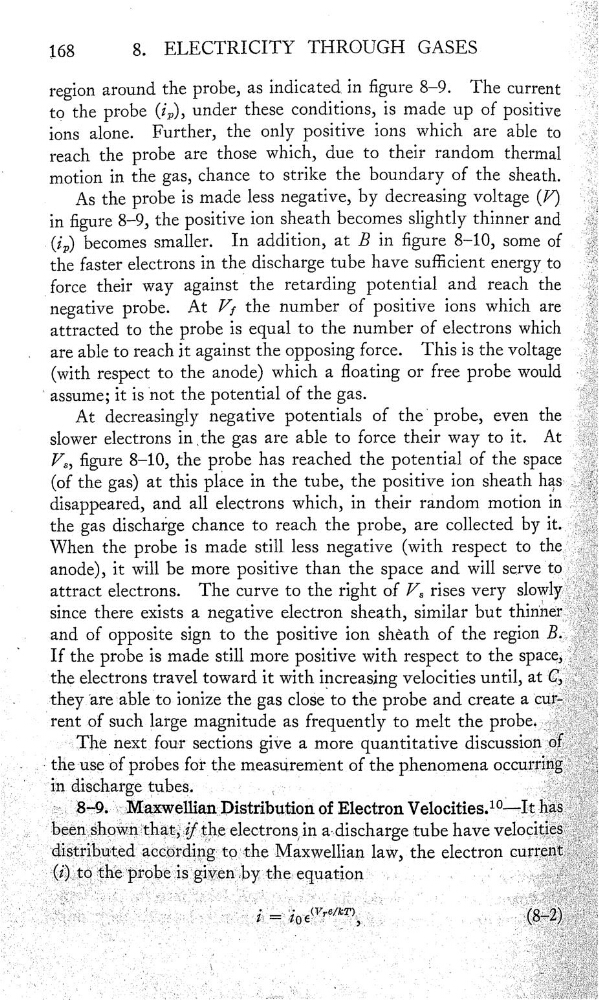
….{ Ï ’ beenshownthat,2f the electrons in a«discharge tube have
d13tïlbUted
Maxwellian law, the electron
8.
ELECTRICITY THROUGH GASES
region around the probe, as indicated in gure 8—9. The current
to the probe (ip), under these conditions, is made up of positive
ions alone.
Further, the only positive ions which are able to
reach the probe are those which, due to their random thermal
motion in the gas, chance to strike the boundary of the sheath.
As the probe is made less negative, by decreasing voltage (V)
in gure 8—9, the positive ion sheath becomes slightly thinner and
-(i,,) becomes smaller.
In addition, at B in gure 8—10, some of
,
the faster electrons in the discharge tube have sufcient energy to
their way against the retarding potential and reach the
negative probe. At ?} the number of positive ions which are
attracted to the probe is equal to the number of electrons Which
.
are able to reach it against the opposing force. This is the voltage
(with respect
to the anode) which a oating or free probe would
"
assume; it is not the potential of the gas.
At decreasingly negative potentials of the probe, even the
slower electrons
gas are able to force their way
to it.
At
V,, gure 8—10, the probe has reached the potential of the space
(of the gas) at this place in the tube, the positive ion sheath
,
disappeared, and all electrons which, in their random motion in
the gas discharge chance to reach the probe, are collected by 1t
When the probe is made still less negative (with respect
to the,
anode), it will be more positive than the space and will serve to
attract electrons.
The curve to the right of V, rises very slowly
since there exists a negative electron sheath, similar but th1nner‘
.
and of opposite sign to the positive ion sheath of the region B
If the probe is made still more positive with respect
to the space,
the electrons travel toward it with increasing velocities until, at C,
_
they ’are able to ioni2e the gas cloSe to the probe and create a cur—
rent of such large magnitude as frequently to melt the probe.
The_hext four sections giVe a more quantitative d1scuss1onof>
..
3 the use of probes
the measurement of the phenomena occurrrng'
.
;Ï8+9=
of Electron
has
*
….{ Ï ’ beenshownthat,2f the electrons in a«discharge tube have
d13tïlbUted
Maxwellian law, the electron