

7—8.
COLLISIONS OF THE SECOND KIND
151
light). Often, however, the wave—number ? is used. This is
the number of waves per centimeter of path; i.e., ? : 1/À.
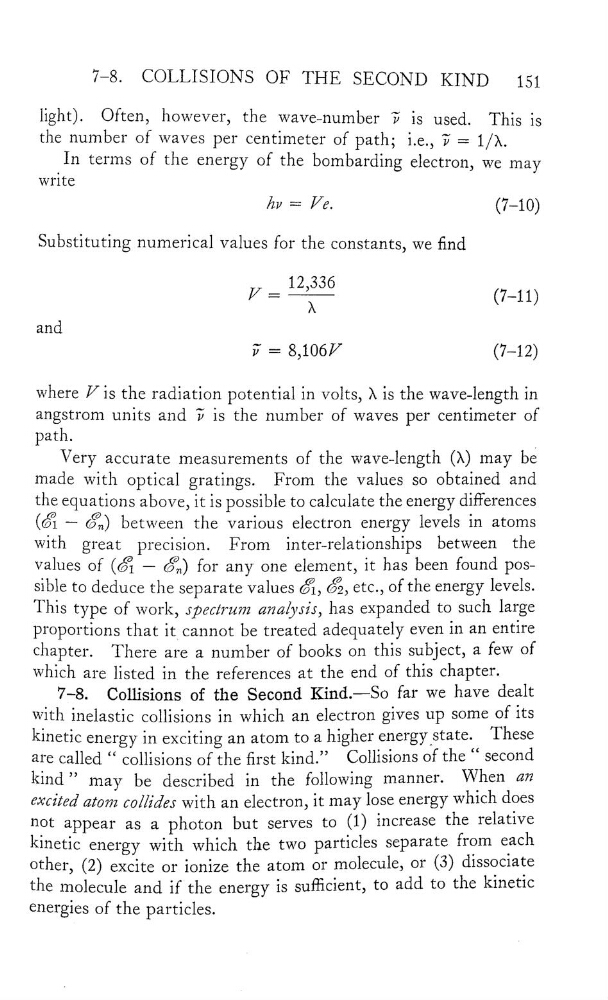
In terms of the energy of the bombarding electron, we may
write
sz = Ve.
(7—10)
Substituting numerical values for the constants, we nd
y :
12,336
(7_…
>\
and
17 = 8,106V
(7—12)
where V is the radiation potential in volts, )\ is the wave-length in
angstrom units and ? is the number of waves per centimeter of
path.
Very accurate measurements of the wave—length (À) may be
made with optical gratings. From the values so obtained and
the equations above, it is possible to calculate the energy differences
(@@1 — @@”) between the various electron energy levels in atoms
with
great
precision.
From
inter-relationships between the
values of
—
éÎ,) for any one element, it has been found pos—
sible to decluce the separate values
etc., of the energy levels.
This type of work, spectrum analysis, has expanded to such large
proportions that it cannot be treated adequately even in an entire
chapter. There are a number of books on this subject, a few of
which are listed in the references at the end of this chapter.
7—8.
Colh‘sîons of the Second Kind—So far we have dealt
with inelastic collisions in which an electron gives up some of its
kinetic energy in exciting an atom to a higher
These
are called “
collisions of the rst kind.”
Collisions of the
"
second
kind” may be described in the following manner. When
em
excited atom col/ide; with an electron, it may lose energy
Which does
not
appear as a photon but serves to (1) increase the relative
kinetic energy With which the two particles separate from each
other, (2) excite or ionize the atom or molecule, or (3) dissociate
the molecule and if the energy
is sufcient, to add to the kinetic
energies of the particles.
COLLISIONS OF THE SECOND KIND
151
light). Often, however, the wave—number ? is used. This is
the number of waves per centimeter of path; i.e., ? : 1/À.
In terms of the energy of the bombarding electron, we may
write
sz = Ve.
(7—10)
Substituting numerical values for the constants, we nd
y :
12,336
(7_…
>\
and
17 = 8,106V
(7—12)
where V is the radiation potential in volts, )\ is the wave-length in
angstrom units and ? is the number of waves per centimeter of
path.
Very accurate measurements of the wave—length (À) may be
made with optical gratings. From the values so obtained and
the equations above, it is possible to calculate the energy differences
(@@1 — @@”) between the various electron energy levels in atoms
with
great
precision.
From
inter-relationships between the
values of
—
éÎ,) for any one element, it has been found pos—
sible to decluce the separate values
etc., of the energy levels.
This type of work, spectrum analysis, has expanded to such large
proportions that it cannot be treated adequately even in an entire
chapter. There are a number of books on this subject, a few of
which are listed in the references at the end of this chapter.
7—8.
Colh‘sîons of the Second Kind—So far we have dealt
with inelastic collisions in which an electron gives up some of its
kinetic energy in exciting an atom to a higher
These
are called “
collisions of the rst kind.”
Collisions of the
"
second
kind” may be described in the following manner. When
em
excited atom col/ide; with an electron, it may lose energy
Which does
not
appear as a photon but serves to (1) increase the relative
kinetic energy With which the two particles separate from each
other, (2) excite or ionize the atom or molecule, or (3) dissociate
the molecule and if the energy
is sufcient, to add to the kinetic
energies of the particles.