

144
7.
THE OUTER PARTS OF THE ATOM
rections had been made for the recoil of their nuclei.
In the light
of later studies of the construction of the nucleus, these apparent
discrepancies in the scattering of alpha particles by light atoms
can be interpreted as evidence of large binding forces operating
over short distances and serving to keep the parts of the nucleus
from) ying apart.
’
7—4.
The Scattering of Electrons by Gases.5—An electron
,
gun is used to direct electrons in a narrow beam through a chamber
-
filled with
at a pressure
around 10‘3 millimeter.
Electrons which are deected or elastical/y scattered by the mercury
"
_
atoms pass through several slits into a faraday chamber and are
”
recorded by means of an electrometer. Various potentials are '
applied to the slits so as to exclude from the chamber all positive
charges and also all electrons which
.
Ÿ
'
have lost energy
at
their encounter‘
with the gas
atoms
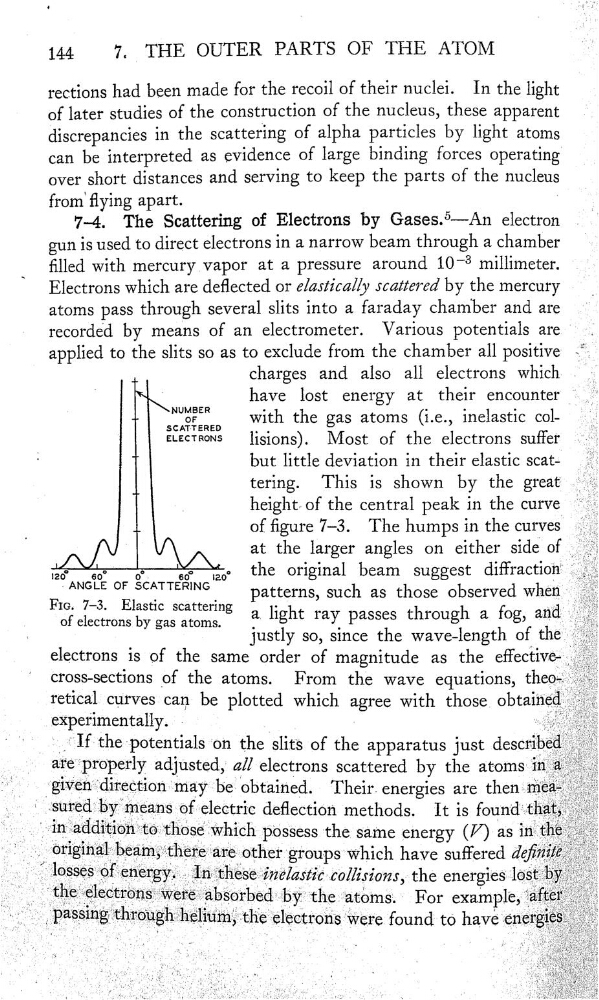
(i.e., inelastic colELECTRONS
lisions).
Most of the electrons suffer
but little deviation in their elastic scat—
tering.
This is shown by the great
height of the central peak in the curve
_
of gure 7—3. The humps in the curves
’
at the larger angles on either side of
129°AN6ÎËOFË°CATTEGROÎNGŒ°°
the original beam suggest diffraction“
FIG. 7—3.
Elastic scattering
patterns,
SUCh as those Observed When
of electrons by gas
a llght ray passes through a fog, and_
justly so, since the wave—length of the)
_
electrons is of the same order of magnitude as the effective—
"
cross—sections of the atoms.
From the wave equations, theoretical curves can be plotted Which agree with those obtained<
'
experimental‘ly. -
'
*
‘
the potentials on the slits of the apparatus just described
Ü
all electrons scattered by the atoms
“maÿ—
Their… energies are thenmea—
‘: 1
suredbYmeans_‘0f—e'leCtri'c deection methods. It is foundthat,
madd1t10nt0
ÏWhich pbssessthe same energy (V) as 1nthe
‘ËTOUPS‘Whi0h have suffered démf"
-
103368 0fenergy In these {” êl&zsîz‘iè œ llz‘riom the energies 41@3tbÿ
;?)
theel€ctronswereabsorbedby the
*
For
° [' ï PaSSlngthroughhdmm’ the {electrons were “found to have energœs
7.
THE OUTER PARTS OF THE ATOM
rections had been made for the recoil of their nuclei.
In the light
of later studies of the construction of the nucleus, these apparent
discrepancies in the scattering of alpha particles by light atoms
can be interpreted as evidence of large binding forces operating
over short distances and serving to keep the parts of the nucleus
from) ying apart.
’
7—4.
The Scattering of Electrons by Gases.5—An electron
,
gun is used to direct electrons in a narrow beam through a chamber
-
filled with
at a pressure
around 10‘3 millimeter.
Electrons which are deected or elastical/y scattered by the mercury
"
_
atoms pass through several slits into a faraday chamber and are
”
recorded by means of an electrometer. Various potentials are '
applied to the slits so as to exclude from the chamber all positive
charges and also all electrons which
.
Ÿ
'
have lost energy
at
their encounter‘
with the gas
atoms
(i.e., inelastic colELECTRONS
lisions).
Most of the electrons suffer
but little deviation in their elastic scat—
tering.
This is shown by the great
height of the central peak in the curve
_
of gure 7—3. The humps in the curves
’
at the larger angles on either side of
129°AN6ÎËOFË°CATTEGROÎNGŒ°°
the original beam suggest diffraction“
FIG. 7—3.
Elastic scattering
patterns,
SUCh as those Observed When
of electrons by gas
a llght ray passes through a fog, and_
justly so, since the wave—length of the)
_
electrons is of the same order of magnitude as the effective—
"
cross—sections of the atoms.
From the wave equations, theoretical curves can be plotted Which agree with those obtained<
'
experimental‘ly. -
'
*
‘
the potentials on the slits of the apparatus just described
Ü
all electrons scattered by the atoms
“maÿ—
Their… energies are thenmea—
‘: 1
suredbYmeans_‘0f—e'leCtri'c deection methods. It is foundthat,
madd1t10nt0
ÏWhich pbssessthe same energy (V) as 1nthe
‘ËTOUPS‘Whi0h have suffered démf"
-
103368 0fenergy In these {” êl&zsîz‘iè œ llz‘riom the energies 41@3tbÿ
;?)
theel€ctronswereabsorbedby the
*
For
° [' ï PaSSlngthroughhdmm’ the {electrons were “found to have energœs