

142
7.
THE OUTER PARTS OF THE ATOM
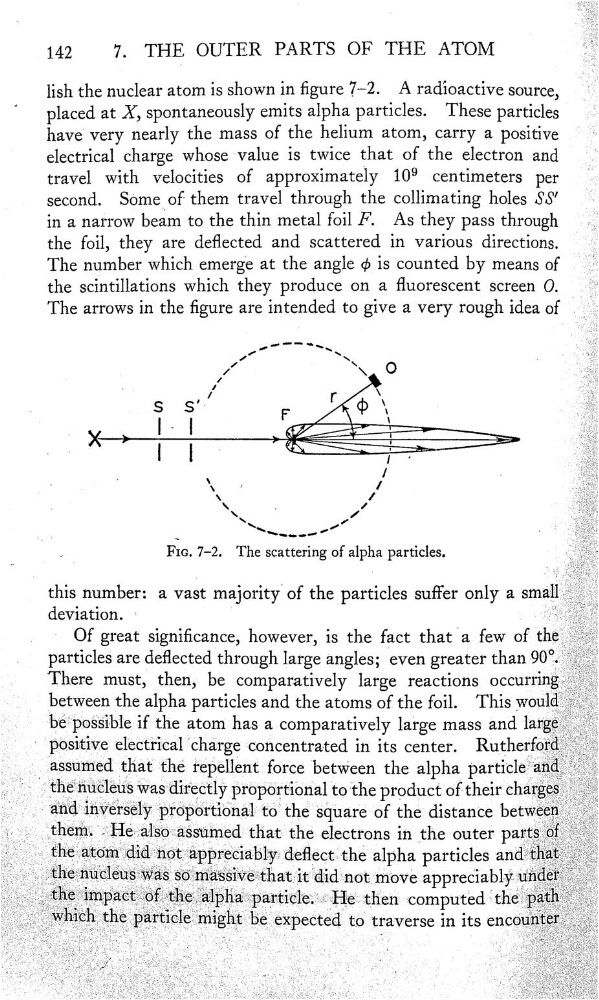
lish the nuclear atom is shown in gure 7—2. A radioactive source,
placed at X, spontaneously emits alpha particles. These particles
have' very nearly the mass of the helium atom, carry a positive
electrical charge whosevalue is twice that
of the electron and
travel with velocities of approximately 109 centimeters per
second.
of them travel through the collimating holes SS’
in a nafrow beam to the thin metal foil F
.
As they pass through
the foil, they are deected and scattered in various directions.
The number which emerge at the angle 43 is counted by means of
the scintillations which they produce on a uorescent screen 0.
The arrows in the gure are intended to give a very rough idea of
/'/
\\ o
'
Ÿ
,
'
”
f
\
î 5.
'
F
X
[
|
-
’
'
'
‘
’
’
\\
,//
,
FIG. 7—2.
The scattering of alpha particles.
_
this number: a vast
of the particles suffer only a small
.
'
Of great signicance, however, is the fact thata few of the
,
particles are deected through large angles; even greater than 90°
_
There must, then, be comparatively large reactions occurrmg
f
between the alpha particles and the atoms of the foil. This would
,
béÉpos‘si‘ble if the atom has a comparatively large mass and large
’
'
positive eleCtrical "charge corieentrated in its center. Rutherford
!;
__
that the repel‘lent force betWeen the alpha part1cleand
…! thenucleus
proportional to the product of - their charges
ï andanerselyproportmnal ”td" the square of the distanCe between
Healsoassmned
the eleCtrons in
outer partsof
theatomdldn0tappî‘eüablÿdeectthe alpha particles andthat
thelmaCt0fthealphapafüdeHethen computed thepath
7.
THE OUTER PARTS OF THE ATOM
lish the nuclear atom is shown in gure 7—2. A radioactive source,
placed at X, spontaneously emits alpha particles. These particles
have' very nearly the mass of the helium atom, carry a positive
electrical charge whosevalue is twice that
of the electron and
travel with velocities of approximately 109 centimeters per
second.
of them travel through the collimating holes SS’
in a nafrow beam to the thin metal foil F
.
As they pass through
the foil, they are deected and scattered in various directions.
The number which emerge at the angle 43 is counted by means of
the scintillations which they produce on a uorescent screen 0.
The arrows in the gure are intended to give a very rough idea of
/'/
\\ o
'
Ÿ
,
'
”
f
\
î 5.
'
F
X
[
|
-
’
'
'
‘
’
’
\\
,//
,
FIG. 7—2.
The scattering of alpha particles.
_
this number: a vast
of the particles suffer only a small
.
'
Of great signicance, however, is the fact thata few of the
,
particles are deected through large angles; even greater than 90°
_
There must, then, be comparatively large reactions occurrmg
f
between the alpha particles and the atoms of the foil. This would
,
béÉpos‘si‘ble if the atom has a comparatively large mass and large
’
'
positive eleCtrical "charge corieentrated in its center. Rutherford
!;
__
that the repel‘lent force betWeen the alpha part1cleand
…! thenucleus
proportional to the product of - their charges
ï andanerselyproportmnal ”td" the square of the distanCe between
Healsoassmned
the eleCtrons in
outer partsof
theatomdldn0tappî‘eüablÿdeectthe alpha particles andthat
thelmaCt0fthealphapafüdeHethen computed thepath