

.
7—1.
INTRODUCTION
139
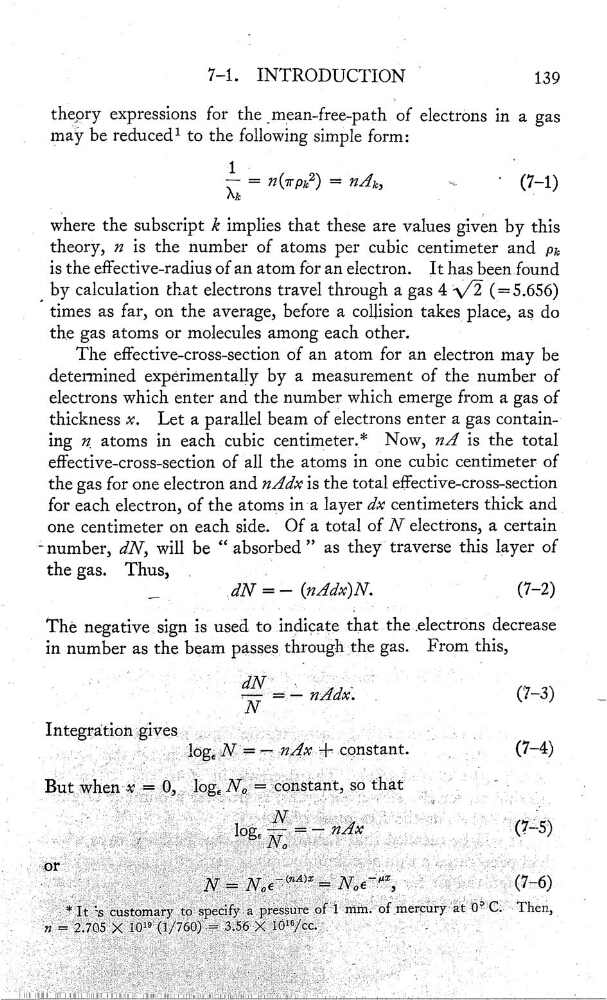
theory expressions for the
of electr0ns in a gas
_
may be reduced1 to the following simple form:
1
——
=
n(7rpk2) = nÂk,
'
(7—1)
>‘k
.
:
where the subscript k implies that these are values given by this
.
theory, 71 is the number of atoms per cubic centimeter and pk
is the effective—radius of an atom f0r an electron.
It has beenfound
by calculation that electrons travel through a gas
4
(=5.656)
times as far, on the average, before a collision takes place, as do
the gas atoms or molecules among each other.
'
The e'ective—cross—section of an atom for an electron may be
detennined expérimentally by a measurement of the number of
electrons which enter and the number which emerge from a gas of
thickness x.
Let a parallel beam of électrons enter a gas
ing n_ atoms in each cubic centimeter._* Now, mi is the total
effective-cross—section of all the atoms in one cubic centimeter of
the gas for one electron and nÂdx is the total effective-cross—section
for each electron, of the atoms ina layer dx centimeters thick and
one centimeter on each side.
Of a total of N electrons, a certain
"" number, dN, Will be
“
absorbed
”
as they" traverse this layer of
the gas.
Thus,
‘
,
,,
=
-—
(nÂdx)N.
'
_
(7—2)
The negativesign is used to indicate that the…electrdns decrease
in number as the beam passes through the gas.
From this,
"
»
”
'
ï
'ÉZÏ=S—' Max“.
_
(7—3)
_
L.
Ï L
…
;
_
…
;
,,
.
_
_
(7—4)
’
:
N=Ne"‘"Æ=NG""a
(7—6)
7—1.
INTRODUCTION
139
theory expressions for the
of electr0ns in a gas
_
may be reduced1 to the following simple form:
1
——
=
n(7rpk2) = nÂk,
'
(7—1)
>‘k
.
:
where the subscript k implies that these are values given by this
.
theory, 71 is the number of atoms per cubic centimeter and pk
is the effective—radius of an atom f0r an electron.
It has beenfound
by calculation that electrons travel through a gas
4
(=5.656)
times as far, on the average, before a collision takes place, as do
the gas atoms or molecules among each other.
'
The e'ective—cross—section of an atom for an electron may be
detennined expérimentally by a measurement of the number of
electrons which enter and the number which emerge from a gas of
thickness x.
Let a parallel beam of électrons enter a gas
ing n_ atoms in each cubic centimeter._* Now, mi is the total
effective-cross—section of all the atoms in one cubic centimeter of
the gas for one electron and nÂdx is the total effective-cross—section
for each electron, of the atoms ina layer dx centimeters thick and
one centimeter on each side.
Of a total of N electrons, a certain
"" number, dN, Will be
“
absorbed
”
as they" traverse this layer of
the gas.
Thus,
‘
,
,,
=
-—
(nÂdx)N.
'
_
(7—2)
The negativesign is used to indicate that the…electrdns decrease
in number as the beam passes through the gas.
From this,
"
»
”
'
ï
'ÉZÏ=S—' Max“.
_
(7—3)
_
L.
Ï L
…
;
_
…
;
,,
.
_
_
(7—4)
’
:
N=Ne"‘"Æ=NG""a
(7—6)