

6—7
.
TETRODES
125
which results from the ir,— potential drop is then a measure of the
current.
A second type of tetrode contains, in addition to the usual
lament, control grid and plate, an additional grid which surrounds
the plate as nearly as possible and serves to screen the control grid
from voltage changes of the plate. See gure 6—13. It is evident
that the voltage on the plate is
CG
P
less than that of the battery Ez,
by an amount equal to the poten'
F
tialdrop in the load resistance ro.
'NPUT
E
+
|
When a voltage, applied to the
'ÏÎ[;|.sÿ
Ip
input terminals, causes a change
—Ec+
'”
i,, in the plate current, the potenF
EB.
IG. 6—13.
A screen—grid tube.
t1al across 7”… and hence also on
the plate, changes by an amo‘unt ipro. This change of plate voltage
would induce a voltage on the control grid were it not for the screen
grid which acts in the manner of a Faraday cage. The capacity
between the control grid and the plate is reduced by the screen, in
a
typical case, from 8 to only 0.008 micromicrofarad. With a
triode, the voltages induced on the control grid because of the feed—
back from the plate can be
'
(:
Ip
su’iciently great to start and
_
maintain oscillations.
This
is especially true at high fre…
quencies, where the reactance
î E3ÿ
EP
_(1/wC)
formed by the capac1ty between the electrodes 18
FIG‘ 6—14‘
£ëËÎ_ËÎËÏÎËÊ
curves
Of a
small. The screen grid greatly
reduces this possibility°
Tubes of the screen-grid type are characterized by high plate
resistance, of the order of a million ohms, and by high voltage
amplication constant, as great as 800. Circuits for the measurement of #, r,, and g… are shown in gures 6—6, 6—10 and 6—11. The
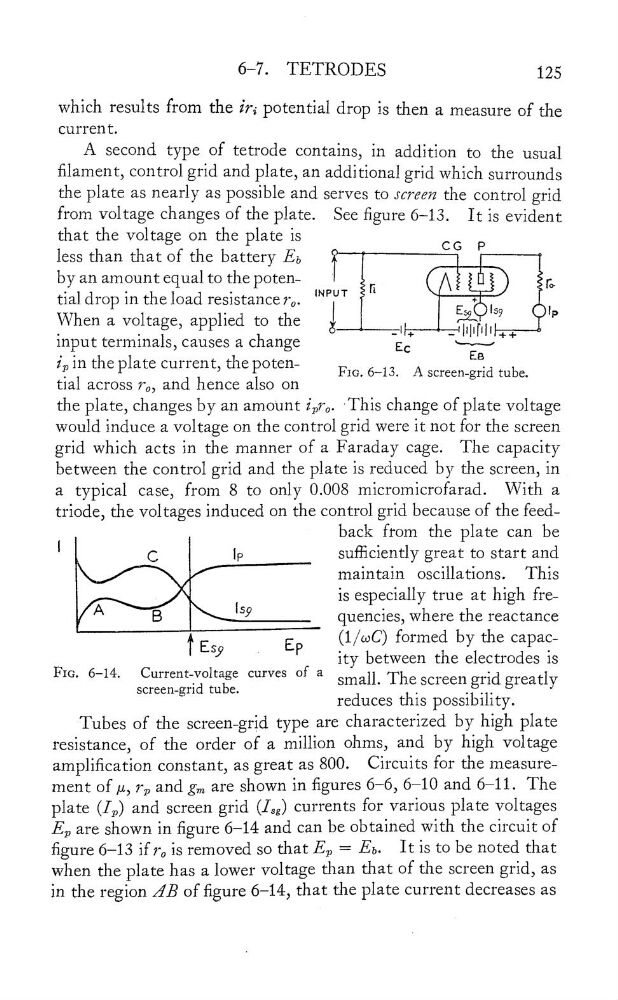
plate
and screen grid ([sg) currents for various plate voltages
E,, are shown in gure 6—14 and can be obtained with the circuit of
gure 6—13 if 70 is removed so that E,) = E5.
It is to be noted that
when the plate has a lower voltage than that of the screen grid, as
in the region 43 of gure 6—14, that the plate current decreases as
.
TETRODES
125
which results from the ir,— potential drop is then a measure of the
current.
A second type of tetrode contains, in addition to the usual
lament, control grid and plate, an additional grid which surrounds
the plate as nearly as possible and serves to screen the control grid
from voltage changes of the plate. See gure 6—13. It is evident
that the voltage on the plate is
CG
P
less than that of the battery Ez,
by an amount equal to the poten'
F
tialdrop in the load resistance ro.
'NPUT
E
+
|
When a voltage, applied to the
'ÏÎ[;|.sÿ
Ip
input terminals, causes a change
—Ec+
'”
i,, in the plate current, the potenF
EB.
IG. 6—13.
A screen—grid tube.
t1al across 7”… and hence also on
the plate, changes by an amo‘unt ipro. This change of plate voltage
would induce a voltage on the control grid were it not for the screen
grid which acts in the manner of a Faraday cage. The capacity
between the control grid and the plate is reduced by the screen, in
a
typical case, from 8 to only 0.008 micromicrofarad. With a
triode, the voltages induced on the control grid because of the feed—
back from the plate can be
'
(:
Ip
su’iciently great to start and
_
maintain oscillations.
This
is especially true at high fre…
quencies, where the reactance
î E3ÿ
EP
_(1/wC)
formed by the capac1ty between the electrodes 18
FIG‘ 6—14‘
£ëËÎ_ËÎËÏÎËÊ
curves
Of a
small. The screen grid greatly
reduces this possibility°
Tubes of the screen-grid type are characterized by high plate
resistance, of the order of a million ohms, and by high voltage
amplication constant, as great as 800. Circuits for the measurement of #, r,, and g… are shown in gures 6—6, 6—10 and 6—11. The
plate
and screen grid ([sg) currents for various plate voltages
E,, are shown in gure 6—14 and can be obtained with the circuit of
gure 6—13 if 70 is removed so that E,) = E5.
It is to be noted that
when the plate has a lower voltage than that of the screen grid, as
in the region 43 of gure 6—14, that the plate current decreases as