

116
6.
HIGH VACUUM, LOW-VOLTAGE TUBES
.
tive as in 3.
In the latter case, electrons are able to escape from
the lament only because of their initial velocities of emission…
The phenomena due to space charges may be shown in another Î !?"
fashion, as in the next section.
6—2.
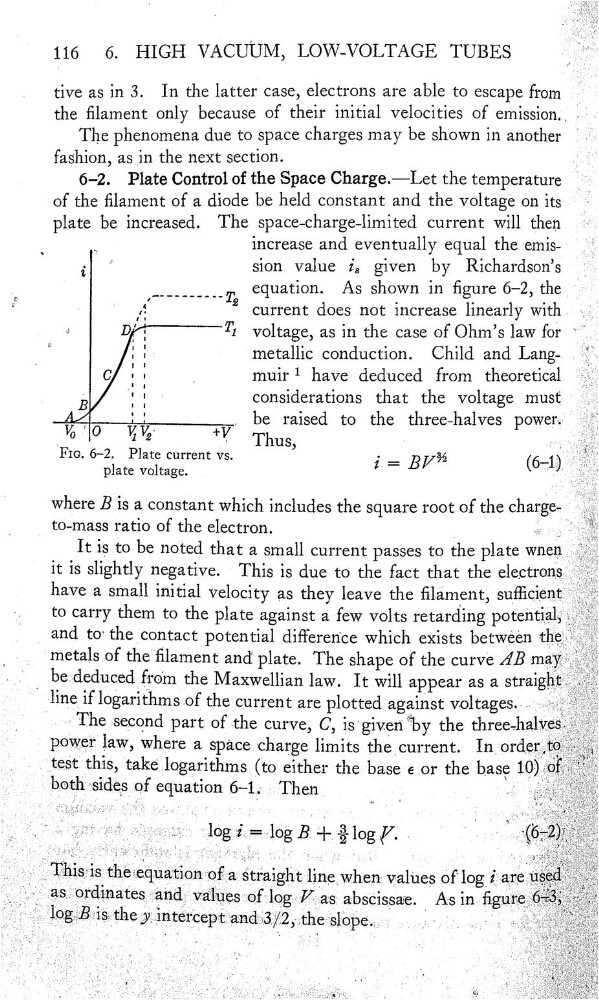
Plate Control of the Space Charge.—Let the temperature
*.
of the lament of a diode be held constant and the voltage on its
plate be increased. The space-charge-limited current will then
_
increase and eventually equal the emis- ‘
,;
sion value is given by Richardson’s
,-—-———--—-T2
equation. As shown in gure 6—2, the
*‘
'
'
current does not increase linearly With…
_
D_' ;
Tz
voltage, as in the case of Ohm’s law for
! i
metallic conduction.
Child and
C
: i
,
muir 1 have deduced from theoretical
3
î
considerations that the voltage must
%
O
VV
+V'
be raised to the three—halves power.»
6—2
Élîte
current vs
Thus,
.
-
3/,
‘
plate voltage.
z : BV
(6—1)
'
where B is a constant which includes the square root of the charge;
_
…
to-mass ratio of the electron.
‘
It is to be noted that a small current passes
to the plate wnen
it is slightly negative. This is due to the fact that the electrons
have a small initial velocity as they leave the làment, suic1ent
to carry them to the plate against a few volts retarding potential,
and to
potential difference which exists between
‘metalg Of the 'lament and“ plate. The shape of the curve ÂB may
.
be…dedueed from the Maxwellian law. It will appear as a stra1ght
…
‘
if logarithms of the current are plotted against voltages.,
The second part of the curve, C;
the three—halVes
,
pOWÇÏ‘ law, where a spàcecharge limits
.
jte…st this, take‘logarithms(to either the base ce or the base
h°thr“8ide_ off equation 6—1ÿ
-
Then.
_
»:
“log
i= »lo'g B +, %— log [/. =
»
.
'
Th1s1s fhèequatlonofa
11ne whenvalues of log zÎ areused
and
’Of 10%
abseîissae.
As in gureô‘3i
Ï
…
.ï ., :
.
_.ï
6.
HIGH VACUUM, LOW-VOLTAGE TUBES
.
tive as in 3.
In the latter case, electrons are able to escape from
the lament only because of their initial velocities of emission…
The phenomena due to space charges may be shown in another Î !?"
fashion, as in the next section.
6—2.
Plate Control of the Space Charge.—Let the temperature
*.
of the lament of a diode be held constant and the voltage on its
plate be increased. The space-charge-limited current will then
_
increase and eventually equal the emis- ‘
,;
sion value is given by Richardson’s
,-—-———--—-T2
equation. As shown in gure 6—2, the
*‘
'
'
current does not increase linearly With…
_
D_' ;
Tz
voltage, as in the case of Ohm’s law for
! i
metallic conduction.
Child and
C
: i
,
muir 1 have deduced from theoretical
3
î
considerations that the voltage must
%
O
VV
+V'
be raised to the three—halves power.»
6—2
Élîte
current vs
Thus,
.
-
3/,
‘
plate voltage.
z : BV
(6—1)
'
where B is a constant which includes the square root of the charge;
_
…
to-mass ratio of the electron.
‘
It is to be noted that a small current passes
to the plate wnen
it is slightly negative. This is due to the fact that the electrons
have a small initial velocity as they leave the làment, suic1ent
to carry them to the plate against a few volts retarding potential,
and to
potential difference which exists between
‘metalg Of the 'lament and“ plate. The shape of the curve ÂB may
.
be…dedueed from the Maxwellian law. It will appear as a stra1ght
…
‘
if logarithms of the current are plotted against voltages.,
The second part of the curve, C;
the three—halVes
,
pOWÇÏ‘ law, where a spàcecharge limits
.
jte…st this, take‘logarithms(to either the base ce or the base
h°thr“8ide_ off equation 6—1ÿ
-
Then.
_
»:
“log
i= »lo'g B +, %— log [/. =
»
.
'
Th1s1s fhèequatlonofa
11ne whenvalues of log zÎ areused
and
’Of 10%
abseîissae.
As in gureô‘3i
Ï
…
.ï ., :
.
_.ï