

5—7.
FIELD EMISSION
111
combined lament at1100° K. will give 30 milliamperes output per
watt input. It is to be understood that these are only approximate
gures and that other factors such as life and durability of the
coating must be considered in choosing a lament.
5—7.
Field Emission—If the voltage on the plate of a twoelectrode vacuum tube or diode is very great, the current which
passes through the tube will be found to be noticeably greater than
‘
that given by Richardson’s equation. The electric eld between
the plate and the lament
the number of electrons Which
can escape from the lament at a given temperature. This
called eld emission is very small at the “usual voltages used With
ordinary vacuum tubes but may become greater. than the thermionic emission when high eld intensities are used. According to
the the0ry developed by Schottky,12 there are two forces acting
simultaneously on an electron as it attempts to escape from the
metal.
First, there is an opposing force set up as an electron
rises above the surface which is due to an equal but oppositely
charged “image” electron induced in the metal and second, there
is an attracting force due to the electrostatic eld of the plate
potential.
Electrons which escape must have sufcient energy
that, aided by the attracting force, they can overcome the oppos—
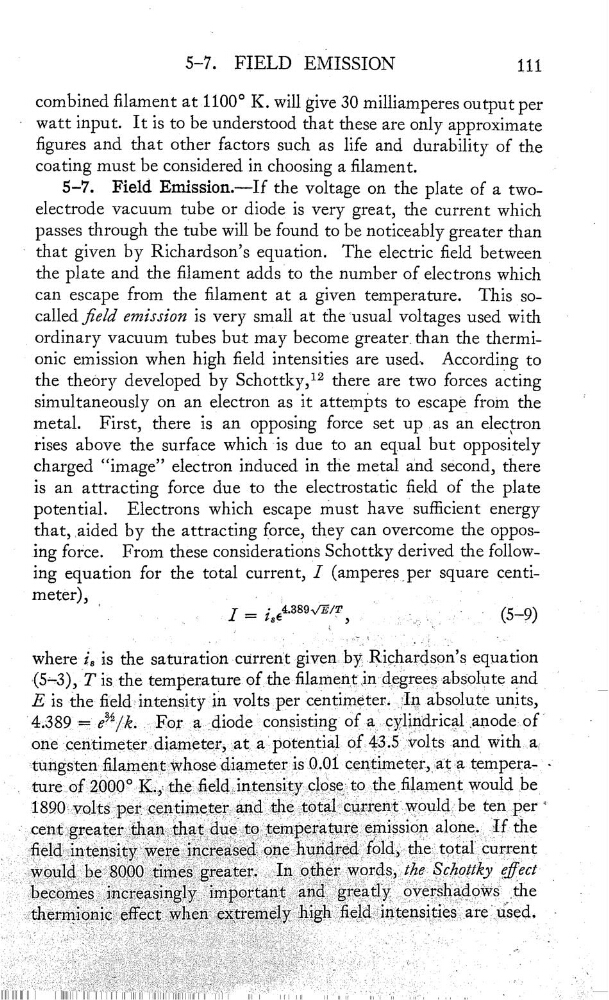
ing force. From these considerations Schottky derived the following equation for the total current, [ (amperesper square centimeter) ,
,
,
_
'
»
_
I :
(5_9)
where i3 is the satu’rationœrrent given…‘by .Richardson’s equation
(S'—3) , T is the temperature of the
and
_
E is the eld.—intensity'in voltsper
absolute units,
4.389 :
For
consisting of
'
'
one
potential…
With a
'
diamÇtüï .iSÇQ.OI centim<æter,;ëät tempera— —‘
.
would be
.
1890voltspercentlmeterandth€t0talcurrentWOUIdbe
_
centgreaterthanthatdueœtemperamœ
em18310n al°n‘îi—a elf the
‘
…
,
wouldbe8®0tlmesgreaærIn0ærwordeheSvh0ky £Æ66f
_
'
beœmesIncreasmglÿlmpœtantandgreadY°VfshadOW—9the
»
‘
…“
.
.
-=
FIELD EMISSION
111
combined lament at1100° K. will give 30 milliamperes output per
watt input. It is to be understood that these are only approximate
gures and that other factors such as life and durability of the
coating must be considered in choosing a lament.
5—7.
Field Emission—If the voltage on the plate of a twoelectrode vacuum tube or diode is very great, the current which
passes through the tube will be found to be noticeably greater than
‘
that given by Richardson’s equation. The electric eld between
the plate and the lament
the number of electrons Which
can escape from the lament at a given temperature. This
called eld emission is very small at the “usual voltages used With
ordinary vacuum tubes but may become greater. than the thermionic emission when high eld intensities are used. According to
the the0ry developed by Schottky,12 there are two forces acting
simultaneously on an electron as it attempts to escape from the
metal.
First, there is an opposing force set up as an electron
rises above the surface which is due to an equal but oppositely
charged “image” electron induced in the metal and second, there
is an attracting force due to the electrostatic eld of the plate
potential.
Electrons which escape must have sufcient energy
that, aided by the attracting force, they can overcome the oppos—
ing force. From these considerations Schottky derived the following equation for the total current, [ (amperesper square centimeter) ,
,
,
_
'
»
_
I :
(5_9)
where i3 is the satu’rationœrrent given…‘by .Richardson’s equation
(S'—3) , T is the temperature of the
and
_
E is the eld.—intensity'in voltsper
absolute units,
4.389 :
For
consisting of
'
'
one
potential…
With a
'
diamÇtüï .iSÇQ.OI centim<æter,;ëät tempera— —‘
.
would be
.
1890voltspercentlmeterandth€t0talcurrentWOUIdbe
_
centgreaterthanthatdueœtemperamœ
em18310n al°n‘îi—a elf the
‘
…
,
wouldbe8®0tlmesgreaærIn0ærwordeheSvh0ky £Æ66f
_
'
beœmesIncreasmglÿlmpœtantandgreadY°VfshadOW—9the
»
‘
…“
.
.
-=