

108
s.
THERMIONIC EMISSION
needed to interpret the experimental values of Â.
It is to be
remembered, however, that Â, as well as qi), is a constant for a given
surface.
In his rst derivation, Richardson assumed that the number of
free electrons per
cubic centimeter inside the metal was
dent of the temperature and obtained an equation containing \/Α
.
instead of T2.
This is a question as to the number of “free” elec— ,
trous per
atom in the metal, i.e., of the binding forces between the
semi-free electrons and ”the atoms.
Later, Richardson assumed
that the number of free electrons increased as the three—halves
power
of the absolute temperature and arrived at the T2 form of
the equation. Dushman also derived the T2 form from thermo—
dynamic rather than kinetic theory considerations.
However,
theeFfect of T in the exponent of equation 5—3 so greatly over-,
shadows’the effect of \/Î or ‘T2 in determining the value of is that
it has not yet been found possible to determine experimentallly
which is correct.
In testing Richardson’s equation (experiment
5—1) the student may verify this for himself.
In view"of the
successes of the Fermi-Dirac law (which gives T2), the Dushman
form with T2 is preferred.
,
,
5—5.
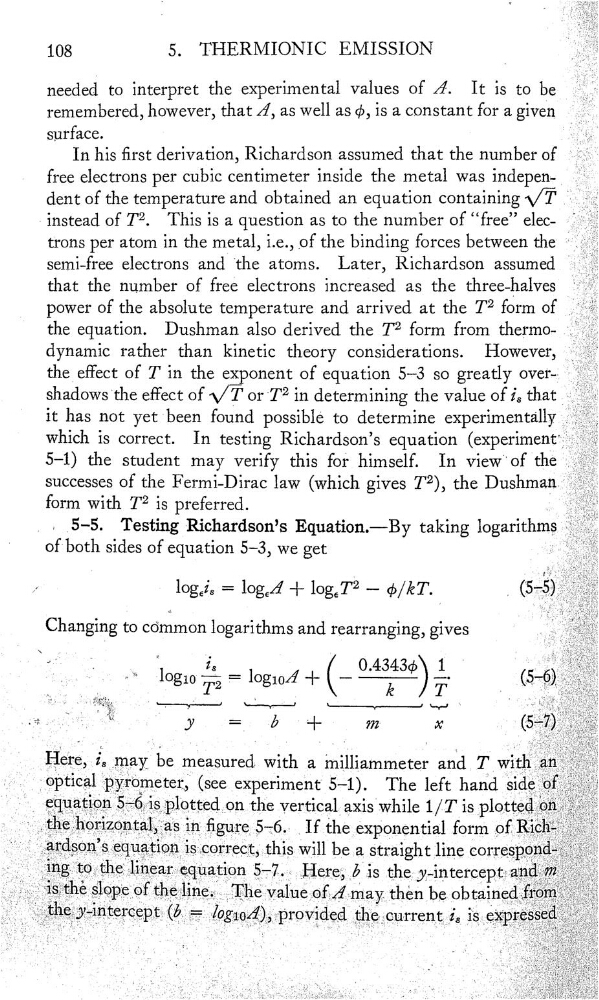
Testing Richardson’s Equation.—By taking logarithms
'
ofboth sides of equation 5—3, we get
à
Changing to cômmon logarithms and rearranging, gives
'
_Here, is_may
be measured with a irlliammeter and TW1than
siii—
opt1calpyrometer, (see experiment 5—1). The left hand Sld<30f
*
equatlon5‘613P10tted0nthe vertical
1/T is plottedon
f
”jthehr10ntalaslgu
1fthe exponential form ofRmh
1ngtothe hneaf€quatl°n 5—7
: Here; & is the y_Ànterceptg andm
s.
THERMIONIC EMISSION
needed to interpret the experimental values of Â.
It is to be
remembered, however, that Â, as well as qi), is a constant for a given
surface.
In his rst derivation, Richardson assumed that the number of
free electrons per
cubic centimeter inside the metal was
dent of the temperature and obtained an equation containing \/Α
.
instead of T2.
This is a question as to the number of “free” elec— ,
trous per
atom in the metal, i.e., of the binding forces between the
semi-free electrons and ”the atoms.
Later, Richardson assumed
that the number of free electrons increased as the three—halves
power
of the absolute temperature and arrived at the T2 form of
the equation. Dushman also derived the T2 form from thermo—
dynamic rather than kinetic theory considerations.
However,
theeFfect of T in the exponent of equation 5—3 so greatly over-,
shadows’the effect of \/Î or ‘T2 in determining the value of is that
it has not yet been found possible to determine experimentallly
which is correct.
In testing Richardson’s equation (experiment
5—1) the student may verify this for himself.
In view"of the
successes of the Fermi-Dirac law (which gives T2), the Dushman
form with T2 is preferred.
,
,
5—5.
Testing Richardson’s Equation.—By taking logarithms
'
ofboth sides of equation 5—3, we get
à
Changing to cômmon logarithms and rearranging, gives
'
_Here, is_may
be measured with a irlliammeter and TW1than
siii—
opt1calpyrometer, (see experiment 5—1). The left hand Sld<30f
*
equatlon5‘613P10tted0nthe vertical
1/T is plottedon
f
”jthehr10ntalaslgu
1fthe exponential form ofRmh
1ngtothe hneaf€quatl°n 5—7
: Here; & is the y_Ànterceptg andm