

'
'EXPERIMENT 4—4.
(h/e)
97
be covered With black paper or cloth to cut out stray light and the -
experiment carried out in a dark room.
'
'
The photo-tube C may be a G—M 71AV, With the base removed.
The glass is carefully cleaned With alcohol or ether and paraîned
around the base. The bottom of the tube and all leads are carefully
insulated; clean parain proving satisfactory. In (6) of gure 4—16,
the electrometer, E, should have a sensitivity of 100—800 milli—
meters per volt; the current through the high resistance R (about
1010 ohms, S. S._ White Dental resistor), is approximately 10“13
amperes, minimum. The protective resistance, R1, may be 10,000
ohms; the needle voltage on a Dolezalek type electrometer, 180
volts.
Use only direct current for the light of the electrometer:
a.c. induces uctuating currents in the electrometer circuits which
.
‘
are rectied by thehon—linear character of the foot of the photo'
current—voltage curves,_and contribute false d.c. currents. Let the
electrometer readings reach a steady value before recording the
deections. R2 is a 1200 ohm slide wire rheostat; the battery across
it is a bank of two or three dry cells. The voltmeter V:, (0 to 1.5 or 3
volts) should have a scale Which may be read in intervals of 0.02
"
volts or less.
_
_
-
Experimènt.+Adjust the electrometer and plot its calibration
curve; i.e.,
w. quadrant voltages, With a xed needle
potential. Readjust_ the instrument if this is not a straight line ‘
over an appreciable range of the scale, say 0 to 10 centimeters.
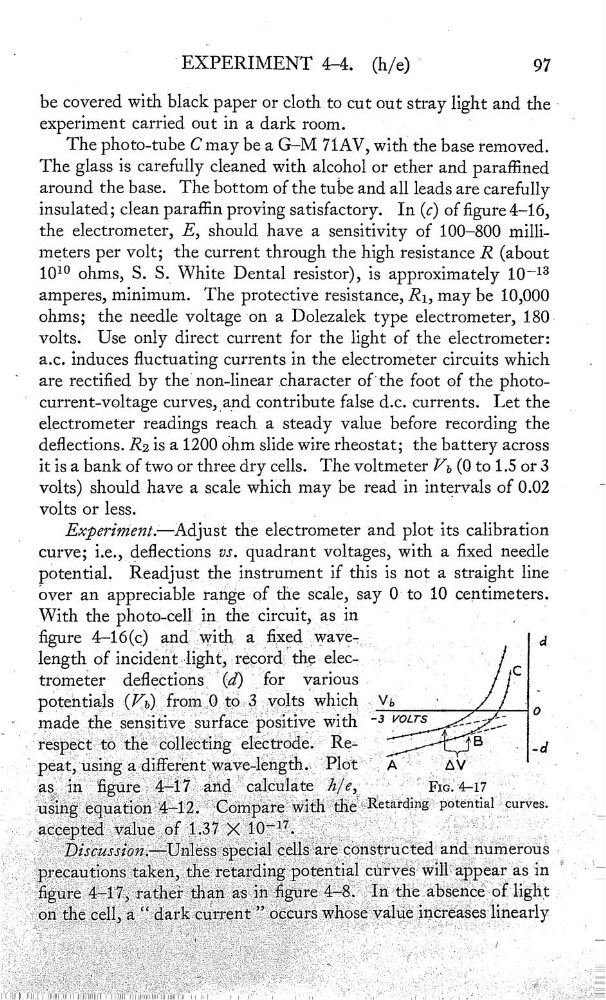
With the photo-cell in thè“ciréuit, ’asin
'
,
gure 4—16(c) andw1th
_
@.
of inCident;—light,
elec—,
'
'
_
trometer
various .
' _
C
pétchtia1s (%)—{fromlot03YP.1tS which —: VB"
‘
'
"
made, thes€n81tlve fÿ,Süî“f aœ Ïîf5@siç3ÿç With
'3 f’°”s E—,<::£—
,
acceptedvalueof137X10“”
‘
Precaut10nstakentheretard1ngp<3tenüalcurveSWI“appearasm
gure4—17ratherthanaSïnguœ4—8Intheabsenœofflihî
@ntheœadarkcurrentOccurswhosevaluemcreasemeaÿ
'EXPERIMENT 4—4.
(h/e)
97
be covered With black paper or cloth to cut out stray light and the -
experiment carried out in a dark room.
'
'
The photo-tube C may be a G—M 71AV, With the base removed.
The glass is carefully cleaned With alcohol or ether and paraîned
around the base. The bottom of the tube and all leads are carefully
insulated; clean parain proving satisfactory. In (6) of gure 4—16,
the electrometer, E, should have a sensitivity of 100—800 milli—
meters per volt; the current through the high resistance R (about
1010 ohms, S. S._ White Dental resistor), is approximately 10“13
amperes, minimum. The protective resistance, R1, may be 10,000
ohms; the needle voltage on a Dolezalek type electrometer, 180
volts.
Use only direct current for the light of the electrometer:
a.c. induces uctuating currents in the electrometer circuits which
.
‘
are rectied by thehon—linear character of the foot of the photo'
current—voltage curves,_and contribute false d.c. currents. Let the
electrometer readings reach a steady value before recording the
deections. R2 is a 1200 ohm slide wire rheostat; the battery across
it is a bank of two or three dry cells. The voltmeter V:, (0 to 1.5 or 3
volts) should have a scale Which may be read in intervals of 0.02
"
volts or less.
_
_
-
Experimènt.+Adjust the electrometer and plot its calibration
curve; i.e.,
w. quadrant voltages, With a xed needle
potential. Readjust_ the instrument if this is not a straight line ‘
over an appreciable range of the scale, say 0 to 10 centimeters.
With the photo-cell in thè“ciréuit, ’asin
'
,
gure 4—16(c) andw1th
_
@.
of inCident;—light,
elec—,
'
'
_
trometer
various .
' _
C
pétchtia1s (%)—{fromlot03YP.1tS which —: VB"
‘
'
"
made, thes€n81tlve fÿ,Süî“f aœ Ïîf5@siç3ÿç With
'3 f’°”s E—,<::£—
,
acceptedvalueof137X10“”
‘
Precaut10nstakentheretard1ngp<3tenüalcurveSWI“appearasm
gure4—17ratherthanaSïnguœ4—8Intheabsenœofflihî
@ntheœadarkcurrentOccurswhosevaluemcreasemeaÿ