

THE SEA BOTTOM
'
63
found
here,
also
the
common
brittlestar, Ophioconia
(Plate 24), and many starsh such as Astérias_î mbens,‘_and
A. glaciàlâs, ‘a related larger, grey species, …=_though these
latter wander far in the pursuit'of food,
In cracks and
holes live the sea gherkins, their whitish bodies hidden, and
only the tentacles exposed. There isthe usual abundance
of crustacéans, such as the lobster (Plate 113), and many
_
crabs, including the edible species and several spider crabs
_
(e.g. Inachus, Hyas, M acropodia) Which have delicate
limbs and disguise themselves with pieces of weed fastened
to
small books on the
,
shell, and so survive in
.
‘
-
spite of their weakness.
-
'
Prawns of various kinds
.
are
always to be found
'
:
among rocks.
_
'
Burrowing animals are
'
the characteristic mem—
bers of the sandy—bottom
.
fauna.
The burrowing
‘
,
.
_
“'Â;—.__
.
bivalves
too numer—
-
—
°'——,=_e.
ous
to
mention.
The
_
,
_:, ,
’
common cockle is never
‘
found,
but
the
spiny
'
""
-
_
'
cockle—a larg'er species
ASta£siÏ
(x })L
with its
shell
covered
.
,
_
.
,—
with powerful spines, the better to enable it to grip the
sandy gravel—tak6sitsplace. . Associated With the bivalves
are carnivorous snails. which bore into and-feed upon them;
.
(Plate 20)
and Spatangu's, and the little heart—urchin, Behinocyamus,
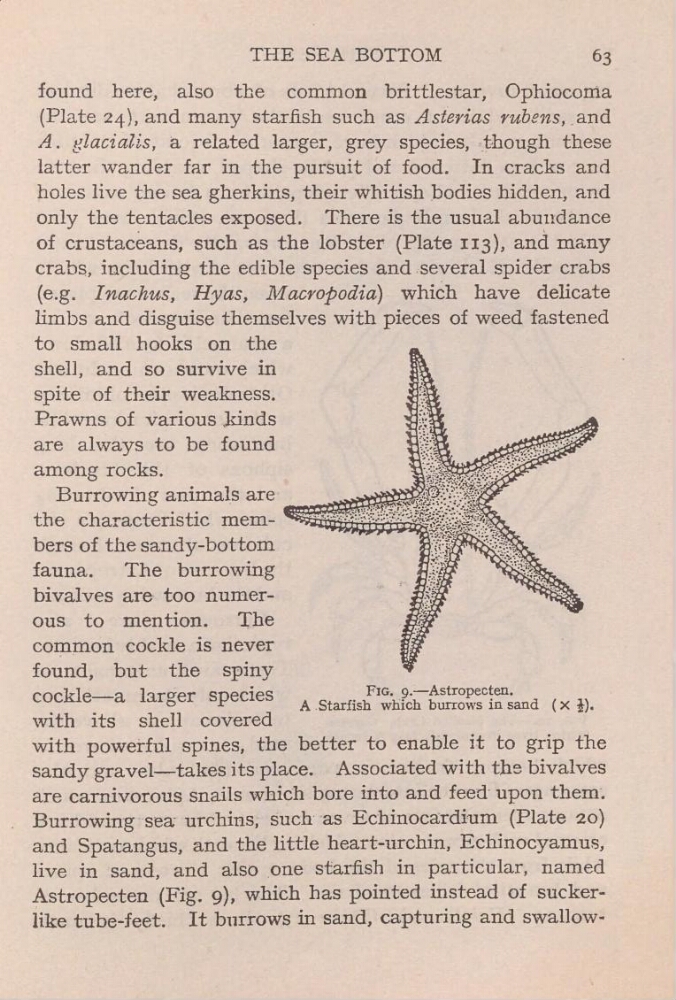
live in sand, 'and also _one starshin particular, named
Astropecten (Fig. 9), WhiCh has pointed instead of suckerlike tube-Îeet.
It biirrows in sand, capturing and swallOwà
'
63
found
here,
also
the
common
brittlestar, Ophioconia
(Plate 24), and many starsh such as Astérias_î mbens,‘_and
A. glaciàlâs, ‘a related larger, grey species, …=_though these
latter wander far in the pursuit'of food,
In cracks and
holes live the sea gherkins, their whitish bodies hidden, and
only the tentacles exposed. There isthe usual abundance
of crustacéans, such as the lobster (Plate 113), and many
_
crabs, including the edible species and several spider crabs
_
(e.g. Inachus, Hyas, M acropodia) Which have delicate
limbs and disguise themselves with pieces of weed fastened
to
small books on the
,
shell, and so survive in
.
‘
-
spite of their weakness.
-
'
Prawns of various kinds
.
are
always to be found
'
:
among rocks.
_
'
Burrowing animals are
'
the characteristic mem—
bers of the sandy—bottom
.
fauna.
The burrowing
‘
,
.
_
“'Â;—.__
.
bivalves
too numer—
-
—
°'——,=_e.
ous
to
mention.
The
_
,
_:, ,
’
common cockle is never
‘
found,
but
the
spiny
'
""
-
_
'
cockle—a larg'er species
ASta£siÏ
(x })L
with its
shell
covered
.
,
_
.
,—
with powerful spines, the better to enable it to grip the
sandy gravel—tak6sitsplace. . Associated With the bivalves
are carnivorous snails. which bore into and-feed upon them;
.
(Plate 20)
and Spatangu's, and the little heart—urchin, Behinocyamus,
live in sand, 'and also _one starshin particular, named
Astropecten (Fig. 9), WhiCh has pointed instead of suckerlike tube-Îeet.
It biirrows in sand, capturing and swallOwà