

THE SEA BOTTOM
'
61
of tangled Laminària (Plate 22), a large population lives
attached to the weed, among the most common of which
sea mats especially Membranipom membmnaaea (Plate 22)
which forms a delicate latticed.'encrustation with typical
rounded _outlines where the colony is activ‘ely growing
over the surface of the frond.
Many hydroids are found,
'
their branching stolons— ramifying over the
the
branches bearing the feedingPolyps projecting—.freely into
the water.
A little limpet (N acella ÿellucz‘da); distinguighed
by the blue Stripes on its shell, is invariably found browsing
on
the
bulbous hold-fasts of the Lamin‘aria. A great
assemblage of animals nd a home in this region, many of
them so small as not to be discovered without great‘care ;
-
o‘f‘f'.
\g/"‘- \
‘
'
( “‘—\
'
î
.
.
.
\…
-
,
.
r
\I ‘
'
\
:
—
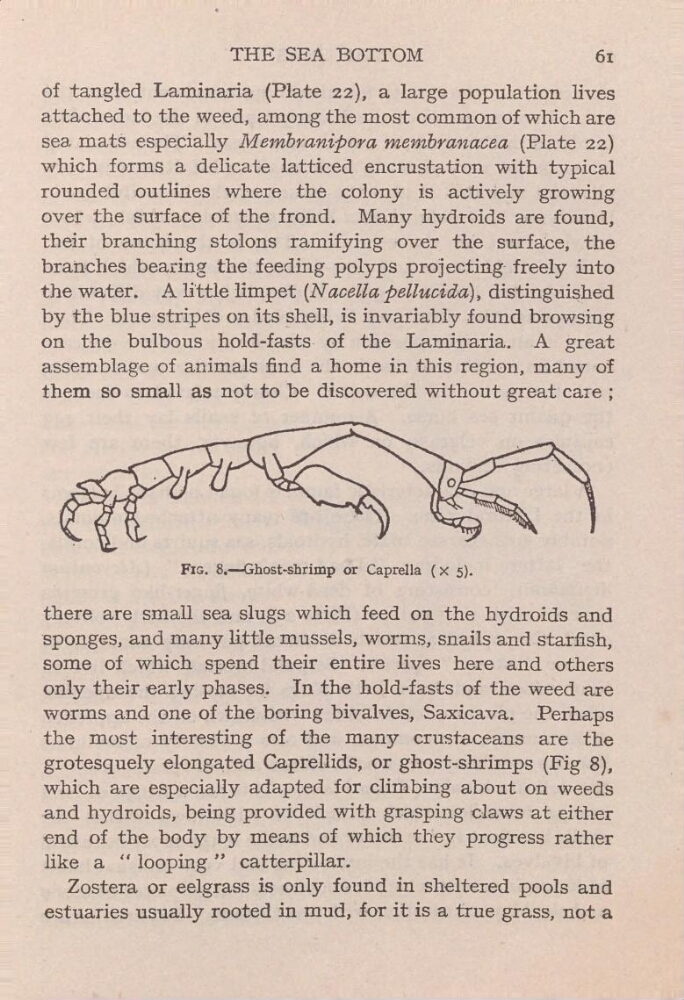
Frs. 8.—-Ghost-shrimp or Caprella (x 5).
_
there are small sea slugs which feed on the hydroids and
.
sponges, and many little mussels, worms, snails andstatsh,
some
of which spend their entire lives here and others
only their early phases,
In the hold—fasts of the weed are
worms
one of the.boring.bivalves, Saxicava.
Perhaps
'
the most interesting of the many crustaceans are the
grotesquely elongated Caprellids, or ghost—shrimps (Fig 8),
_
which are especially adapted for climbing about on weeds
_
and hydroids,. being provided with grasping claws at either
end of the body by means of which they. progress rather
_
like a “ looping.” catterpillar.
5
,
‘
Zostera or eelgrass is only found in
pools and
estuaries usually rooted in mud, for it is a true
not a.
'
61
of tangled Laminària (Plate 22), a large population lives
attached to the weed, among the most common of which
sea mats especially Membranipom membmnaaea (Plate 22)
which forms a delicate latticed.'encrustation with typical
rounded _outlines where the colony is activ‘ely growing
over the surface of the frond.
Many hydroids are found,
'
their branching stolons— ramifying over the
the
branches bearing the feedingPolyps projecting—.freely into
the water.
A little limpet (N acella ÿellucz‘da); distinguighed
by the blue Stripes on its shell, is invariably found browsing
on
the
bulbous hold-fasts of the Lamin‘aria. A great
assemblage of animals nd a home in this region, many of
them so small as not to be discovered without great‘care ;
-
o‘f‘f'.
\g/"‘- \
‘
'
( “‘—\
'
î
.
.
.
\…
-
,
.
r
\I ‘
'
\
:
—
Frs. 8.—-Ghost-shrimp or Caprella (x 5).
_
there are small sea slugs which feed on the hydroids and
.
sponges, and many little mussels, worms, snails andstatsh,
some
of which spend their entire lives here and others
only their early phases,
In the hold—fasts of the weed are
worms
one of the.boring.bivalves, Saxicava.
Perhaps
'
the most interesting of the many crustaceans are the
grotesquely elongated Caprellids, or ghost—shrimps (Fig 8),
_
which are especially adapted for climbing about on weeds
_
and hydroids,. being provided with grasping claws at either
end of the body by means of which they. progress rather
_
like a “ looping.” catterpillar.
5
,
‘
Zostera or eelgrass is only found in
pools and
estuaries usually rooted in mud, for it is a true
not a.