

48
THE SEAS
-
'
-
’
outthe tail or hind end of the body.. Periwinkles, whelks
and all their allies really“ glide oV‘er.the Surface, waves of
_
movement pasSing’over the broad at Α sole ” of the large
eshy
“
foot.”
Anemones and: atworms glide in a similar
'
manner.. Apart from the sh, many animals swim, the
.
lobsters by sudden movements Of the tail which propei
them quicklybackwards through the water, while many
_
worms are able to sw'mi to a greater or less extent by undulatory movements of the long body, some, most highly
specialised, having paddle-‘like aps on the side of the body.
Mention will be -made of the swimming crabs and of the
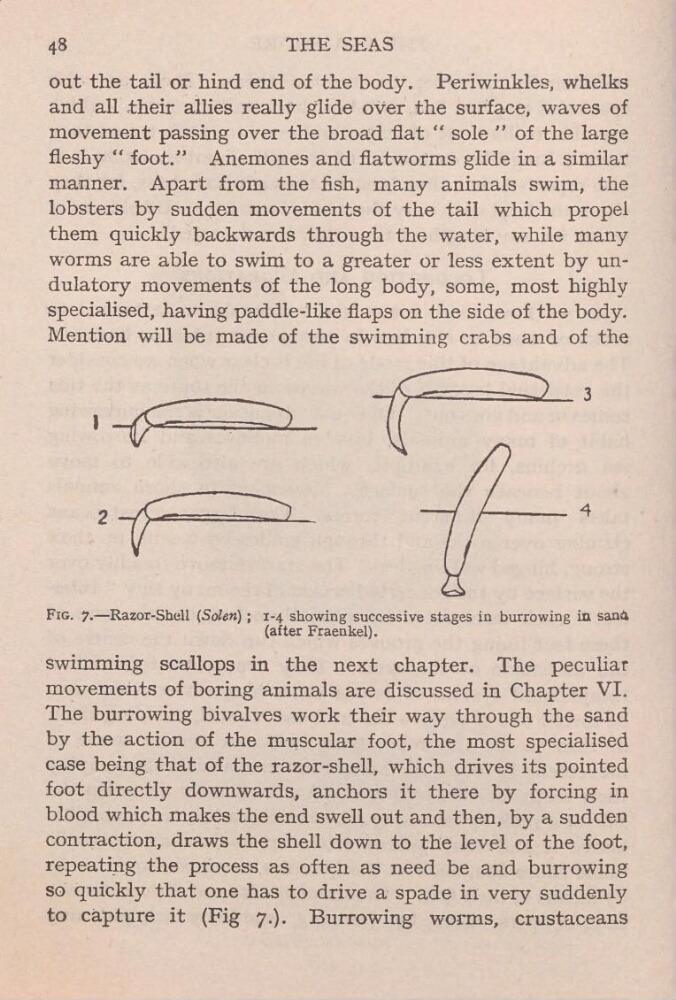
FîG. 7.—Razor-Shell (Solen) ; 1—4 showing successive stages in burrowing in sanû
.
_
-
(afterFraenkel).
.
Swimming scallops
the next chapter.
The peculiar
movements of boring animals are discussed in Chapter VI.
The burrowing bivalves work their way through the sand
by the action of the muscular foot, the most Specialised
that of- the razer—shell, which drives its pointed
"
foot directly downwards, anC‘hors it there by forcing in
blood which makes the end swell out and then, by a sudden‘
»
contraction, draws the shell down to the level of the foot,
repea_ng the process as often as need” be and burrowing
"
_
so quickly that one has to drive a spade in very Suddenly
…
to Capture it (Fig
Burrowing worms, ; crustaceans
THE SEAS
-
'
-
’
outthe tail or hind end of the body.. Periwinkles, whelks
and all their allies really“ glide oV‘er.the Surface, waves of
_
movement pasSing’over the broad at Α sole ” of the large
eshy
“
foot.”
Anemones and: atworms glide in a similar
'
manner.. Apart from the sh, many animals swim, the
.
lobsters by sudden movements Of the tail which propei
them quicklybackwards through the water, while many
_
worms are able to sw'mi to a greater or less extent by undulatory movements of the long body, some, most highly
specialised, having paddle-‘like aps on the side of the body.
Mention will be -made of the swimming crabs and of the
FîG. 7.—Razor-Shell (Solen) ; 1—4 showing successive stages in burrowing in sanû
.
_
-
(afterFraenkel).
.
Swimming scallops
the next chapter.
The peculiar
movements of boring animals are discussed in Chapter VI.
The burrowing bivalves work their way through the sand
by the action of the muscular foot, the most Specialised
that of- the razer—shell, which drives its pointed
"
foot directly downwards, anC‘hors it there by forcing in
blood which makes the end swell out and then, by a sudden‘
»
contraction, draws the shell down to the level of the foot,
repea_ng the process as often as need” be and burrowing
"
_
so quickly that one has to drive a spade in very Suddenly
…
to Capture it (Fig
Burrowing worms, ; crustaceans