

THE SHELLFISH. INDUSTRY
299
surface, on which
oysters are laid, is kept clean and'
free from the ubiquit0us crabe and starsh, the" oyster
cultivator’s greatest enemies. “In the early summer the
qollectors (Plate 107) are arranged in preparation for the
spat which will appear. as soon as thewater becomes
enough for the oysters to start breeding, and in-preparation
for this the tiles are scraped clean and relimed, and later
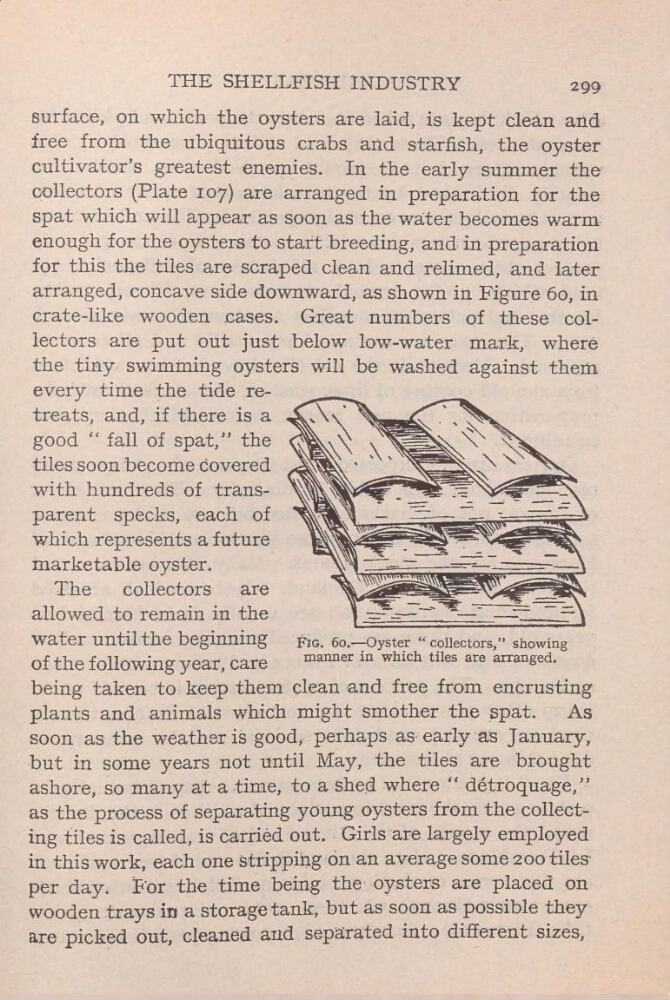
arranged, concave side downward, as shown in Figure 60, in
crate—like wooden cases.
Great numbers
of these collectors are put out just below low—water mark, where
the tiny swimming oysters will be washed against them
every time the. tide're—
.
"
-
,
'
treats, and, if thereis a _\
=
good
“
fall of spat,” the
\—_
È
__
tiles soon become Covered
.\=\“L
î—:—,—\
_
With hundreds of trans,
\\
parent - specks,: each of
\
_
_
__
.
=
which represents a future
marketable oyster.
,
__
_
_
'.
The
collectors
are
.
.
‘\\Ë
—
allowed to remain in the
‘
_
water until the beginning - -‘ FiG. 60Ç-—Oystér “Îcollectors,” showing
Of the following year, care
_
___—manner _in which tiles are arranged._
'
being taken to keep»therr1 clean and free from encrusting
_
plants and animals which might smother the spat.
_
As
soon as the Weather iS'good,-.perhaps as- early*a‘s January,
but in some years
not until May, the tiles are brought
so many at a time, toa she_d where “
détroquage,”
as the process of separating y0ung oysters from the collect— .
ing tiles is called, is carried out. « Girls=‘are largely employed
in this work, each one "strippihgdn an average 50me zoo tiles
.
day.
areplaced
on
_
w00den .trays in a storagetank, but as_ soon
as _posslble they
are picked out, cleaned and Sep'a‘ra‘ted mto d1”_erent sizes,'
299
surface, on which
oysters are laid, is kept clean and'
free from the ubiquit0us crabe and starsh, the" oyster
cultivator’s greatest enemies. “In the early summer the
qollectors (Plate 107) are arranged in preparation for the
spat which will appear. as soon as thewater becomes
enough for the oysters to start breeding, and in-preparation
for this the tiles are scraped clean and relimed, and later
arranged, concave side downward, as shown in Figure 60, in
crate—like wooden cases.
Great numbers
of these collectors are put out just below low—water mark, where
the tiny swimming oysters will be washed against them
every time the. tide're—
.
"
-
,
'
treats, and, if thereis a _\
=
good
“
fall of spat,” the
\—_
È
__
tiles soon become Covered
.\=\“L
î—:—,—\
_
With hundreds of trans,
\\
parent - specks,: each of
\
_
_
__
.
=
which represents a future
marketable oyster.
,
__
_
_
'.
The
collectors
are
.
.
‘\\Ë
—
allowed to remain in the
‘
_
water until the beginning - -‘ FiG. 60Ç-—Oystér “Îcollectors,” showing
Of the following year, care
_
___—manner _in which tiles are arranged._
'
being taken to keep»therr1 clean and free from encrusting
_
plants and animals which might smother the spat.
_
As
soon as the Weather iS'good,-.perhaps as- early*a‘s January,
but in some years
not until May, the tiles are brought
so many at a time, toa she_d where “
détroquage,”
as the process of separating y0ung oysters from the collect— .
ing tiles is called, is carried out. « Girls=‘are largely employed
in this work, each one "strippihgdn an average 50me zoo tiles
.
day.
areplaced
on
_
w00den .trays in a storagetank, but as_ soon
as _posslble they
are picked out, cleaned and Sep'a‘ra‘ted mto d1”_erent sizes,'