

METHODS OF OCEANOGRAPHICAL RESEARCH 255
-.
introduction of submarine telègraphy a study of the
contours of the bottom at all depths became necessary
'
for the laying of thegreat transoceaniCcables.
'
In shallow water the usual method is to heave. overboard
alead weight attached to a length of rope whi‘chis'marked
o at intervals with pieces of leather'and other materials
to indicate. the depth in fathoms.
The lead " weight is
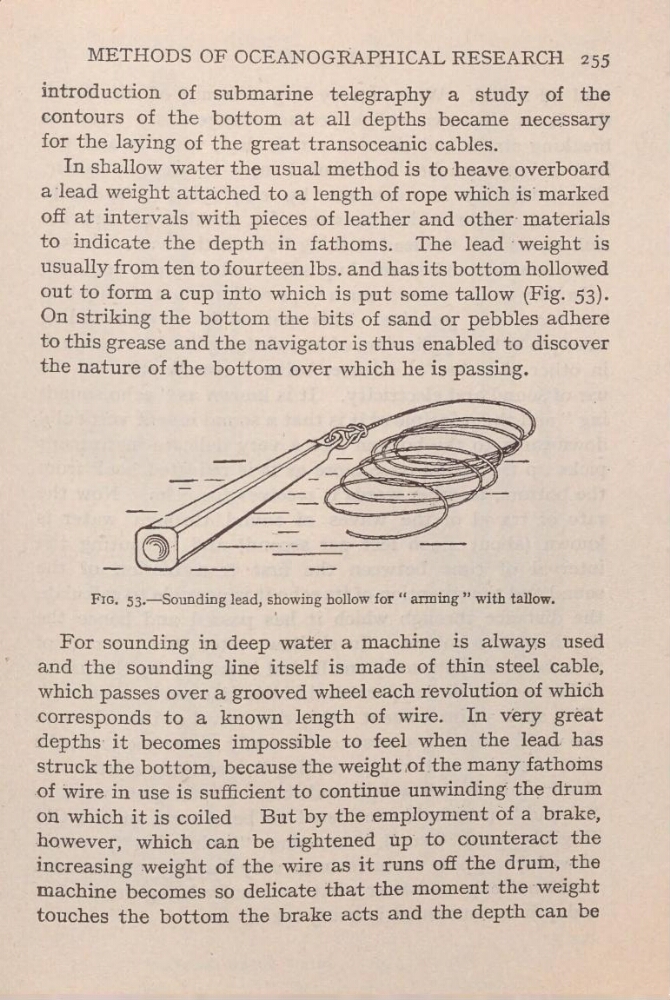
usually from ten to iourteen lbs. and has its bottom hollowed
out to_form a cup into which is put some tallow (Fig. 53).
On 'striking the bottom the bits” of sand ofpebbles adhere
to this grease and the navigator is thus enabled to discover
the nature of the bottom over which he is passing.
a>»
-
—
«
“T:“
'
:
__
/l *=—— ___—-— ; f——
,
_
'
FIG. 5 3.—Sounding lead, showing hollow for “ arming ” with tauow.
'
,
For sounding in deep water & machine is always used
and the sounding line itselfis made of thin steel cable,
Which passes over a grooved wheel each r‘evolution
of whiCh
_
corresponds to a known length of wire; ‘In—v‘ery great
LdÔPthS' it becomes impossible:to feel when the
has
_,
struck the bottom, because the weight ;of ;the many;iathoms
_
of Wire in use is sufcient-to continue unwinding the drum
on which it is coiled
.,
But by the employmèntbf' a:
however, which can 'be tightened up
COUHË€T&Ct the
_
.
increasing weight of the wire as it runs o the drum, the
machine becomes so delicate thatthe moment—theiweight
‘
touches the bottom the brake acts and the depth
-.
introduction of submarine telègraphy a study of the
contours of the bottom at all depths became necessary
'
for the laying of thegreat transoceaniCcables.
'
In shallow water the usual method is to heave. overboard
alead weight attached to a length of rope whi‘chis'marked
o at intervals with pieces of leather'and other materials
to indicate. the depth in fathoms.
The lead " weight is
usually from ten to iourteen lbs. and has its bottom hollowed
out to_form a cup into which is put some tallow (Fig. 53).
On 'striking the bottom the bits” of sand ofpebbles adhere
to this grease and the navigator is thus enabled to discover
the nature of the bottom over which he is passing.
a>»
-
—
«
“T:“
'
:
__
/l *=—— ___—-— ; f——
,
_
'
FIG. 5 3.—Sounding lead, showing hollow for “ arming ” with tauow.
'
,
For sounding in deep water & machine is always used
and the sounding line itselfis made of thin steel cable,
Which passes over a grooved wheel each r‘evolution
of whiCh
_
corresponds to a known length of wire; ‘In—v‘ery great
LdÔPthS' it becomes impossible:to feel when the
has
_,
struck the bottom, because the weight ;of ;the many;iathoms
_
of Wire in use is sufcient-to continue unwinding the drum
on which it is coiled
.,
But by the employmèntbf' a:
however, which can 'be tightened up
COUHË€T&Ct the
_
.
increasing weight of the wire as it runs o the drum, the
machine becomes so delicate thatthe moment—theiweight
‘
touches the bottom the brake acts and the depth