

340
'
THE SEAS
'
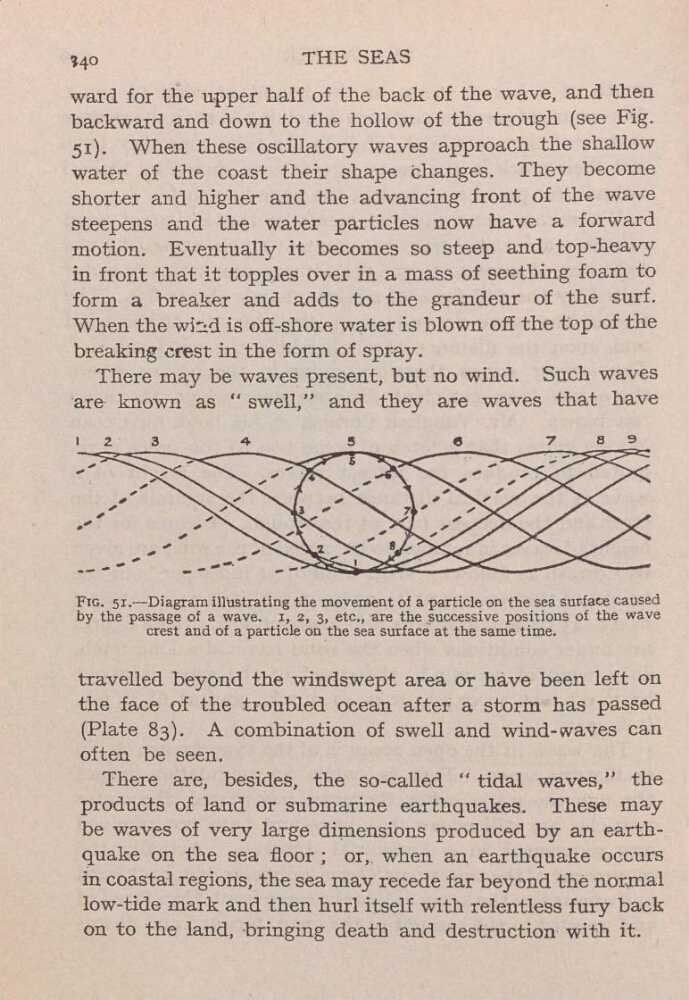
ward for the upper half of the back of the wave, and then
.
backward and down to the hollow of the trough (see Fig.
51).
When these oscillatory waves approach the shallow_
water of the Coast their shape Changes.
They become
'
shorter and higher and the advancing front of the wave
steepens and the water particles now have a forward
motion.
it becomes so steep and top—heavy
in front that it topples over in a»mass of seething foam to
form a breaker and adds to the grandeur of the surf.
When the wind is Off—shore water is blown off the top of the
'
breaking crest in the form of spray.
'
There may be waves present, but rio-wind.
Such waves
"are— known
“
swell,” and they are waves
that have
'
|
2'
3
_
4
.:
a
7
"
Fm.;5r.——Diagram illustrating' the movement of a particle on the-sea surface caused
by the passage of a wave.
I, 2, 3, etc., are the successive positions of the wave
-
crest and of a particle onthe sea surface at the same time. '
-
'
travelled bey0nd the windswept area or have been left on
the face of the troùbled ocean after a“ storm has passed
(Plate 83).
A combination of swell and wind—Waves can
0ften be seen.
'
.
‘
'
_
-
'
-
'There are, be"sides, the so=calléd “
tidal- waves,” the
‘
pr0ducts of
or submarine earthquakes. These may
”be Waves of very large dimensions pr0duced by an earth— »
.
quake onthe sea oor;
when an earthquake Occurs
in coastal
sea may recede far beyond the normal
'
.
low—tide mark and then hùrl itself with relentless fury
on to the land, bringing death and
it.
'
THE SEAS
'
ward for the upper half of the back of the wave, and then
.
backward and down to the hollow of the trough (see Fig.
51).
When these oscillatory waves approach the shallow_
water of the Coast their shape Changes.
They become
'
shorter and higher and the advancing front of the wave
steepens and the water particles now have a forward
motion.
it becomes so steep and top—heavy
in front that it topples over in a»mass of seething foam to
form a breaker and adds to the grandeur of the surf.
When the wind is Off—shore water is blown off the top of the
'
breaking crest in the form of spray.
'
There may be waves present, but rio-wind.
Such waves
"are— known
“
swell,” and they are waves
that have
'
|
2'
3
_
4
.:
a
7
"
Fm.;5r.——Diagram illustrating' the movement of a particle on the-sea surface caused
by the passage of a wave.
I, 2, 3, etc., are the successive positions of the wave
-
crest and of a particle onthe sea surface at the same time. '
-
'
travelled bey0nd the windswept area or have been left on
the face of the troùbled ocean after a“ storm has passed
(Plate 83).
A combination of swell and wind—Waves can
0ften be seen.
'
.
‘
'
_
-
'
-
'There are, be"sides, the so=calléd “
tidal- waves,” the
‘
pr0ducts of
or submarine earthquakes. These may
”be Waves of very large dimensions pr0duced by an earth— »
.
quake onthe sea oor;
when an earthquake Occurs
in coastal
sea may recede far beyond the normal
'
.
low—tide mark and then hùrl itself with relentless fury
on to the land, bringing death and
it.