

230
'_
THE SEAS
it has lost a certain amount of its speed and has widened
out ‘- cohSidérably.
At the same time, coming into less
heated clirr‘res, it has cooled down to a certain extent.
Just near the Labrador coast however a potent force
comes
into
_
play.- Here are vast masses of drifting ice
.
oat‘ing down from polar seas on the cold Labrador currents.
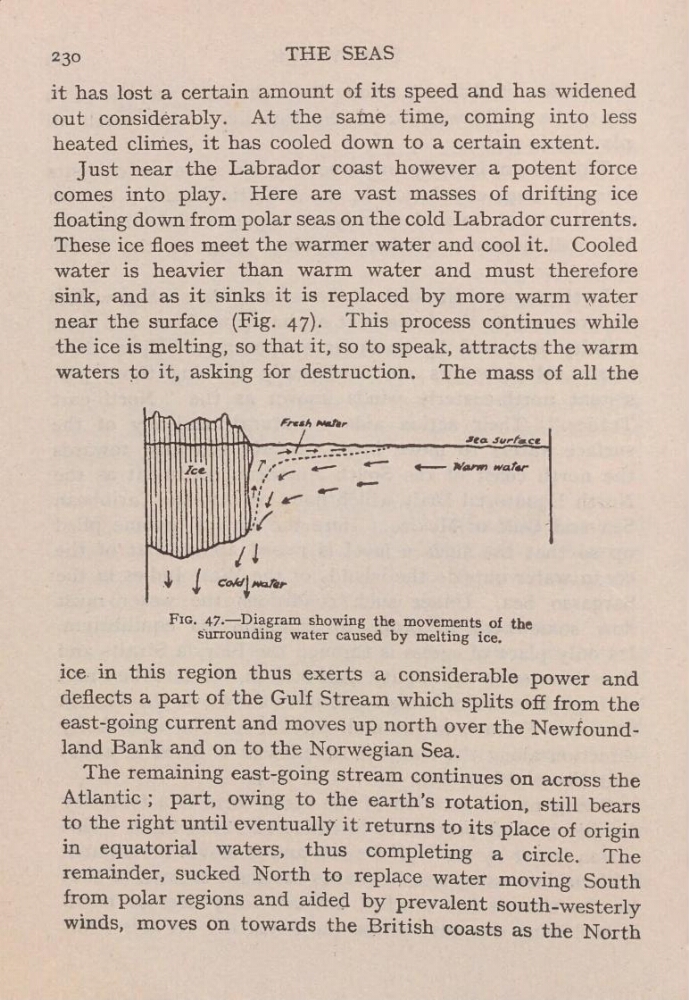
These ice oes meet the warmer water and cool it.
Cooled
water is heavier than warm water and must therefore
sink, and as it 'sinks it is replaced by more warm water
near the surface (Fig.- 47).
This process continues while
the ice is melting, so that it, so to speak, attracts the warm
waters to it, asking for destruction.
The mass of all the
llllllullllllllliu "““j‘;
__
.
=
f
‘ i l
'*
'
.
;/ .
{l
.
—
‘
.
.
'
Frs. 47.—_Diagram showing the movements of the
,
_
_
s‘unound1ng water caused by melting ice.
ice. in this region thus exerts a considerable power and
deects a part of the Gulf Stream which splits o_ from the
»
east-going current arid moves up north over the Newfound—
'
'
land Bank and on to the Norwegian Sea.
,'
,
The remaining east—going stream continues on across the
Atlantic; part,
to the earth’s rotation, .Stillbears
to
the right-_ until—eventuallÿ' it returns to 'its' place of'origin '
1n
waters,
thus
completing a circle.
The
-
.
remainder, ,sucked North to replaCe water moving. South
=
from POÏ&TT€gÏOUS and aided by prevalent sonth-‘Westerly
'
winds, moves on towards the British coasts as the North
'_
THE SEAS
it has lost a certain amount of its speed and has widened
out ‘- cohSidérably.
At the same time, coming into less
heated clirr‘res, it has cooled down to a certain extent.
Just near the Labrador coast however a potent force
comes
into
_
play.- Here are vast masses of drifting ice
.
oat‘ing down from polar seas on the cold Labrador currents.
These ice oes meet the warmer water and cool it.
Cooled
water is heavier than warm water and must therefore
sink, and as it 'sinks it is replaced by more warm water
near the surface (Fig.- 47).
This process continues while
the ice is melting, so that it, so to speak, attracts the warm
waters to it, asking for destruction.
The mass of all the
llllllullllllllliu "““j‘;
__
.
=
f
‘ i l
'*
'
.
;/ .
{l
.
—
‘
.
.
'
Frs. 47.—_Diagram showing the movements of the
,
_
_
s‘unound1ng water caused by melting ice.
ice. in this region thus exerts a considerable power and
deects a part of the Gulf Stream which splits o_ from the
»
east-going current arid moves up north over the Newfound—
'
'
land Bank and on to the Norwegian Sea.
,'
,
The remaining east—going stream continues on across the
Atlantic; part,
to the earth’s rotation, .Stillbears
to
the right-_ until—eventuallÿ' it returns to 'its' place of'origin '
1n
waters,
thus
completing a circle.
The
-
.
remainder, ,sucked North to replaCe water moving. South
=
from POÏ&TT€gÏOUS and aided by prevalent sonth-‘Westerly
'
winds, moves on towards the British coasts as the North