

192
-
'
THE SEAS ‘
’
on to the most highly evolved of the molluscs, the group
Which includes the octopus and cuttlesh,. we nd that
luminous organs are both common and in the highest degree
elaborate, especially in the squids which swi_m near the
_
__
___
.
' _
_
_
surface
and
.
sometimes
in
1
‘
-__'._… those from deeper
water
..
/ \," _Ÿi'/Î
(Plate 74).
The octopus and
-
__
__
its immediateallies are never
__
/
luminescent.
Though occa—
‘
.
i
=
'
sionally the light organs are
'
,
(
.
»_
°
simple, they usually consist
"'
_'
of
a
light-producing area
';
Ç_
backed by reectors and a
protecting coat of pigment,
'
‘:‘ ‘ '_
very similar to those we have
___—
\+7
)
already described for
the
.
crustaceans, the light being
"
“î'_’=';»
_
.
_
focused by a- lens and the
__
,
g
_
whole-protected by a cornea,
_
'
fÏ"-‘i-î
.
just as in the eye.
Some
'_._; -.
_
°
of these cuttlesh from the
Ÿ
’
__
deep sea have over twenty
Ü
Ï
f:
_
; *; '
,
.
light organs in various parts
-_
—"
of the body; most of these
_
._
throw a white light but a
_
.._
'
_Ï
_
few are deep blue, two near
.
_._‘
ÎÏ._._‘_" ‘_
’
the eyes — are
usually - sky—
,
blue while. two
organs- on
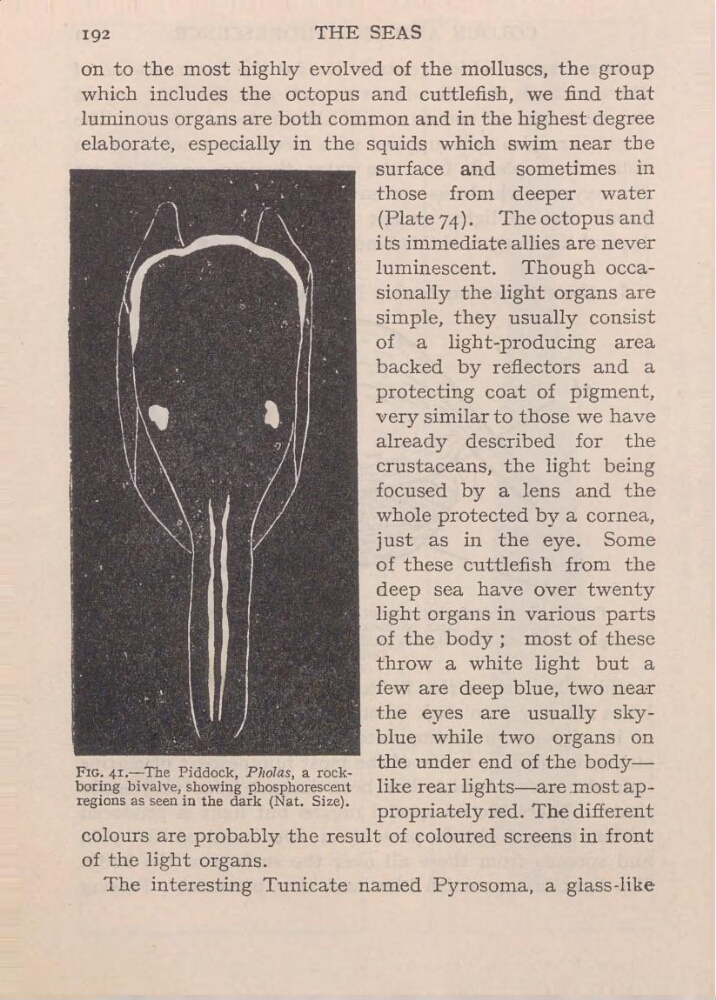
41.———Îhé Piddock, Pholds, a
tllê under_
end
b0dy—
boting bivalve,_showing phosphores_cent
11ke rear 11ghts—are.most ap—
regions
as seen
in the dark
(Nat. Sue).
propriately fed. The different
colours are probably the result of coloured screensin front
of the light organs.
:
.
-
=
‘
.
The interesting Tunicate named Pyrosoma, a glass—like
-
'
THE SEAS ‘
’
on to the most highly evolved of the molluscs, the group
Which includes the octopus and cuttlesh,. we nd that
luminous organs are both common and in the highest degree
elaborate, especially in the squids which swi_m near the
_
__
___
.
' _
_
_
surface
and
.
sometimes
in
1
‘
-__'._… those from deeper
water
..
/ \," _Ÿi'/Î
(Plate 74).
The octopus and
-
__
__
its immediateallies are never
__
/
luminescent.
Though occa—
‘
.
i
=
'
sionally the light organs are
'
,
(
.
»_
°
simple, they usually consist
"'
_'
of
a
light-producing area
';
Ç_
backed by reectors and a
protecting coat of pigment,
'
‘:‘ ‘ '_
very similar to those we have
___—
\+7
)
already described for
the
.
crustaceans, the light being
"
“î'_’=';»
_
.
_
focused by a- lens and the
__
,
g
_
whole-protected by a cornea,
_
'
fÏ"-‘i-î
.
just as in the eye.
Some
'_._; -.
_
°
of these cuttlesh from the
Ÿ
’
__
deep sea have over twenty
Ü
Ï
f:
_
; *; '
,
.
light organs in various parts
-_
—"
of the body; most of these
_
._
throw a white light but a
_
.._
'
_Ï
_
few are deep blue, two near
.
_._‘
ÎÏ._._‘_" ‘_
’
the eyes — are
usually - sky—
,
blue while. two
organs- on
41.———Îhé Piddock, Pholds, a
tllê under_
end
b0dy—
boting bivalve,_showing phosphores_cent
11ke rear 11ghts—are.most ap—
regions
as seen
in the dark
(Nat. Sue).
propriately fed. The different
colours are probably the result of coloured screensin front
of the light organs.
:
.
-
=
‘
.
The interesting Tunicate named Pyrosoma, a glass—like