

CORAL REÉFS
173
’
Barrier Reef and the coast of Queensland—but should the
land have been a small island which nally sank, then all
that would nally appear above the surface of the sea would
be a ring of coral surrounding a central lagôbn, in other
'
words a typical atoll.
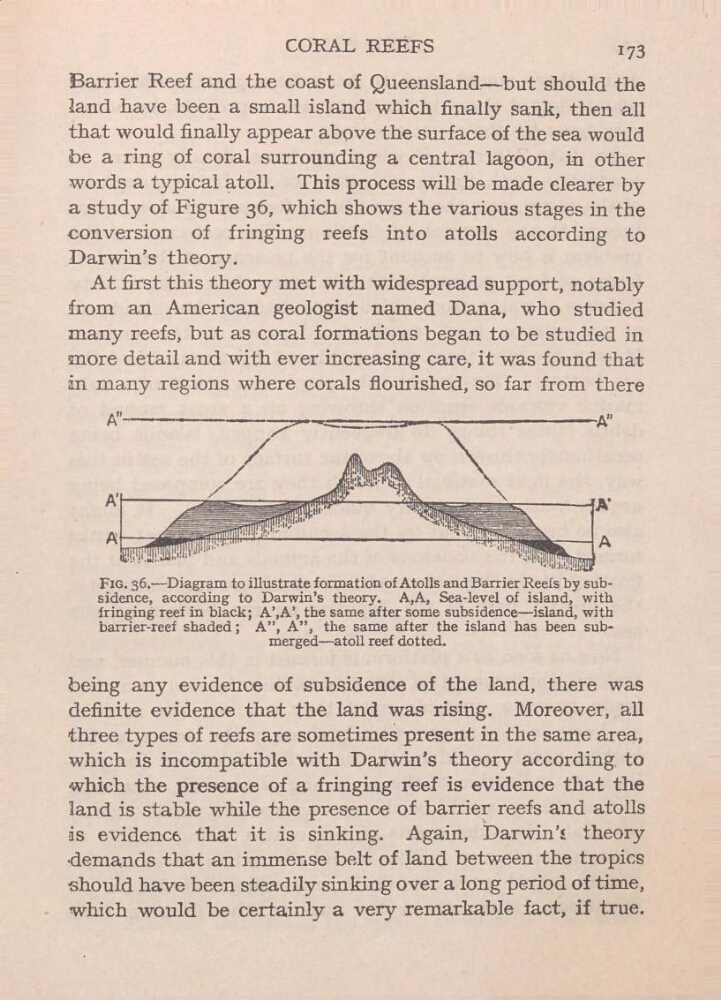
This process willbe made clearer by
a study of Figure 36, which shows the various stages in the
conversion
of
fringing reefs into atolls according to
.
Darwi'n’s theory.
—
.
At rst this theory met with widespread support, notably
from an American geologist named Dana, who studied
many reefs, but as coral formations began to be studied in
more detail and with ever increasing care, it was found that
in many regions where corals ourished, so far from there
A
.
A
.
,
_
A
-
FIG.
to illustrate formation of Atolls and Barrier Ree£s by sub—
sidence, according to Darwin’s theory.
A,A, Sea—level of island, with
.
fringing‘ reef in black; A’,A’, the same after some subsidence—island, with
barrier—red shaded;
A”, A”, the same after the island has been sub.
merged—atoll reef dotted.
'
being any evidence of subsidence of the—land, there was
denite evidence that the land was rising.
Moreover, fall
three types ofreefs are sometimes present in the same area,
which is incompatible with Darwin’s , theory according to
'
.
which the presence of a fringing reef is evidence that the
land is stable while the presence of barrier
reef-s and atolls
'
is evidence that it is sinking.
Again, Darwin’s theory
.
—demands that an immense belt of land between the tropics
should have been Steadin sinking over a long period
of time,
which would be certainly a very remarkable fact, if true.
—
173
’
Barrier Reef and the coast of Queensland—but should the
land have been a small island which nally sank, then all
that would nally appear above the surface of the sea would
be a ring of coral surrounding a central lagôbn, in other
'
words a typical atoll.
This process willbe made clearer by
a study of Figure 36, which shows the various stages in the
conversion
of
fringing reefs into atolls according to
.
Darwi'n’s theory.
—
.
At rst this theory met with widespread support, notably
from an American geologist named Dana, who studied
many reefs, but as coral formations began to be studied in
more detail and with ever increasing care, it was found that
in many regions where corals ourished, so far from there
A
.
A
.
,
_
A
-
FIG.
to illustrate formation of Atolls and Barrier Ree£s by sub—
sidence, according to Darwin’s theory.
A,A, Sea—level of island, with
.
fringing‘ reef in black; A’,A’, the same after some subsidence—island, with
barrier—red shaded;
A”, A”, the same after the island has been sub.
merged—atoll reef dotted.
'
being any evidence of subsidence of the—land, there was
denite evidence that the land was rising.
Moreover, fall
three types ofreefs are sometimes present in the same area,
which is incompatible with Darwin’s , theory according to
'
.
which the presence of a fringing reef is evidence that the
land is stable while the presence of barrier
reef-s and atolls
'
is evidence that it is sinking.
Again, Darwin’s theory
.
—demands that an immense belt of land between the tropics
should have been Steadin sinking over a long period
of time,
which would be certainly a very remarkable fact, if true.
—