

170
'
-
THE SEAS
'
surrounds the formation of the other two types of-reefs
Let us rst assume the presence of a coastline, ideally
_
situated for the growth of corals but which, perhaps because
great earth movements have only recently raised it above
the surface of the sea, has no growth of corals.
Corals
,
establish themselVes in depths of thirty fathoms and less,
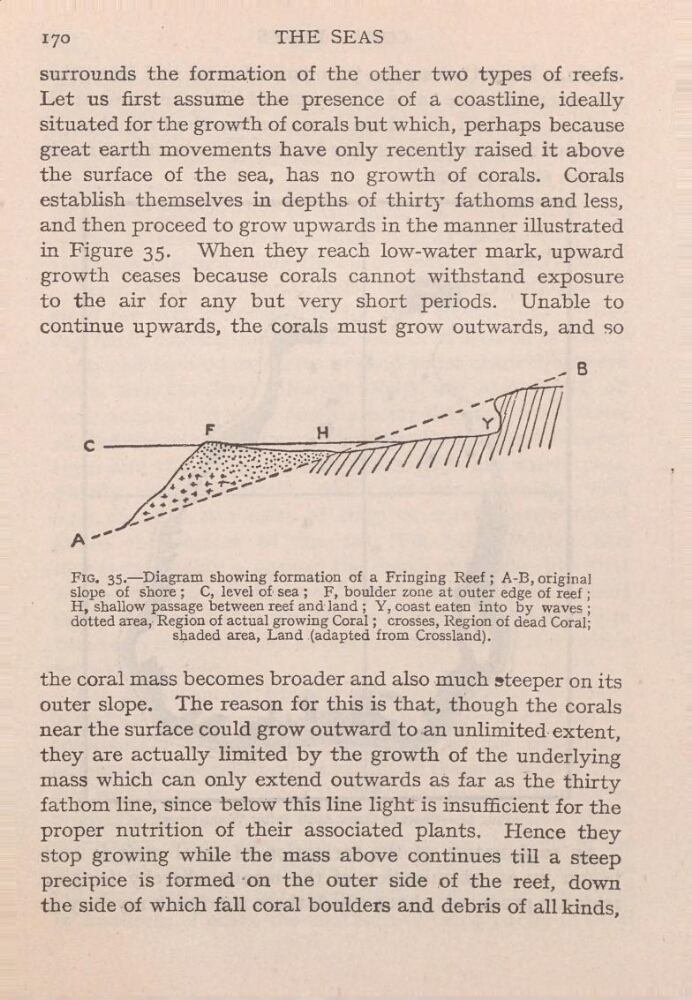
and then proceed to grow upwards in the manner illustrated
in Figure 3 5.
When they reach low-water mark, upward
.
growth ceases because corals cannot withstand exposure
to the air for any but very short periods.
Unable to
continue upwards, the corals must grow outwards, and so
,
5 .
Hd
Y///
c
..:îf'=:::;:-'—;—-.-=:.z-:.—:=zz—'-'
-
-:--z—î=:=;—:—:-.=.-:—=:-w7
.
,
.
7
'
,
A "
»
'
.
‘
FIG. 35.—Diagram showing formation of a Fringing Reef; A-B, original
slope of shore;
C, level of sea ;
F, boulder zone at outer edge of reef ;,
'
'
H, shallow passage between reef and land; Y, coast eaten into by waves ;
‘
dotted area,- Region of actual growing Coral ; crosèes, Region of dead Coral;
_
'
shaded area, Land,(adapted from Crossland).
.
the coral mass becomes broaderand also much steeper on its —
'
Outer
The reason for this is that,though the corals
,
'
near the Surface could grow outWard to an unlimited extent,
they 'are actually limited by the growth of the underlying
mass which can only extend
as far as the thirty
'
fathom'line, “since"below this line light is insu’icient for the
proper nutrition of their associated plants.‘ Hence they
stop growing whilethe mass
above continues till 8. steep
_
:
precipice is formed =on the outer Side 'ofthe met, doWn'
,
the side of Which fall coral' boulders
of all kinds,
'
-
THE SEAS
'
surrounds the formation of the other two types of-reefs
Let us rst assume the presence of a coastline, ideally
_
situated for the growth of corals but which, perhaps because
great earth movements have only recently raised it above
the surface of the sea, has no growth of corals.
Corals
,
establish themselVes in depths of thirty fathoms and less,
and then proceed to grow upwards in the manner illustrated
in Figure 3 5.
When they reach low-water mark, upward
.
growth ceases because corals cannot withstand exposure
to the air for any but very short periods.
Unable to
continue upwards, the corals must grow outwards, and so
,
5 .
Hd
Y///
c
..:îf'=:::;:-'—;—-.-=:.z-:.—:=zz—'-'
-
-:--z—î=:=;—:—:-.=.-:—=:-w7
.
,
.
7
'
,
A "
»
'
.
‘
FIG. 35.—Diagram showing formation of a Fringing Reef; A-B, original
slope of shore;
C, level of sea ;
F, boulder zone at outer edge of reef ;,
'
'
H, shallow passage between reef and land; Y, coast eaten into by waves ;
‘
dotted area,- Region of actual growing Coral ; crosèes, Region of dead Coral;
_
'
shaded area, Land,(adapted from Crossland).
.
the coral mass becomes broaderand also much steeper on its —
'
Outer
The reason for this is that,though the corals
,
'
near the Surface could grow outWard to an unlimited extent,
they 'are actually limited by the growth of the underlying
mass which can only extend
as far as the thirty
'
fathom'line, “since"below this line light is insu’icient for the
proper nutrition of their associated plants.‘ Hence they
stop growing whilethe mass
above continues till 8. steep
_
:
precipice is formed =on the outer Side 'ofthe met, doWn'
,
the side of Which fall coral' boulders
of all kinds,