

.
BOEING LIFE
_
141
when they.ar6 able to infect ”new timber.
It has been shown
‘
by experiments that: these larval .Shipworms are Ïattracted
by wood Or by; an extract of wood- made in alcohol or..
ether, and, as a result-of this attraction, they remain on
its surface should they chance to drift there, Whereas they
do not remain on any other hard surface such
'
Very soon after it has alighted on the surface of the wood,
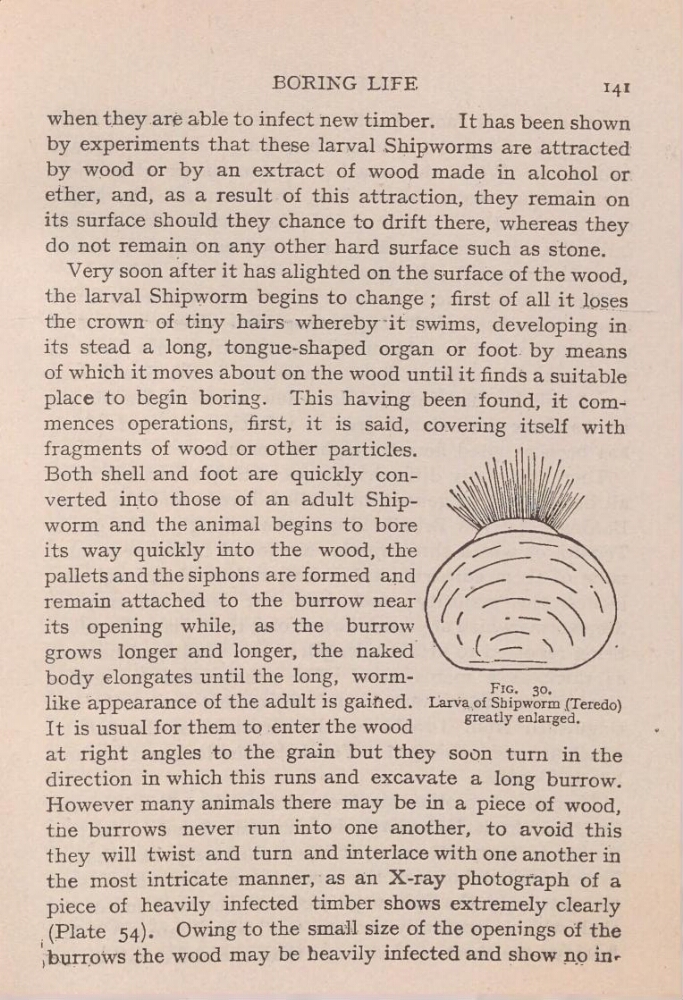
the larval Shipworm begins to change ; rst of all__it
"
the
developing in.
its stead a long, tongue-shaPed organ or foot by means
of which it moVes about on the wood until it nds a suitable
place'to begin boring.
This having been found, it Com—- '
mences
operations,. rst, it “is said, covering itself with“
fragments of woodor other‘particles.
_
'
Both shell and foot are quickly cori,
verted into those of an adult Ship\
'
//
worm and the animal begins to b0re
A/ .'
its way quickly into the wood, the
pallets and the siphons are formed and
remain attached to the burrow near
'
its
opening while, as the
@
_
grows
longer and longer, thenaked ‘
'.
body elongates until the long, worm.
FK}.
like “appearance of the adult is gaihed." ’LärŸapf8hipworm fl‘eredo)
It is usual for them to. enter thewood
greaüy emar-ged'
-
«
.
at right angles to
turn
in the
direction in which this runs and excavate a long burrow.
However many animals there may be in a piece-of wood,
the burrows never run into one another, to ”avoid this
.
they will tWist and turn and interlace with one another in
'
the most intricate. manner;as an
photograph of a
'
piece of heavin infected timber shows extremely clearly
'
_(Plate 54).
Owingto the“ small
size of the openings of the
:
";‘burrows the wood maybe heavin infected and show _n_o in»
_
BOEING LIFE
_
141
when they.ar6 able to infect ”new timber.
It has been shown
‘
by experiments that: these larval .Shipworms are Ïattracted
by wood Or by; an extract of wood- made in alcohol or..
ether, and, as a result-of this attraction, they remain on
its surface should they chance to drift there, Whereas they
do not remain on any other hard surface such
'
Very soon after it has alighted on the surface of the wood,
the larval Shipworm begins to change ; rst of all__it
"
the
developing in.
its stead a long, tongue-shaPed organ or foot by means
of which it moVes about on the wood until it nds a suitable
place'to begin boring.
This having been found, it Com—- '
mences
operations,. rst, it “is said, covering itself with“
fragments of woodor other‘particles.
_
'
Both shell and foot are quickly cori,
verted into those of an adult Ship\
'
//
worm and the animal begins to b0re
A/ .'
its way quickly into the wood, the
pallets and the siphons are formed and
remain attached to the burrow near
'
its
opening while, as the
@
_
grows
longer and longer, thenaked ‘
'.
body elongates until the long, worm.
FK}.
like “appearance of the adult is gaihed." ’LärŸapf8hipworm fl‘eredo)
It is usual for them to. enter thewood
greaüy emar-ged'
-
«
.
at right angles to
turn
in the
direction in which this runs and excavate a long burrow.
However many animals there may be in a piece-of wood,
the burrows never run into one another, to ”avoid this
.
they will tWist and turn and interlace with one another in
'
the most intricate. manner;as an
photograph of a
'
piece of heavin infected timber shows extremely clearly
'
_(Plate 54).
Owingto the“ small
size of the openings of the
:
";‘burrows the wood maybe heavin infected and show _n_o in»
_