

118
THE SEAS
,
are noteworthy for pOssessing solid ske1etons on which their ‘
-
protoplasm is_ supported.
Although these skeletons are so
'
minute, they are fashioned in the most beautiful and '
Ï
“,
symmetrical patterns.
Almost every conceivable shape is
to be found among them; and a_few forms from bottom
'
deposits are gured in Plate 21.
Another unicellular animal that is very commonly found
.
is the Globigerina, which builds a calcareous shell made up of
a number of connecting compartments (Plate 21).—
So abundant are these two groups, the Radiolarians and
the Globigerinas, in certain parts of the ocean, that when
'
they die their skeletons, sinking
7 ,
_
,
to the bottom, form characteristic
Ï
deposits.
These are the Radio.
2
’.Î
larian ' and
Globigerina' Oozes
&
.
mentioned
in
Chapter III ; in
‘
certain
localities
also
Diatom
.
Oozes are formed from the rain of
3
‘7
siliceous frustules, the skeletons,
of the dead diatoms.
.
ï
,
-
.
_
-
Enough has been said of the
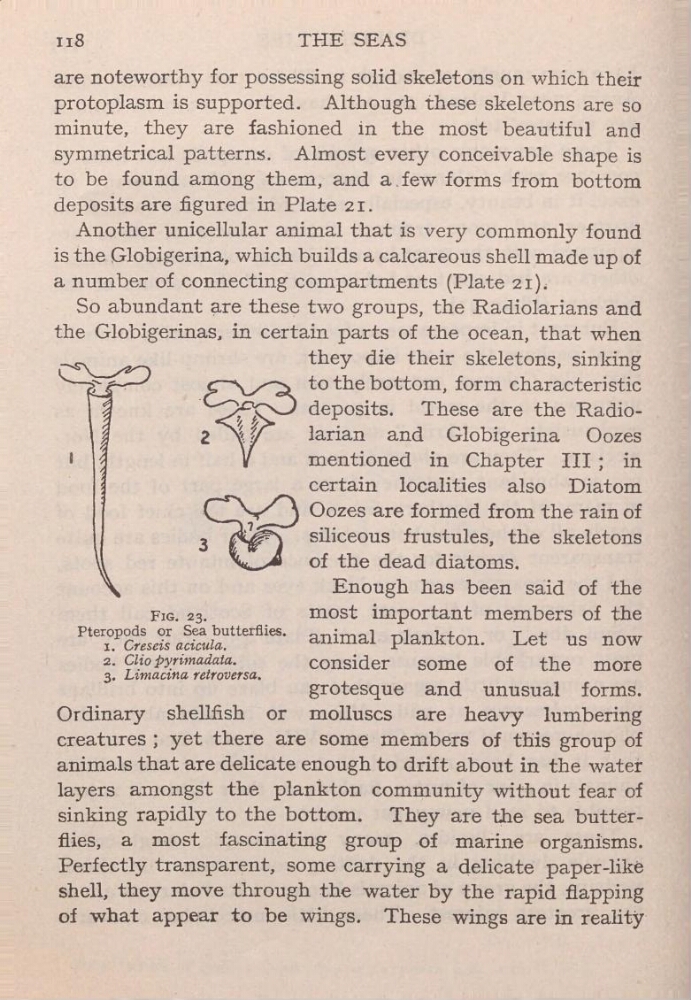
Flo. 23.
most important members of the
PterÏPËÎÎSÊÏ aîää‘fttefiæ° animal plankton.
Let“ us now
'
z.
Cl_ioÿyrimadataconsider
some
of
the
more
_
_
3. Lzmacma retroversa.
'
'
_
‘
grotesque
and
unusual
forms.
.
Ordinary shellsh
or
are
lumbering
,
creatùres; yet there are some“- members of this group of
‘
animals that are delicate enoughto drift about in the
"
layers amongst the plankton community withoutfear of
_,
‘
sinking rapidly to the bottom. They are the sea butter— \
ies,
a
most
fascinating group et marine organisms.
,
Perfectly«transparent, some carrying a delicate‘ paper—like
-
shell, they, move through the water by the rapid apping
'
of what appear to be wings.
These wings are in reality
_
THE SEAS
,
are noteworthy for pOssessing solid ske1etons on which their ‘
-
protoplasm is_ supported.
Although these skeletons are so
'
minute, they are fashioned in the most beautiful and '
Ï
“,
symmetrical patterns.
Almost every conceivable shape is
to be found among them; and a_few forms from bottom
'
deposits are gured in Plate 21.
Another unicellular animal that is very commonly found
.
is the Globigerina, which builds a calcareous shell made up of
a number of connecting compartments (Plate 21).—
So abundant are these two groups, the Radiolarians and
the Globigerinas, in certain parts of the ocean, that when
'
they die their skeletons, sinking
7 ,
_
,
to the bottom, form characteristic
Ï
deposits.
These are the Radio.
2
’.Î
larian ' and
Globigerina' Oozes
&
.
mentioned
in
Chapter III ; in
‘
certain
localities
also
Diatom
.
Oozes are formed from the rain of
3
‘7
siliceous frustules, the skeletons,
of the dead diatoms.
.
ï
,
-
.
_
-
Enough has been said of the
Flo. 23.
most important members of the
PterÏPËÎÎSÊÏ aîää‘fttefiæ° animal plankton.
Let“ us now
'
z.
Cl_ioÿyrimadataconsider
some
of
the
more
_
_
3. Lzmacma retroversa.
'
'
_
‘
grotesque
and
unusual
forms.
.
Ordinary shellsh
or
are
lumbering
,
creatùres; yet there are some“- members of this group of
‘
animals that are delicate enoughto drift about in the
"
layers amongst the plankton community withoutfear of
_,
‘
sinking rapidly to the bottom. They are the sea butter— \
ies,
a
most
fascinating group et marine organisms.
,
Perfectly«transparent, some carrying a delicate‘ paper—like
-
shell, they, move through the water by the rapid apping
'
of what appear to be wings.
These wings are in reality
_