

.
SWIMÏVIÏNG ANIMALS
101
so
_charactestic of», fast—swimming sh.
They possess
!
two large ippers where their front legs or arms should be.
.
Many of them carry a vertical n on their back and their
-
tails are developed into powerful ukes ; but unlike those
of Sh, these tails are attened horizon‘tally instead of
vertically, probably to a1d in the continual, journeyings
‘
'
to the surface to breathe.
An examination of the skeleton
reveals the fact that the front ippers are 'undoubtedly the
same as a true leg, for buried in the esh are typical leg
-
bones ending in numbers of Small boues similar to those
‘
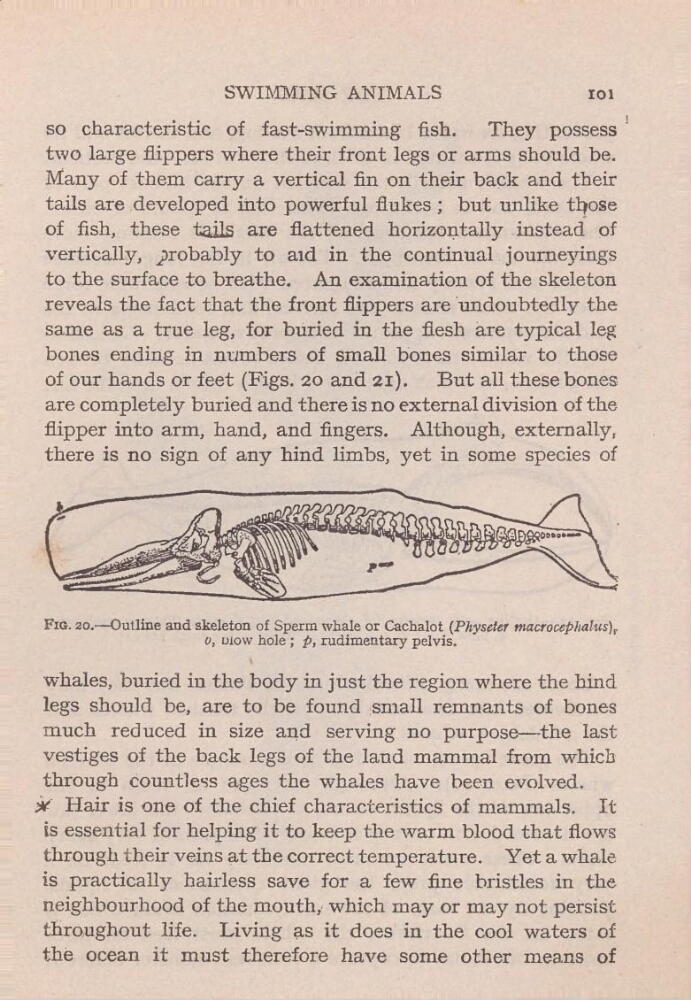
of our hands or feet (Figs. 20 and 21).
But all these boues
_
are completely buried and there is no external division of the
.
ipper into arm, hand, and 'ngers. Although, extemally,
,
there is no sign of any hindlimbs, yet in some species of
-
4«ff««m
A .
.
.
* ****æ*
…
-
_
$«è‘-+f
«“'
_
…
»‘$
,
..
FIG. zo.—-Oùtline and Skeleton of Sperm whale or Cachalot (Physeter
' —
0, view hole ; j), rudiinentary pelvis.
whales, buried in the body in just the region where the bind
legs should be, are to be found small remuants-of bones
much reduced in size and serving no
last
vestiges of the back legs of the land màmmal- from which
through c‘ountless ages the whales have been evolved.
à!“ Hair is one of the chief characteristics of mammals.
It
is essential f0r helping it to keep the warm blood that ows
through their veins at the correct temperature.
Yet a whale
—
is praCtically hairlèss save for a few ne bristlesin the
neighboùrhood of
which may or may not petsist
‘
_
throughout life. Living as it
in the cool waters of
the ocean it must therefore have some other means of
'
SWIMÏVIÏNG ANIMALS
101
so
_charactestic of», fast—swimming sh.
They possess
!
two large ippers where their front legs or arms should be.
.
Many of them carry a vertical n on their back and their
-
tails are developed into powerful ukes ; but unlike those
of Sh, these tails are attened horizon‘tally instead of
vertically, probably to a1d in the continual, journeyings
‘
'
to the surface to breathe.
An examination of the skeleton
reveals the fact that the front ippers are 'undoubtedly the
same as a true leg, for buried in the esh are typical leg
-
bones ending in numbers of Small boues similar to those
‘
of our hands or feet (Figs. 20 and 21).
But all these boues
_
are completely buried and there is no external division of the
.
ipper into arm, hand, and 'ngers. Although, extemally,
,
there is no sign of any hindlimbs, yet in some species of
-
4«ff««m
A .
.
.
* ****æ*
…
-
_
$«è‘-+f
«“'
_
…
»‘$
,
..
FIG. zo.—-Oùtline and Skeleton of Sperm whale or Cachalot (Physeter
' —
0, view hole ; j), rudiinentary pelvis.
whales, buried in the body in just the region where the bind
legs should be, are to be found small remuants-of bones
much reduced in size and serving no
last
vestiges of the back legs of the land màmmal- from which
through c‘ountless ages the whales have been evolved.
à!“ Hair is one of the chief characteristics of mammals.
It
is essential f0r helping it to keep the warm blood that ows
through their veins at the correct temperature.
Yet a whale
—
is praCtically hairlèss save for a few ne bristlesin the
neighboùrhood of
which may or may not petsist
‘
_
throughout life. Living as it
in the cool waters of
the ocean it must therefore have some other means of
'