

94
THE SEAS
,
_
curious twisting,takes place in their head region and the eye
from one side travels round so that eventually both eyes
come to lie on the same side of the head.
The sh then
turns over and settles on the bottom on its eyeless side.
In some species it is the left eye which changes its position
and in others the right eye, and it is rather unusual to nd
_
a sh with both its eyes on the opposite side to that typical
for the species.
,
Other shes, however, are attened quite normally.
The skates for instance are at from above downwards and
the eyes keep their same relative position thr0ughout life.
'}':.‘
,:—
-
.
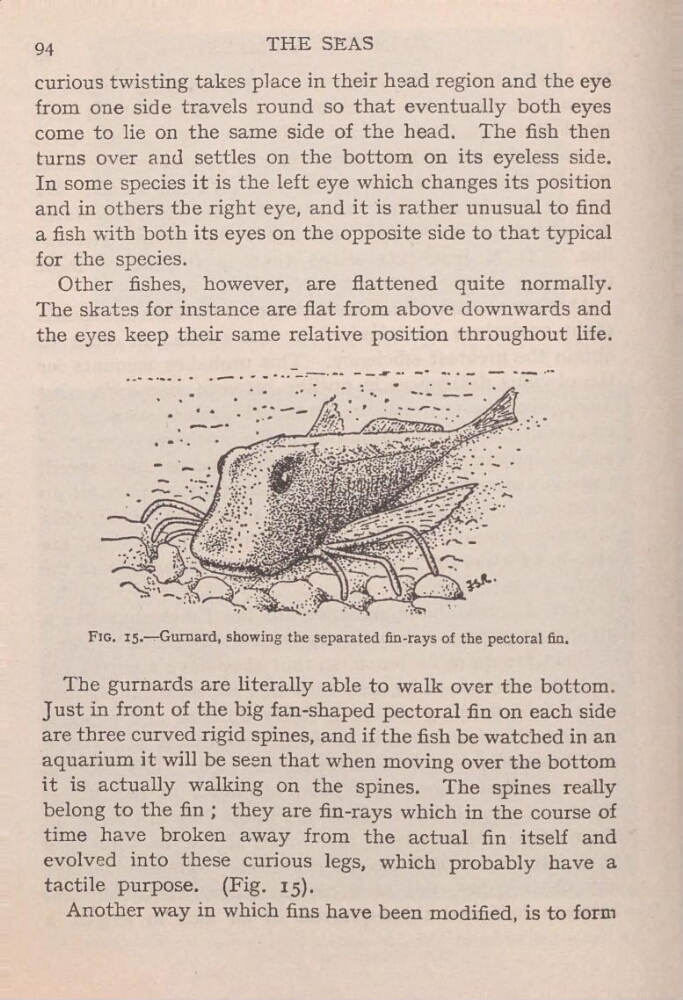
FlG. I5.—Gumard, showing the separated n-rays of the pectoral n.
,
The gurhards are literally able to walk over the bottom.
lust
in front of the big fan—shaped pectoral n on each side
'
are three curved rigid spines, and if the sh be watched in an
_
will be seen that When moving over the bottom
,
it is actually walking on the spines.
The spiries really
__
belong to the n ; they are n-rays which in the course of
time have broken away from the actual
itself and
evolved into
_
these c_urious legs, which probably have a
tactile purpose.
(Fig. 15).
"
-
Another way in which ns have been modied, is to form
.
,
THE SEAS
,
_
curious twisting,takes place in their head region and the eye
from one side travels round so that eventually both eyes
come to lie on the same side of the head.
The sh then
turns over and settles on the bottom on its eyeless side.
In some species it is the left eye which changes its position
and in others the right eye, and it is rather unusual to nd
_
a sh with both its eyes on the opposite side to that typical
for the species.
,
Other shes, however, are attened quite normally.
The skates for instance are at from above downwards and
the eyes keep their same relative position thr0ughout life.
'}':.‘
,:—
-
.
FlG. I5.—Gumard, showing the separated n-rays of the pectoral n.
,
The gurhards are literally able to walk over the bottom.
lust
in front of the big fan—shaped pectoral n on each side
'
are three curved rigid spines, and if the sh be watched in an
_
will be seen that When moving over the bottom
,
it is actually walking on the spines.
The spiries really
__
belong to the n ; they are n-rays which in the course of
time have broken away from the actual
itself and
evolved into
_
these c_urious legs, which probably have a
tactile purpose.
(Fig. 15).
"
-
Another way in which ns have been modied, is to form
.
,