

__
SWIMMING ANIMALS
87
coasts of Europe, a very remarkable change comes over
them.
From their leaf—like shape they gradually assume a
true eel—like appearance, becoming narrower, rounder, and
-
at the same time slightly shorter in length.
After this
} change has taken place ;they are the ,. typical little eels,
known as “_ elvers,Î ’ that ascend some of our rivers in such
countlass numbers.
Here they remain in fresh water,
feeding
and growing.
After a course of time, that may vary
—
.
.
.
$,»
_
'
_
o
'.
1635‘““'“îüô‘5æilæ
'
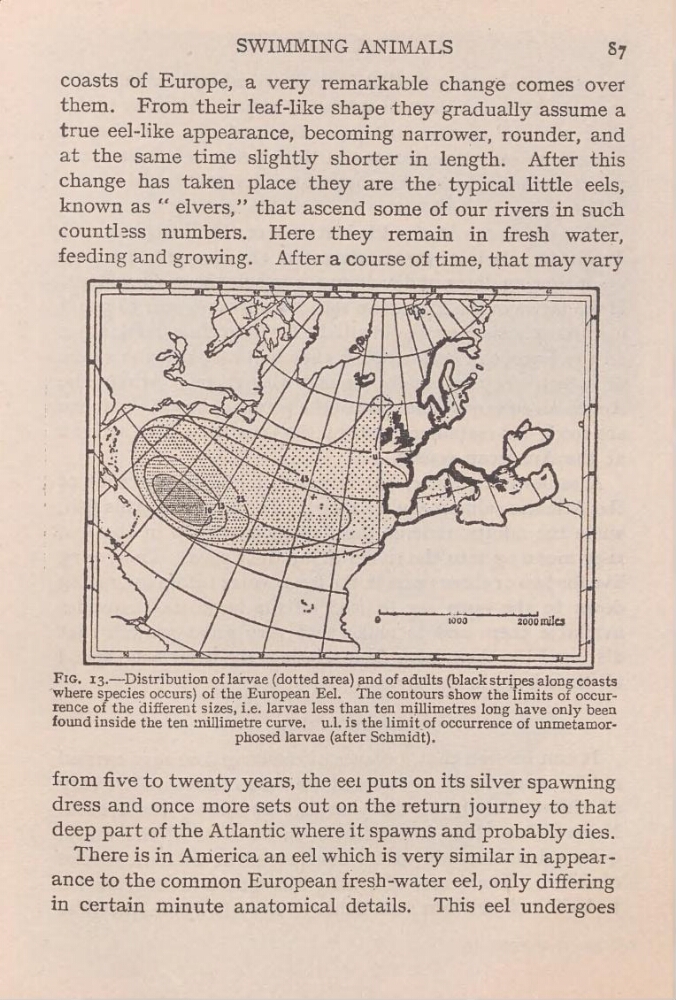
FIG. 13.—Distribution of larvae (dotted area) and of adults (black Stripes along coasts
”where species occurs) of the European Eel. The contours show the limits of occur—
rence of the different sizes, i.e. larvae less than ten millimetres long have only been
found inside the ten mülimetre curve.
u.l. is the limit_of occurrence of unmetamor_
phosed larvae (after Schmidt).
from ve to twentÿ years, the ee1 puts on its silver
'
dress and once more sets out on. the return' journey»to that
deep part of_the
where it spawns and probably dies.
There is in America an eel which is Very similar in appear_
ance tothe common European fresh—water eel, only differing
in certain minute anatomical details.
This eel undergoes.
SWIMMING ANIMALS
87
coasts of Europe, a very remarkable change comes over
them.
From their leaf—like shape they gradually assume a
true eel—like appearance, becoming narrower, rounder, and
-
at the same time slightly shorter in length.
After this
} change has taken place ;they are the ,. typical little eels,
known as “_ elvers,Î ’ that ascend some of our rivers in such
countlass numbers.
Here they remain in fresh water,
feeding
and growing.
After a course of time, that may vary
—
.
.
.
$,»
_
'
_
o
'.
1635‘““'“îüô‘5æilæ
'
FIG. 13.—Distribution of larvae (dotted area) and of adults (black Stripes along coasts
”where species occurs) of the European Eel. The contours show the limits of occur—
rence of the different sizes, i.e. larvae less than ten millimetres long have only been
found inside the ten mülimetre curve.
u.l. is the limit_of occurrence of unmetamor_
phosed larvae (after Schmidt).
from ve to twentÿ years, the ee1 puts on its silver
'
dress and once more sets out on. the return' journey»to that
deep part of_the
where it spawns and probably dies.
There is in America an eel which is Very similar in appear_
ance tothe common European fresh—water eel, only differing
in certain minute anatomical details.
This eel undergoes.