

60
M. Callisto et al.
concentration of chlorophyll a (Chla) was obtained according to Golterman et al. (1978) and the transparency was estimated using a Secchi disc (S). Additionally, large seasonal
variations of temperature and rainfall were evaluated during
the sample period. The average monthly values of temperature and precipitation were calculated for all the sampling
periods based on data from the Brazilian National Institute of
Meteorology (INMET) for the metropolitan region of Belo
Horizonte in 2008 and 2009.
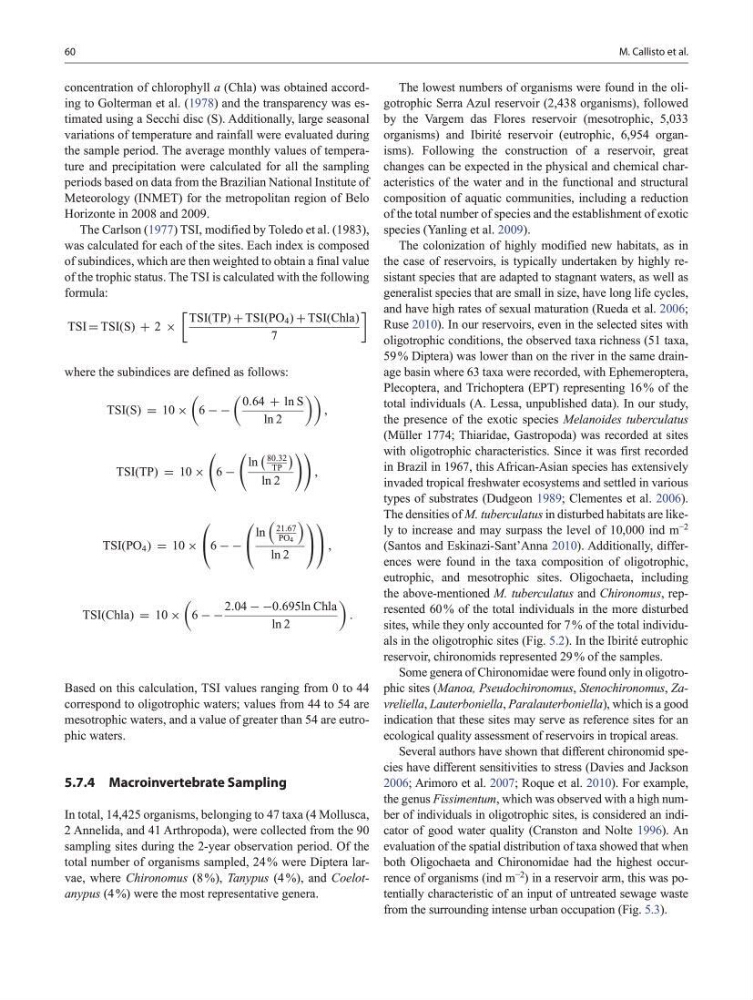
The Carlson (1977) TSI, modified by Toledo et al. (1983),
was calculated for each of the sites. Each index is composed
of subindices, which are then weighted to obtain a final value
of the trophic status. The TSI is calculated with the following
formula:
where the subindices are defined as follows:
Based on this calculation, TSI values ranging from 0 to 44
correspond to oligotrophic waters; values from 44 to 54 are
mesotrophic waters, and a value of greater than 54 are eutrophic waters.
5.7.4 Macroinvertebrate Sampling
In total, 14,425 organisms, belonging to 47 taxa (4 Mollusca,
2 Annelida, and 41 Arthropoda), were collected from the 90
sampling sites during the 2-year observation period. Of the
total number of organisms sampled, 24 % were Diptera larvae, where Chironomus (8 %), Tanypus (4 %), and Coelotanypus (4 %) were the most representative genera.
TSI = TSI(S) + 2 ×
TSI(TP) + TSI(PO 4 ) + TSI(Chla)
7
TSI(S) = 10 ×
6 − −
0.64 + ln S
ln 2
,
TSI(TP) = 10 ×
6 −
ln
80.32
TP
ln 2
,
TSI(PO 4 ) = 10 ×
6 − −
ln
21.67
PO 4
ln 2
,
TSI(Chla) = 10 ×
6 − −
2.04 − −0.695ln Chla
ln 2
.
The lowest numbers of organisms were found in the oligotrophic Serra Azul reservoir (2,438 organisms), followed
by the Vargem das Flores reservoir (mesotrophic, 5,033
organisms) and Ibirité reservoir (eutrophic, 6,954 organisms). Following the construction of a reservoir, great
changes can be expected in the physical and chemical characteristics of the water and in the functional and structural
composition of aquatic communities, including a reduction
of the total number of species and the establishment of exotic
species (Yanling et al. 2009).
The colonization of highly modified new habitats, as in
the case of reservoirs, is typically undertaken by highly resistant species that are adapted to stagnant waters, as well as
generalist species that are small in size, have long life cycles,
and have high rates of sexual maturation (Rueda et al. 2006;
Ruse 2010). In our reservoirs, even in the selected sites with
oligotrophic conditions, the observed taxa richness (51 taxa,
59 % Diptera) was lower than on the river in the same drainage basin where 63 taxa were recorded, with Ephemeroptera,
Plecoptera, and Trichoptera (EPT) representing 16 % of the
total individuals (A. Lessa, unpublished data). In our study,
the presence of the exotic species Melanoides tuberculatus
(Müller 1774; Thiaridae, Gastropoda) was recorded at sites
with oligotrophic characteristics. Since it was first recorded
in Brazil in 1967, this African-Asian species has extensively
invaded tropical freshwater ecosystems and settled in various
types of substrates (Dudgeon 1989; Clementes et al. 2006).
The densities of M. tuberculatus in disturbed habitats are likely to increase and may surpass the level of 10,000 ind m
−2
(Santos and Eskinazi-Sant’Anna 2010). Additionally, differences were found in the taxa composition of oligotrophic,
eutrophic, and mesotrophic sites. Oligochaeta, including
the above-mentioned M. tuberculatus and Chironomus, represented 60 % of the total individuals in the more disturbed
sites, while they only accounted for 7 % of the total individuals in the oligotrophic sites (Fig. 5.2). In the Ibirité eutrophic
reservoir, chironomids represented 29 % of the samples.
Some genera of Chironomidae were found only in oligotrophic sites ( Manoa, Pseudochironomus, Stenochironomus, Zavreliella, Lauterboniella, Paralauterboniella), which is a good
indication that these sites may serve as reference sites for an
ecological quality assessment of reservoirs in tropical areas.
Several authors have shown that different chironomid species have different sensitivities to stress (Davies and Jackson
2006; Arimoro et al. 2007; Roque et al. 2010). For example,
the genus Fissimentum, which was observed with a high number of individuals in oligotrophic sites, is considered an indicator of good water quality (Cranston and Nolte 1996). An
evaluation of the spatial distribution of taxa showed that when
both Oligochaeta and Chironomidae had the highest occurrence of organisms (ind m
−2
) in a reservoir arm, this was potentially characteristic of an input of untreated sewage waste
from the surrounding intense urban occupation (Fig. 5.3).
M. Callisto et al.
concentration of chlorophyll a (Chla) was obtained according to Golterman et al. (1978) and the transparency was estimated using a Secchi disc (S). Additionally, large seasonal
variations of temperature and rainfall were evaluated during
the sample period. The average monthly values of temperature and precipitation were calculated for all the sampling
periods based on data from the Brazilian National Institute of
Meteorology (INMET) for the metropolitan region of Belo
Horizonte in 2008 and 2009.
The Carlson (1977) TSI, modified by Toledo et al. (1983),
was calculated for each of the sites. Each index is composed
of subindices, which are then weighted to obtain a final value
of the trophic status. The TSI is calculated with the following
formula:
where the subindices are defined as follows:
Based on this calculation, TSI values ranging from 0 to 44
correspond to oligotrophic waters; values from 44 to 54 are
mesotrophic waters, and a value of greater than 54 are eutrophic waters.
5.7.4 Macroinvertebrate Sampling
In total, 14,425 organisms, belonging to 47 taxa (4 Mollusca,
2 Annelida, and 41 Arthropoda), were collected from the 90
sampling sites during the 2-year observation period. Of the
total number of organisms sampled, 24 % were Diptera larvae, where Chironomus (8 %), Tanypus (4 %), and Coelotanypus (4 %) were the most representative genera.
TSI = TSI(S) + 2 ×
TSI(TP) + TSI(PO 4 ) + TSI(Chla)
7
TSI(S) = 10 ×
6 − −
0.64 + ln S
ln 2
,
TSI(TP) = 10 ×
6 −
ln
80.32
TP
ln 2
,
TSI(PO 4 ) = 10 ×
6 − −
ln
21.67
PO 4
ln 2
,
TSI(Chla) = 10 ×
6 − −
2.04 − −0.695ln Chla
ln 2
.
The lowest numbers of organisms were found in the oligotrophic Serra Azul reservoir (2,438 organisms), followed
by the Vargem das Flores reservoir (mesotrophic, 5,033
organisms) and Ibirité reservoir (eutrophic, 6,954 organisms). Following the construction of a reservoir, great
changes can be expected in the physical and chemical characteristics of the water and in the functional and structural
composition of aquatic communities, including a reduction
of the total number of species and the establishment of exotic
species (Yanling et al. 2009).
The colonization of highly modified new habitats, as in
the case of reservoirs, is typically undertaken by highly resistant species that are adapted to stagnant waters, as well as
generalist species that are small in size, have long life cycles,
and have high rates of sexual maturation (Rueda et al. 2006;
Ruse 2010). In our reservoirs, even in the selected sites with
oligotrophic conditions, the observed taxa richness (51 taxa,
59 % Diptera) was lower than on the river in the same drainage basin where 63 taxa were recorded, with Ephemeroptera,
Plecoptera, and Trichoptera (EPT) representing 16 % of the
total individuals (A. Lessa, unpublished data). In our study,
the presence of the exotic species Melanoides tuberculatus
(Müller 1774; Thiaridae, Gastropoda) was recorded at sites
with oligotrophic characteristics. Since it was first recorded
in Brazil in 1967, this African-Asian species has extensively
invaded tropical freshwater ecosystems and settled in various
types of substrates (Dudgeon 1989; Clementes et al. 2006).
The densities of M. tuberculatus in disturbed habitats are likely to increase and may surpass the level of 10,000 ind m
−2
(Santos and Eskinazi-Sant’Anna 2010). Additionally, differences were found in the taxa composition of oligotrophic,
eutrophic, and mesotrophic sites. Oligochaeta, including
the above-mentioned M. tuberculatus and Chironomus, represented 60 % of the total individuals in the more disturbed
sites, while they only accounted for 7 % of the total individuals in the oligotrophic sites (Fig. 5.2). In the Ibirité eutrophic
reservoir, chironomids represented 29 % of the samples.
Some genera of Chironomidae were found only in oligotrophic sites ( Manoa, Pseudochironomus, Stenochironomus, Zavreliella, Lauterboniella, Paralauterboniella), which is a good
indication that these sites may serve as reference sites for an
ecological quality assessment of reservoirs in tropical areas.
Several authors have shown that different chironomid species have different sensitivities to stress (Davies and Jackson
2006; Arimoro et al. 2007; Roque et al. 2010). For example,
the genus Fissimentum, which was observed with a high number of individuals in oligotrophic sites, is considered an indicator of good water quality (Cranston and Nolte 1996). An
evaluation of the spatial distribution of taxa showed that when
both Oligochaeta and Chironomidae had the highest occurrence of organisms (ind m
−2
) in a reservoir arm, this was potentially characteristic of an input of untreated sewage waste
from the surrounding intense urban occupation (Fig. 5.3).