

49
4 The Economics of Eutrophication
regulations, emissions regulations have several desirable
features that broadly can be summarized as follows: the
focus is on the problem, which makes the regulatory framework more transparent, tractable, and traceable (Batie 2008).
As a result, economists have been searching ways to make
emissions regulations applicable even in settings where transaction costs—in the nonpoint source emission setting, the
costs of measuring emissions—are high. This gives rise to
a third type of regulatory approach: regulations that seek to
solve the problem of unobservable emissions from individual
farm fields or properties. The latter class of regulations does
not suffer from some of the problems associated with procedural or input-based regulations, but entails more complicated economic modeling where game theory (Gibbons 1997)
and “truthtelling” (Holmstrom 1979) are key elements. I will
return to these three classes of regulatory approaches.
The perceived environmental damages from emissions are
the major reason why pollution control policies are implemented. Mean emission is the most frequent statistic reported
for most pollutants. However, the distribution of emissions
may also matter for environmental damages (Braden and
Segerson 1993). For example, peak loads of nutrients into a
stream may periodically deter water quality to the point that
fish species are wiped out even if they are well adapted to the
average emission levels. From a policy perspective, this adds
complexity—a policy instrument that performs well when it
comes to reducing mean emissions, may still lead to insufficient control of the variability in emission levels. As such,
controlling mean emissions and their variability can be seen
as two separate objectives, which leads us to the Tinbergen
(1950) principle: In situations where there are multiple objectives and problems, at least one policy instrument should be
used to alleviate each threat and pursue each objective.
The implications of the Tinbergen principle are profound:
if separate instruments are used for each link between a threat
and an objective, then it is simpler to readjust the policy mix
as circumstances change. Climate change and economic recession are recent examples of such changes. For eutrophication issues, it is rather straightforward to see the importance
of variability in climate and growing conditions.
4.5 Procedural Regulations
Procedural regulations are widely used to control nonpoint
source emissions. Examples of such regulations include
restrictions on how and when to spread manure, no-till or
reduced tillage, or planting of buffer strips and vegetation
zones. These three examples represent the main groups of
procedural regulations. Each of these three groups will be
discussed after I have addressed another issue—how to implement such regulations.
There are basically two ways of implementing procedural regulations: requiring farmers or subsidizing farmers to
adopt the practice in question. Requiring certain practices
sorts under CAC regulations. The main disadvantage of CAC
regulations is that they could entail substantial cost for some
producers. Hence, cost effectiveness is unlikely to take place.
Still, many procedural regulations are implemented using
CAC, in particular, on timing decisions like it is illegal to
spread manure after a certain date in fall.
Subsidies to induce desired practices do not suffer from
the same “stiffness” as CAC regulations. The reason for this
is that farmers are allowed to choose between accepting the
payment and adopt the desired practice or decline the payment and continue using their current practices. Any expected profit maximizing farmer will only choose to adopt the
desired practice if the payment exceeds the expected loss in
profits from adoption. Farmers with high adoption costs are
therefore more likely to opt out of the scheme, while those
with low adoption costs are more likely to opt in. The costs
of adopting a new practice are likely to decline over time for
two reasons. First, because it takes time for farmers to master
the new practice. Second, because it takes time for producers
of equipment to develop new machines suited for the new
market created by the subsidy. A natural policy response to
these time dimensions is to offer rather high payments in the
early phase of implementing a procedural regulation and to
reduce payments over time (to reduce the strain of the program on public funds). For example, when Norway implemented its reduced tillage program in grain production, it
pursued such a strategy in the mid-1990s.
4.5.1 Timing Procedures
The time of manure application greatly influenced nitrate
leaching (Van Es et al. 2006) and phosphorus leaching
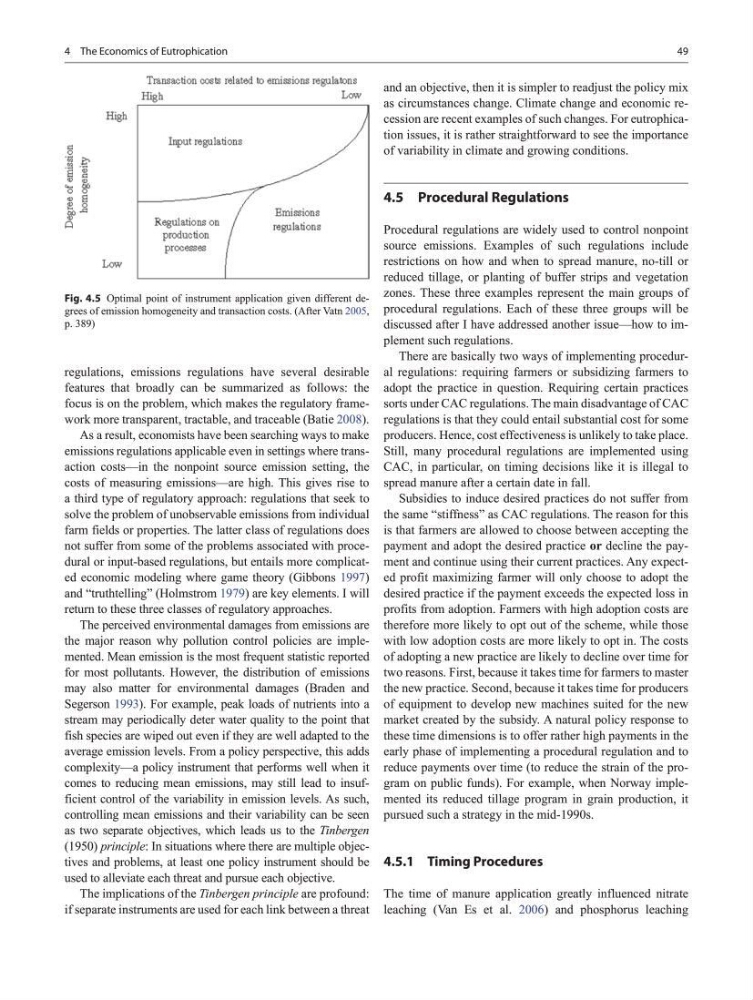
Fig. 4.5 Optimal point of instrument application given different degrees of emission homogeneity and transaction costs. (After Vatn 2005,
p. 389)
4 The Economics of Eutrophication
regulations, emissions regulations have several desirable
features that broadly can be summarized as follows: the
focus is on the problem, which makes the regulatory framework more transparent, tractable, and traceable (Batie 2008).
As a result, economists have been searching ways to make
emissions regulations applicable even in settings where transaction costs—in the nonpoint source emission setting, the
costs of measuring emissions—are high. This gives rise to
a third type of regulatory approach: regulations that seek to
solve the problem of unobservable emissions from individual
farm fields or properties. The latter class of regulations does
not suffer from some of the problems associated with procedural or input-based regulations, but entails more complicated economic modeling where game theory (Gibbons 1997)
and “truthtelling” (Holmstrom 1979) are key elements. I will
return to these three classes of regulatory approaches.
The perceived environmental damages from emissions are
the major reason why pollution control policies are implemented. Mean emission is the most frequent statistic reported
for most pollutants. However, the distribution of emissions
may also matter for environmental damages (Braden and
Segerson 1993). For example, peak loads of nutrients into a
stream may periodically deter water quality to the point that
fish species are wiped out even if they are well adapted to the
average emission levels. From a policy perspective, this adds
complexity—a policy instrument that performs well when it
comes to reducing mean emissions, may still lead to insufficient control of the variability in emission levels. As such,
controlling mean emissions and their variability can be seen
as two separate objectives, which leads us to the Tinbergen
(1950) principle: In situations where there are multiple objectives and problems, at least one policy instrument should be
used to alleviate each threat and pursue each objective.
The implications of the Tinbergen principle are profound:
if separate instruments are used for each link between a threat
and an objective, then it is simpler to readjust the policy mix
as circumstances change. Climate change and economic recession are recent examples of such changes. For eutrophication issues, it is rather straightforward to see the importance
of variability in climate and growing conditions.
4.5 Procedural Regulations
Procedural regulations are widely used to control nonpoint
source emissions. Examples of such regulations include
restrictions on how and when to spread manure, no-till or
reduced tillage, or planting of buffer strips and vegetation
zones. These three examples represent the main groups of
procedural regulations. Each of these three groups will be
discussed after I have addressed another issue—how to implement such regulations.
There are basically two ways of implementing procedural regulations: requiring farmers or subsidizing farmers to
adopt the practice in question. Requiring certain practices
sorts under CAC regulations. The main disadvantage of CAC
regulations is that they could entail substantial cost for some
producers. Hence, cost effectiveness is unlikely to take place.
Still, many procedural regulations are implemented using
CAC, in particular, on timing decisions like it is illegal to
spread manure after a certain date in fall.
Subsidies to induce desired practices do not suffer from
the same “stiffness” as CAC regulations. The reason for this
is that farmers are allowed to choose between accepting the
payment and adopt the desired practice or decline the payment and continue using their current practices. Any expected profit maximizing farmer will only choose to adopt the
desired practice if the payment exceeds the expected loss in
profits from adoption. Farmers with high adoption costs are
therefore more likely to opt out of the scheme, while those
with low adoption costs are more likely to opt in. The costs
of adopting a new practice are likely to decline over time for
two reasons. First, because it takes time for farmers to master
the new practice. Second, because it takes time for producers
of equipment to develop new machines suited for the new
market created by the subsidy. A natural policy response to
these time dimensions is to offer rather high payments in the
early phase of implementing a procedural regulation and to
reduce payments over time (to reduce the strain of the program on public funds). For example, when Norway implemented its reduced tillage program in grain production, it
pursued such a strategy in the mid-1990s.
4.5.1 Timing Procedures
The time of manure application greatly influenced nitrate
leaching (Van Es et al. 2006) and phosphorus leaching
Fig. 4.5 Optimal point of instrument application given different degrees of emission homogeneity and transaction costs. (After Vatn 2005,
p. 389)